 Enlarge this image
At a December 2022 meeting, the Mendocino County Board of Supervisors decided to use $63,000 of opioid settlement funds to help cover a budget shortfall. Since settlement payments will arrive annually till 2038, they plan to use it as an ongoing revenue source. KFF/Screengrab of Dec. 13, 2022, Mendocino County Board of Supervisors meeting hide caption
toggle caption
KFF/Screengrab of Dec. 13, 2022, Mendocino County Board of Supervisors meeting
At a December 2022 meeting, the Mendocino County Board of Supervisors decided to use $63,000 of opioid settlement funds to help cover a budget shortfall. Since settlement payments will arrive annually till 2038, they plan to use it as an ongoing revenue source.
KFF/Screengrab of Dec. 13, 2022, Mendocino County Board of Supervisors meeting
Over the past two years, as state attorneys general agreed to more than $50 billion in legal settlements with companies that made or sold opioids, they vowed the money would be spent on addiction treatment and prevention. They were determined to avoid the misdirection of the tobacco settlement of the 1990s, in which billions of dollars from cigarette companies went to plug budget gaps instead of funding programs to stop or prevent smoking.
But in at least one California county, history is repeating itself. And across the country, there are concerns about the lack of transparency regarding how this money will be used. Many local leaders are finding themselves in difficult positions: choosing between paying bills due today or investing in the fight against an ongoing crisis.
Mendocino County in rural Northern California has reported the highest rate of overdose deaths in the state. Yet, its board of supervisors decided to use more than $63,000 of opioid settlement funds — about 6.5% of all the settlement cash the county has received in the first two years of distribution— to help fill a general budget shortfall of about $6 million.
Specifically, the money has been allotted to cover employee health insurance premiums, wage increases, and cost-of-living adjustments. County officials plan to use that amount as a recurring source of payment, since opioid settlements are scheduled to arrive annually till 2038.
Shots – Health News
Here’s who controls the $50 billion opioid settlement funds in each state
The board also used retirement reserves and delayed repair projects and equipment purchases to plug the gap.
“We have to balance our budget by law,” said Glenn McGourty, chair of the board of supervisors. “You find money where you can.”
Vice Chair Mo Mulheren added that health insurance deficits were caused, in part, by the overprescribing of opioids and the costs of addiction treatment for county employees or their family members. Now the settlement dollars can make the county “whole again,” she said.
Enlarge this image
At a December 2022 meeting, Mo Mulheren, vice chair of the Mendocino County Board of Supervisors, raised concerns about using opioid settlement funds to cover a budget shortfall. But she later told KFF Health News that the use was appropriate because it made the county “whole again” after years of paying for opioid-related health insurance claims. Mendocino County Board of Supervisors meeting screengrab via KFF hide caption
toggle caption
Mendocino County Board of Supervisors meeting screengrab via KFF
At a December 2022 meeting, Mo Mulheren, vice chair of the Mendocino County Board of Supervisors, raised concerns about using opioid settlement funds to cover a budget shortfall. But she later told KFF Health News that the use was appropriate because it made the county “whole again” after years of paying for opioid-related health insurance claims.
Mendocino County Board of Supervisors meeting screengrab via KFF
But many people with substance use disorders and their loved ones want the money to be used to make their communities whole again in a different way — by supporting people in recovery and preventing opioid-related deaths. More than 100,000 Americans died of drug overdoses last year.
The settlement funds are the result of thousands of lawsuits filed against a host of health care companies, including Johnson & Johnson, McKesson, CVS Health, and Walmart, for aggressively promoting and distributing painkillers. The money should remediate the effects of that corporate behavior, say attorneys general, treatment providers, and those directly affected by the crisis.
In Mendocino County, McGourty said, “we certainly expend a lot of money on substance abuse.” But tourism and tax revenues, which were boosted at the height of the pandemic as Bay Area residents escaped to the rural county, have recently decreased. Meanwhile, costs for the sheriff’s office, jail, and behavioral health programs often run over budget, partly due to the opioid epidemic, he said.
The story is all too familiar to Matthew Myers, former president of the Campaign for Tobacco-Free Kids, which monitors how states spend money from the tobacco master settlement agreement of 1998.
Back then, states won more than $240 billion to be distributed over the first 25 years and continued annual payments for as long as the companies are selling cigarettes. In theory, the money was to be used to help people stop smoking, but there were no legal restrictions on how it was spent. In a 2007 report, the Government Accountability Office reported states had allocated $16.8 billion, or 30% of the money they’d received, to health care and $12.8 billion, or 23%, to budget shortfalls.
Shots – Health News
Biden promised a watchdog for opioid settlement billions, but feds are quiet so far
“Almost from the beginning, a significant number of states used the tobacco settlement money for anything but tobacco,” Myers said. “What’s most concerning, though, is that over time the track record of the states has gotten worse.”
People who made the original agreements left office, budget needs arose — especially during recessions — and oversight from the public and nonprofit organizations waned. Tobacco settlement money flowed to transportation departments to fill potholes, support corporate tax breaks, and even subsidize tobacco farmers. Today, less than 3% of the annual payouts is used for smoking cessation or prevention.
It’s a sobering statistic that many attorneys general kept in mind when negotiating the opioid settlements. To avoid the same scenarios, they set restrictions: At least 85% of the money has to be spent on opioid remediation, with a menu of suggested strategies. The balance can be used freely, but to some advocates that’s a slippery slope.
Some states are stricter than others. In California, for example, 70% of the settlement funds funnel into an abatement account from which the state doles it out to counties and cities. All money from that account must be spent on future opioid remediation efforts, with at least half for creating treatment infrastructure, diverting people from the criminal justice system, preventing youth addiction, or other activities the state identified as high-impact. The state Department of Health Care Services has issued written guidance, held webinars, and offered customized assistance to local governments to ensure the money is used appropriately.
“We really want to make sure that all of this funding is for opioid remediation,” said Marlies Perez, who oversees opioid settlement funding at the department.
If her team finds examples of misspending, they can take local governments to court.
But there’s a caveat: The department has authority only over money that comes from the abatement fund and an additional 15% the state receives directly. The final 15% of the state’s settlement money goes straight to local governments and can be used for anything the localities define as opioid-related.
That’s why Mendocino County was able to use $63,000 to plug its budget hole and plan to spend a chunk of future funds similarly. (It has received roughly $780,000 more through the state abatement fund, which must be spent on opioid remediation.)
Even if that use of funds is legal, some people question whether it is appropriate.
Enlarge this image
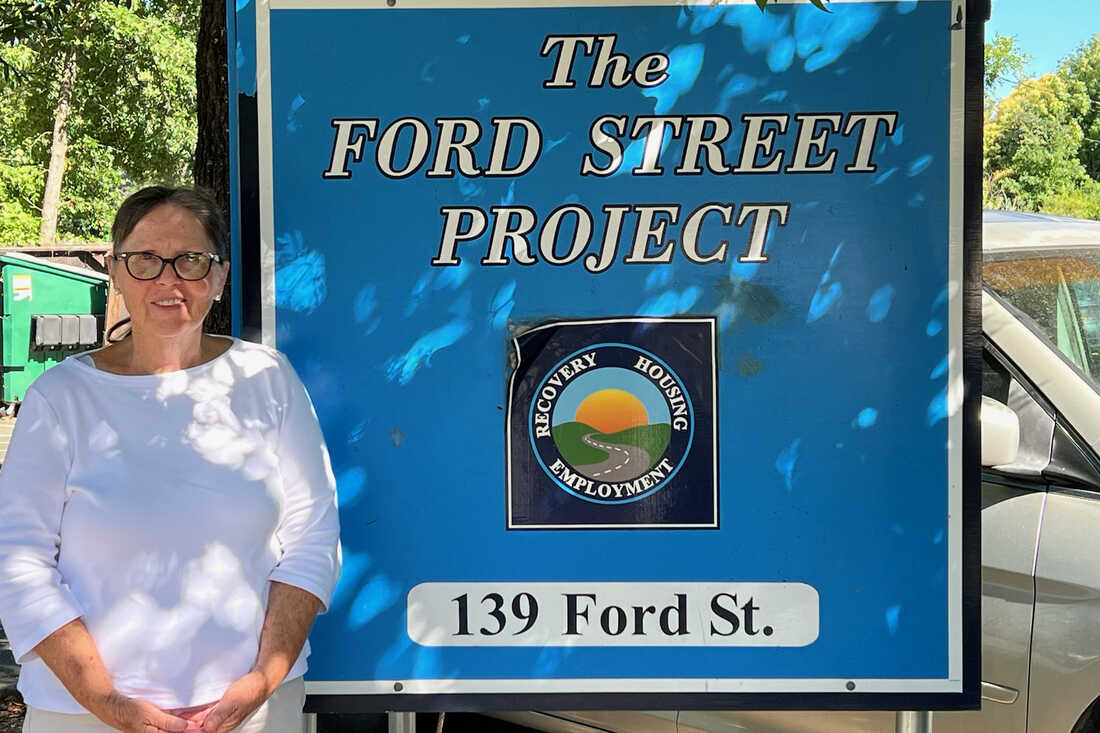
Jacqueline Williams is executive director of the Ford Street Project, a nonprofit that runs Mendocino County’s only adult residential addiction treatment program. “It’s disheartening that the need is so great,” she says, yet some of the county’s opioid settlement money is being spent on a budget shortfall instead of going directly to the crisis. JT Williams hide caption
toggle caption
JT Williams
Jacqueline Williams is executive director of the Ford Street Project, a nonprofit that runs Mendocino County’s only adult residential addiction treatment program. “It’s disheartening that the need is so great,” she says, yet some of the county’s opioid settlement money is being spent on a budget shortfall instead of going directly to the crisis.
JT Williams
Jacqueline Williams is executive director of the Ford Street Project, a nonprofit that runs a food bank, homeless shelter, and Mendocino County’s only adult residential addiction treatment program. “It’s disheartening that the need is so great,” she said, yet some of the settlement money is not going directly to the crisis.
She has asked the county for $4 million to build a 24-bed sober living facility, where clients — many of whom are homeless — can stay after completing residential treatment. “The hardest thing is when somebody asks for help if you don’t have a bed,” said Williams, who hasn’t received a final response to her request.
Jenine Miller, Mendocino County’s behavioral health director, said the county is using revenue from a local sales tax increase to build a psychiatric hospital, crisis respite facilities, and mobile response teams, but there is still a need for more residential treatment for addiction specifically.
“I can never say I have enough funds to do everything we need to do,” she said.
Miller signed off on a report the county is required to file with administrators of the settlement, saying it spent $63,000 on purposes that do not qualify as opioid remediation. She told KFF Health News that she understands the county’s need to recuperate costs to its health insurance plan, “but the largest amount of the money needs to be in our community doing prevention, early intervention, and treatment.”
Mulheren, the vice chair of the board of supervisors, said if the county has savings in future years, it may be able to put some of the recurring $63,000 toward addiction initiatives. The county recently switched from being self-insured to a group health insurance plan for its roughly 900 employees.
“We’re trying to constantly figure out how we can save money, especially when it comes to the health insurance premiums.” Mulheren said.
But Myers, of the Campaign for Tobacco-Free Kids, said his experience with the tobacco settlement suggests the first few years of spending set the tone for the future.
“If states don’t start spending money for the designated purpose effectively and build it into the DNA of the budget process, the risks down the road only grow,” he said.
KFF Health News, formerly known as Kaiser Health News (KHN), is a national newsroom that produces in-depth journalism about health issues and is one of the core operating programs at KFF — the independent source for health policy research, polling, and journalism.
Share this Post
