 Enlarge this image
Archaeologist Armand Salvador Mijares was digging in this cave on Luzon island in the Philippines in 2007 when he turned up an ancient toe bone that wasn’t quite like a modern human’s. Callao Cave Archaeology Project hide caption
toggle caption
Callao Cave Archaeology Project
Archaeologist Armand Salvador Mijares was digging in this cave on Luzon island in the Philippines in 2007 when he turned up an ancient toe bone that wasn’t quite like a modern human’s.
Callao Cave Archaeology Project
An unusual species of human apparently lived on the island of Luzon in the Philippines as recently as 50,000 years ago. Based on teeth and bones found there, scientists suspect that these early humans probably stood less than 4 feet tall and had several apelike features. Yet, the researchers say, the bones are distinctly human — from a previously undiscovered species.
The first clue was a bone that surfaced in 2007. Archaeologist Armand Salvador Mijares was digging in a cave on the island of Luzon and found a toe bone. He says it didn’t look like a modern human bone. “There’s something peculiar with this bone,” he recalls thinking. But one bone wasn’t enough to say for sure who or what it belonged to.
Enlarge this image
The pronounced curve of this toe bone — the proximal phalanx — from a specimen of Homo luzonensis, an early human found in a Philippine cave, looks more like it came from tree-climbing Australopithecus than from a modern human, scientists say. Callao Cave Archaeology Project hide caption
toggle caption
Callao Cave Archaeology Project
The pronounced curve of this toe bone — the proximal phalanx — from a specimen of Homo luzonensis, an early human found in a Philippine cave, looks more like it came from tree-climbing Australopithecus than from a modern human, scientists say.
Callao Cave Archaeology Project
Mijares, who’s with the University of the Philippines, was part of a team looking for bones of early humans. They kept digging for four more years. In 2011, they hit pay dirt — more toe bones, as well as finger bones, part of a thigh bone and seven teeth. And none looked like it belonged to modern humans. “We agreed that this could probably be a new species,” Mijares says.
Discovering a new species of ancient human is a career-maker in anthropology — or career-breaker, if you’re wrong. So the team spent another eight years studying the bones and teeth. They now conclude that the skeletal fragments are from three individuals who lived sometime between 50,000 and 67,000 years ago. Writing this week in the journal Nature, the scientists call them Homo luzonensis, after the island.
And, says paleoanthropologist Shara Bailey of New York University, these three are pretty unusual.
“We tend to define species based on unique combinations of traits,” Bailey says, “and that seems to be what’s going on here.” She says it’s “super-surprising” how the teeth and bones exhibit some “very primitive traits” along with modern ones.
For example, one toe bone is more curved than modern human toe bones. In fact, it looks just like the toe of a tree-climbing, ape-like creature, Australopithecus, that lived millions of years ago — well before the first humans evolved.
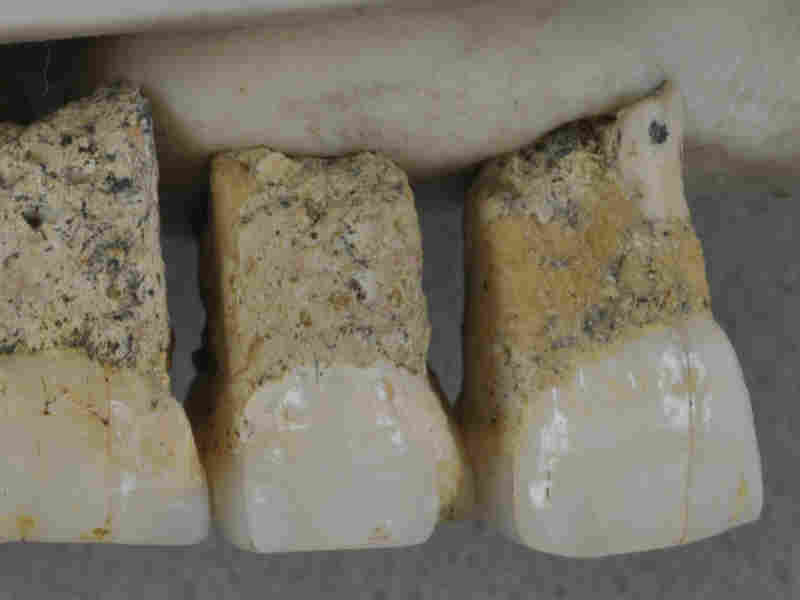
Even the mouth combines an unusual mix of past and present: Some of the teeth look much like ours, while others are more like the teeth of ancestors that lived millions of years ago.
Bailey calls the find a “mosaic” species: “I think it just opens up so many new questions,” she says. “It’s exciting.”
One question is: Were these creatures related to the Hobbits (no, not the movie characters).
“Hobbit” is the widely used nickname for another tiny, primitive human species that lived on an Indonesian island from about 100,000 years ago until 50,000 years ago. More formally called Homo floresiensis, the Hobbits were discovered 15 years ago. They, too, had a surprising mix of primitive and humanlike bones and teeth.
Enlarge this image
Several teeth and a few bones may be all that remain of a diminutive species of early human who lived on the island of Luzon prior to 50,000 years ago. Callao Cave Archaeology Project hide caption
toggle caption
Callao Cave Archaeology Project
Several teeth and a few bones may be all that remain of a diminutive species of early human who lived on the island of Luzon prior to 50,000 years ago.
Callao Cave Archaeology Project
Paleoanthropologist Matt Tocheri at Lakehead University in Canada is an expert on the Hobbits. “Here we are not that much later, and now we’ve got a similar thing popping up on an island in the Philippines,” Tocheri says. “They’re living out on these oceanic islands — and they’re essentially there at the same time [as] our species is, you know, conquering the world.”
With two puzzling species in Southeast Asia, scientists are also wondering what it tells us about the migration of human ancestors out of Africa.
The standard view holds that the first species of human to leave Africa was a large-bodied, fairly big-brained group called Homo erectus, almost 2 million years ago. Homo erectus spread through Asia and Europe.
One possible explanation for the existence of Homo luzonensis is that a population of Homo erectus got to the Philippines long ago — maybe hundreds of thousands of years ago — and stayed put. As they evolved, some of their physical traits became more like those of modern humans — some of the teeth, for example. But other traits, like toes, did not evolve or may even have regressed to a more primitive form.
That’s the view of Florent Détroit, a paleoanthropologist at the National Museum of Natural History in Paris and one of the discoverers of the new species. He says evolution plays some unusual tricks, especially on organisms that live in isolation.
“This is yet another piece of evidence to show that the features [of the body] definitely do not evolve at the same speed,” Détroit says, “especially in different species in different geographical places.”
But Tocheri says there may be another explanation: a different migration out of Africa, not by Homo erectus but by some other more apelike species that settled in remote parts of Asia.
“That’s where it gets exciting,” Tocheri says. “Because, if it’s true that the other species of early Homo also made it out [of Africa], it means that what we’re finding in Asia is even more complex and more interesting than we ever dreamed of.”
With two oddball species of early human turning up in the past two decades, paleontologists are wondering what the findings mean for the history of humanity.
“The evolution of Homo is getting weirder and weirder,” says Rick Potts, head of the Human Origins Program at the Smithsonian Institution’s National Museum of Natural History. “Species are fluid entities, which makes them highly malleable, subject to change,” he says.
These discoveries, Potts says, “are going to play havoc with any easy classification” of our ancestors and with the notion that there was a fairly orderly progression from primitive to more “modern” traits.
What is becoming clearer, anthropologists say, is that early humans came in a lot more shapes and sizes than scientists once thought.
Share this Post
