 Enlarge this image
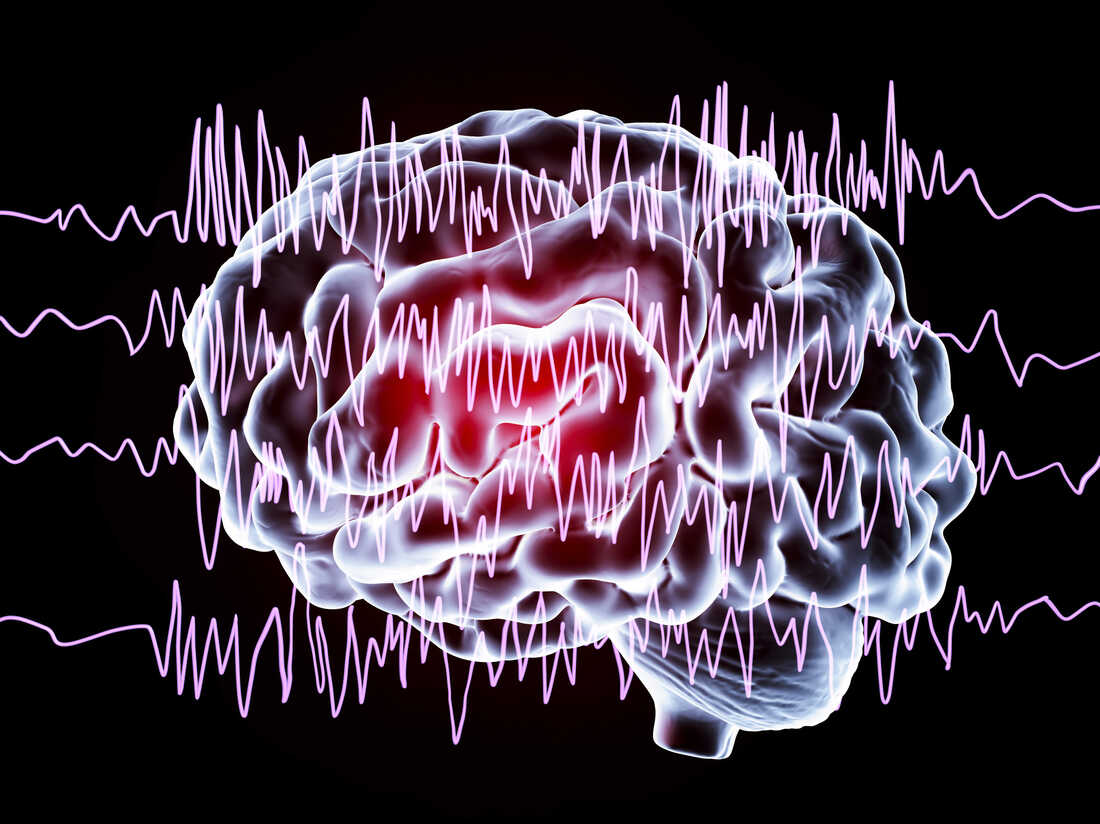
If the brain is a musical instrument, “the electrophysiology is the music,” says Dr. Alexander Khalessi. New tools to treat epilepsy patients now let doctors “listen to the music a little bit better.” Kateryna Kon/Science Photo Library/Getty Images hide caption
toggle caption
Kateryna Kon/Science Photo Library/Getty Images
If the brain is a musical instrument, “the electrophysiology is the music,” says Dr. Alexander Khalessi. New tools to treat epilepsy patients now let doctors “listen to the music a little bit better.”
Kateryna Kon/Science Photo Library/Getty Images
When Tom’s epileptic seizures could no longer be controlled with drugs, he started considering surgery.
Tom – who asked that we not use his last name because he worries that employers might be alarmed by his medical history – was hoping doctors could remove the faulty brain tissue that sometimes caused him to convulse and lose consciousness.
He underwent a grueling evaluation at the epilepsy center at the University of California, San Diego. Doctors removed a piece of his skull and placed electrodes on the surface of his brain. He spent a week in the hospital while doctors watched him having seizures.
Then, he got bad news.
“You’re not an optimal surgery patient,” he recalled the doctors telling him.” We don’t feel safe operating on you.”
That was in 2009. In 2018, with epilepsy taking a heavy toll on his work and family life, Tom went back to his doctors at UCSD to discuss treatment options. This time he met with Dr. Jerry Shih, the center’s director.
Shots – Health News
One Scientist’s Quest To Vanquish Epileptic Seizures
“I told him, you know what, we’re in a unique situation now where we have some of the newer technologies that were not available” in 2009, Shih says.
This time, the team inserted tiny electrodes into Tom’s brain to find the primary source of his seizures. Then, in 2019, they used a laser to remove that bit of his brain.
Tom, 48, is seizure free now, as long as he takes his medication.
There are a growing number of patients like Tom. Their stories show how new technology is changing the way doctors assess and treat drug-resistant epilepsy, which affects more than a quarter of the roughly 3 million people in the U.S. with the disorder.
Technological advances include not only tiny electrodes and lasers, but MRI machines that provide high-resolution images during surgery, and implanted devices that can stop a seizure in its tracks.
“We help the vast majority of patients we treat quite significantly with a combination of these technologies,” says Dr. Sharona Ben-Haim, the neurosurgeon at UCSD who operated on Tom.
All of these approaches involve surgery, which was once considered a last resort for treating epilepsy. Today, though, surgical treatment is increasingly common, and many patients need only minimally invasive procedures.
When epilepsy drugs aren’t enough
Like many people with epilepsy, Tom was initially able to control his disorder with medication.
His first big seizure came when he was 16. His mom heard him making strange sounds.
Shots – Health News
After Months In A Dish, Lab-Grown Minibrains Start Making ‘Brain Waves’
“She went upstairs to my bedroom and I was just in full convulsions,” Tom says. “My bed was completely soaked through with sweat and my head was contorted.”
Tom woke up in the hospital. But once doctors put him on an epilepsy drug, his seizures stopped.
He went to college, worked as an English teacher in Mexico, came back to California, and moved in with the woman he would later marry.
Then he had another big seizure, and another trip to the hospital.
“Now, you know, I’m 25 and I’m diagnosed with a potentially devastating, potentially uncontrollable disorder,” Tom says.
That meant some daily activities were no longer safe.
“Suddenly you can’t take a bath anymore,” he says. “You can’t go swimming anymore. No more free weights in the gym.”
Tom tried to adapt. He found a job, got married, and had kids. But his epilepsy began taking a big toll on his family.
After being told he wasn’t a good candidate for surgery in 2009, Tom had returned to work still struggling with uncontrolled seizures. Within a couple of years, though, he lost his job. His marriage ended.
During this difficult period in Tom’s life, though, researchers were introducing the technologies that would eventually help him.
Listening to the music of the brain
The changes in epilepsy diagnosis and treatment rely on improvements in monitoring the brain’s electrical activity, or electrophysiology.
“If you think about the brain like a musical instrument, the electrophysiology is the music,” says Dr. Alexander Khalessi, a neurosurgeon at UCSD.”For so long, we were only looking at a picture of the violin. Now we’re able to listen to the music a little bit better.”
Shots – Health News
Her Seizures Looked Like Epilepsy, But Her Brain Looked Fine
That means doctors are more likely to detect a sour note, like the one produced when brain cells produce the faulty signals that can cause an epileptic seizure.
One key advance involves a procedure known as stereoelectroencephalography (SEEG). Surgeons drill one or more small holes in a patient’s skull and insert electrodes into areas of the brain thought to be causing a patient’s seizures.
Then they wait until the patient has a seizure. For Tom, that meant many days in the hospital with wires coming out of several holes in his head. But it paid off.
“We were able to see that there was one specific region of his brain that was really the driver of most of his seizures,” says Ben-Haim.
Tom also benefited from technology that allows SEEG information to be combined with high-resolution MRI scans. That shows surgeons precisely where the trouble spots are.
“As a surgeon, you can’t hit what you can’t see,” Khalessi says.
New forms of MRI also help surgeons reach their target without damaging other brain areas, Khalessi says.
To illustrate his point, he calls up an image of a patient’s brain on his computer screen. It shows a diseased area. It also shows the bundles of critical nerve tracts that lie between the brain’s surface and the problem.
“What you see here is a case where we can plan a trajectory to avoid those tracts and deliver laser energy to ablate that area,” he says.
Shots – Health News
With Epilepsy Treatment, The Goal Is To Keep Kids Seizure-Free
In Tom’s case, that laser energy was delivered through a probe so thin it could pass through a drinking straw. The probe, guided by an MRI scanner in the operating room, heated up the target area and “actually knocked out that very active seizure focus,” Shih says.
“It was a single hole, a single stitch, and I don’t have a scar,” Tom says. That was all the more impressive given that the surgery to diagnose his condition in 2009 left a five-inch, J-shaped scar running from his right ear to his forehead.
Getting better all the time
Some of the technology changing epilepsy care is being developed right on the UCSD campus.
“This is our microfabrication lab,” Shadi Dayeh says as he walks through a high-tech facility that could be in Silicon Valley. Dayeh, a professor of electrical and computer engineering, is the scientist in charge here.
Inside a glass-enclosed clean room, figures in white tyvek suits work with machines like the ones used to make electronic displays.
One goal here is to improve the devices used to study brain activity. A limiting factor has been the number of electrodes, or sensors, scientists can squeeze into a small space. So Dayeh has been borrowing from techniques used to shrink the electronics that produce high-resolution monitors.
“Why not take these advances and implement [them] for the benefit of medicine?” he says.
Dayeh shows me a sensor grid slightly larger than a postage stamp. It’s extremely flexible and thinner than a human hair.
An earlier, thicker and less flexible version of this sort of grid was placed on the surface of Tom’s brain back in 2009 to measure the electrical activity below. But that one had only a few dozen sensors, limiting its resolution. Dayeh’s new grids have thousands.
“This allows us to look at the activity from the surface of the brain with very high resolution,” he says. “We call it the brain telescope.”
Dayeh and his team have also been improving the sort of probe used to study activity deep in Tom’s brain in 2018.
More than 100 closely-spaced sensors along the probe pick up the electrical activity of brain cells, and can also deliver deep brain stimulation.
“The tip is really very thin so it causes minimal tissue damage,” Dayeh says. “Less tissue damage means better recording from the brain – and less side effects.”
Robots and brain defibrillators
Both lasers and diagnostic probes need to be positioned precisely in the brain. And that’s where another technological advance can help: robots.
At UCSD and other cutting-edge epilepsy centers, surgeons often use a system called ROSA, which acts as a sort of GPS for the brain.
“It allows us to essentially steer a robot arm that takes us right to our target,” Ben-Haim says.
Sometimes, doctors find that seizures are coming from several brain areas, or from an area that’s too important to eliminate. That’s when doctors may try a device that studies the signals coming from electrodes permanently implanted in a patient’s brain.
“It’s constantly recording in the background,” Ben-Haim says. “And then it’s able to essentially defibrillate the brain when it senses the onset of a seizure.”
All of these advances mean that more patients with drug-resistant epilepsy can now look beyond medication to prevent their seizures.
“We’ve transitioned to more of a surgical-based treatment as well as minimally invasive surgical techniques that I think have really revolutionized the treatment of epilepsy,” Shih says.
Tom is happy to be a part of that revolution. He still takes medication to remain seizure-free. But he’s remarried, working part time, and driving a car for the first time in years.
“I have a sense of independence now that I hadn’t had since 2007,” he says. All thanks to technology that didn’t exist back then.
Share this Post
