 Enlarge this image
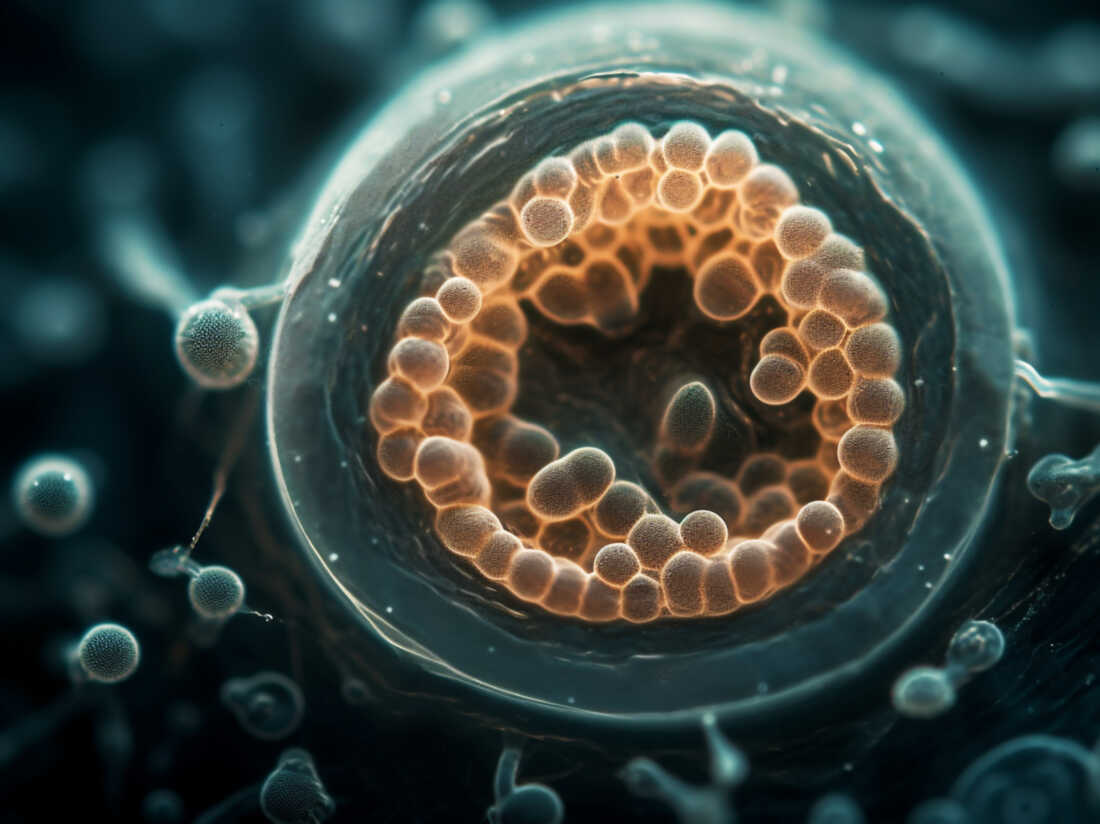
An illustration of the blastocyst stage of embryo development at about five to nine days after fertilization. The outer layer will grow to form the placenta. The inner cells will become the fetus. Juan Gaertner/Getty Images/Science Photo Library hide caption
toggle caption
Juan Gaertner/Getty Images/Science Photo Library
An illustration of the blastocyst stage of embryo development at about five to nine days after fertilization. The outer layer will grow to form the placenta. The inner cells will become the fetus.
Juan Gaertner/Getty Images/Science Photo Library
An Alabama Supreme Court ruling that frozen embryos can be considered “extrauterine children” under state law has major implications for how in vitro fertilization, commonly called IVF, is performed.
The ruling came in a wrongful death lawsuit brought by couples whose frozen embryos were destroyed in an accident at a fertility clinic in Mobile, Ala. The court agreed with the couples that the embryos were protected under the state’s Wrongful Death of a Minor Act. Legal and reproductive medicine experts say the ruling raises the risks and costs of IVF for both patients and medical practitioners.
Already, at least three providers in Alabama have announced that they are pausing IVF treatments in light of last Friday’s court ruling. And an Alabama lawmaker has said he will introduce state legislation that would clarify that IVF can continue in the state. For the moment, the legal ramifications for IVF only affect Alabama. That could change as other states adopt “personhood” statutes that say life, and rights, begin at conception.
Here’s what you need to know about the science of how the IVF process works – and how the ruling could affect its future.
1. IVF is a multistep process, and timing is crucial.
Each cycle of IVF is a multistep process that is keyed to a patient’s menstrual cycle in the beginning. First, a patient needs to take injectable hormones every day for a 10- to 12-day period, explains Dr. Eve Feinberg, a reproductive endocrinologist and infertility specialist at Northwestern University in Chicago. Those hormones prime multiple eggs to mature inside the ovary, in little fluid-filled sacs called follicles. Patients are monitored regularly, often daily. Once those follicles reach a certain size, the patient takes a different hormone that gets the eggs ready to be retrieved.
The second step of the process is egg retrieval, which happens when the patient is under anesthesia. Once the eggs are removed, they’re placed in a dish with sperm so they can be fertilized, which is Step 3 in the process.
Then comes Step 4, when the fertilized egg is is grown in the lab for about three to seven days until it has reached the blastocyst stage, “which is a highly developed embryo that contains two different cell layers — the cells that become the placenta and then the cells that become the fetus,” Feinberg explains.
Short Wave
IVF Has Come A Long Way, But Many Don’t Have Access
At that point, the embryo is either transferred into the woman’s uterus, which is Step 5, or frozen for future use. Sometimes, both scenarios happen — one embryo is transferred, while surplus embryos are frozen for later use.
An IVF cycle can take about 2.5 weeks from hormone shots to implantation if the embryo is implanted right away, Feinberg says. Oftentimes, she says, embryos are frozen and then transferred into the uterus in a separate cycle.
Of course, embryos can also be frozen for years before being transferred into a woman’s uterus. And one of the big questions the Alabama decision raises is whether all frozen embryos in the state will have to be stored indefinitely.
2. Fertilized eggs often don’t survive — both in nature and in the lab.
Feinberg says that it’s common for fertilized eggs not to make it — that’s just how fertility works naturally. “Every month there are many women that are walking around that probably have fertilized eggs or embryos that are floating around in their body” that do not become pregnancies, she says. A fertilized egg has to make it to the uterine cavity and implant and continue to grow. Even in a healthy 28-year-old woman, that will only happen naturally about 25% of the time, she says.
When it comes to IVF, once eggs are fertilized in the lab, only about 55% of those embryos make it to the blastocyst stage, she says, and that’s at the best IVF clinics. Feinberg says the Alabama Supreme Court ruling raises the risks that a medical practitioner could now be charged for wrongful death for embryos lost at any point during this process.
“By definition, 45% of all embryos grown in the laboratory ‘die,'” she says. “And the charge of wrongful death can now be applied. As a reproductive specialist, that idea is terrifying,” Feinberg says. “Who wants to assume that risk?”
In 2021, more than 97,000 infants were born in the U.S. from more than 400,000 cycles of assisted reproductive technology, or ART, according to data gathered by the Centers for Disease Control and Prevention.
3. IVF can be used to avoid genetic diseases. It can also be used by same-sex couples who want children.
Some patients will choose to get genetic testing for embryos before they are transferred. For example, older patients may choose testing because the risks of chromosomal abnormalities in the embryo rise with age. And those who might carry a genetic disease they don’t want to pass on may also opt for tests, Feinberg says. Known as PGT-IVF, for “preimplantation genetic testing,” it can help people avoid devastating illnesses such as Tay-Sachs disease and other conditions.
Waiting for those results before transferring the embryo can add several weeks to an IVF cycle, she says.
Same-sex couples may also use IVF, surrogacy and other ART procedures and treatments to have children.
4. Surplus frozen embryos reduce costs — and risks — of IVF.
“Our ability to freeze embryos has really revolutionized how we care for fertility patients,” Feinberg says.
For one thing, it’s helped lower the health risks for patients, because multiple eggs can be harvested from one ovarian stimulation cycle and then fertilized and frozen for future use. She says that’s helped move the field toward transferring one embryo at a time, reducing the risks associated with carrying twins and triplets.
She says freezing embryos before transferring them into the uterus has also essentially eliminated the risk of ovarian hyperstimulation syndrome. OHSS is a potentially life-threatening response to fertility medications that can result in fluid in a woman’s abdomen and raises the risk of blood clots getting into the lungs.
Shots – Health News
When does life begin? As state laws define it, science, politics and religion clash
Freezing embryos can also increase the chance of success. Many patients don’t succeed with IVF after one cycle. Having multiple frozen embryos makes it more economically feasible for couples to try again for a successful implantation, because the bulk of the cost of IVF comes during the ovarian stimulation and egg retrieval process, she says.
“From a cost-effectiveness perspective, you want to get multiple embryos so that you don’t have to go back and go through multiple egg retrieval cycles,” she says.
That’s important because IVF is very expensive. Feinberg says a typical IVF cycle can cost anywhere from $12,000 to $24,000, depending on where you go. And that doesn’t include the costs of medications, which can cost thousands of dollars per cycle.
A handful of states mandate that employers provide infertility coverage, but most insurance policies do not cover the costs of IVF. Many people go into debt to achieve their dream of having children.
5. It’s still unclear how the Alabama ruling will affect IVF in the state … and beyond.
One of the questions the ruling raises: If embryos are people under the law, says Mary Ziegler, a law professor at the University of California, Davis, do you have to implant every embryo that is created in a particular IVF cycle?
Normally, extra frozen embryos that aren’t transferred into a uterus are stored, donated for research or destroyed. But Ziegler says it’s not clear donation or destruction are still legal options under the Alabama ruling. If that’s the case, she says providers in the state might feel the need to create only one embryo per IVF cycle.
“If you were not allowed to create more than one embryo per cycle, that’s likely to make IVF even more financially out of reach for people who don’t have insurance coverage and who struggle to pay that hefty price tag,” Ziegler told NPR.
Feinberg says it’s possible that providers could store surplus frozen embryos out of state, but that would also raise costs significantly — especially if patients had to pay to store their embryos indefinitely.
Ziegler says the ruling also could have implications outside of Alabama, as part of a broader strategy by the anti-abortion movement to win legal recognition of a fetus or embryo as a person, especially under the federal constitution.
“I think you’ll see the anti-abortion movement making a gradual case that the more state courts — the more state laws — recognize a fetus or embryo as a person for different circumstances and reasons, the more compelling they can say is the case for fetal personhood under the constitution,” Ziegler say.
Feinberg says the ruling could potentially also make offering IVF too costly for providers, who might have to pay more for malpractice insurance in states where embryos are considered people.
Share this Post
