Explaining Medicine
  • News
  • Health & Lifestyle
    • Diet & Weight Management
    • Exercise & Fitness
    • Nutrition, Food & Recipes
    • Prevention & Wellness
  • Conditions
    • Custom1
      • Conditions A-Z
      • Procedures A-Z
      • Allergies
      • Alzheimer’s
      • Arthritis
      • Asthma
      • Blood Pressure
      • Cholesterol
      • Cancer
    • Custom2
      • Chronic Pain
      • Cold Flu
      • Depression
      • Diabetes
      • Digestion
      • Eyesight
      • Health Living
      • Healthy Kids
      • Hearing Ear
    • Custom3
      • Heart
      • HIV/AIDS
      • Infectious Disease
      • Lung Conditions
      • Menopause
      • Men’s Health
      • Mental Health
      • Migraine
      • Neurology
    • Custom4
      • Oral Health
      • Pregnancy
      • Senior Health
      • Sexual Health
      • Skin Problems
      • Sleep
      • Thyroid
      • Travel Health
      • Women’s Health
  • Medications
    • Medications
    • Supplements and Vitamins
  • Medical Dictionary
  • Health Alerts
Is It Dry Skin or Atopic Dermatitis?
Atopic Dermatitis: How to Get Enough Sleep
Atopic Dermatitis: Help for Broken Skin
Atopic Dermatitis and Food Triggers
What’s at stake as the Supreme Court hears...
Oncologists’ meetings with drug reps don’t help cancer...
Chronic Spontaneous Urticaria: What to Know
CSU: What to Wear and What to Avoid
Treatment Plan for Chronic Spontaneous Urticaria
When the Hives of CSU Don’t Go Away...
Top Posts

Explaining Medicine

  • News
  • Health & Lifestyle
    • Diet & Weight Management
    • Exercise & Fitness
    • Nutrition, Food & Recipes
    • Prevention & Wellness
  • Conditions
    • Custom1
      • Conditions A-Z
      • Procedures A-Z
      • Allergies
      • Alzheimer’s
      • Arthritis
      • Asthma
      • Blood Pressure
      • Cholesterol
      • Cancer
    • Custom2
      • Chronic Pain
      • Cold Flu
      • Depression
      • Diabetes
      • Digestion
      • Eyesight
      • Health Living
      • Healthy Kids
      • Hearing Ear
    • Custom3
      • Heart
      • HIV/AIDS
      • Infectious Disease
      • Lung Conditions
      • Menopause
      • Men’s Health
      • Mental Health
      • Migraine
      • Neurology
    • Custom4
      • Oral Health
      • Pregnancy
      • Senior Health
      • Sexual Health
      • Skin Problems
      • Sleep
      • Thyroid
      • Travel Health
      • Women’s Health
  • Medications
    • Medications
    • Supplements and Vitamins
  • Medical Dictionary
  • Health Alerts
  • News

    Using Music And Rhythm To Help Kids With Grammar And Language

    by NPR June 1, 2017

    Enlarge this image

    Research analyst Allison Aaron and Assistant Professor Reyna Gordon are studying how music and rhythm training could help children who struggle with language development. Their work is part of Vanderbilt’s Program for Music, Mind and Society. Kacie Dunham/Courtesy of Reyna Gordon hide caption

    toggle caption

    Kacie Dunham/Courtesy of Reyna Gordon

    Research analyst Allison Aaron and Assistant Professor Reyna Gordon are studying how music and rhythm training could help children who struggle with language development. Their work is part of Vanderbilt’s Program for Music, Mind and Society.

    Kacie Dunham/Courtesy of Reyna Gordon

    Reyna Gordon was an aspiring opera singer fresh out of college when she began contemplating the questions that would eventually define her career.

    “I moved to Italy when I finished my bachelor of music, and I started to take more linguistic classes and to think about language in the brain, and music in the brain,” she says. “What was happening in our brains when we were listening to music, when we were singing? What was happening in my brain when I was singing?”

    Those questions led her to a graduate program in neuroscience in Marseilles, France.

    Today, Gordon is director of the Music Cognition Lab in the Department of Otolaryngology at Vanderbilt University Medical Center. She studies the connections between rhythm and grammar, and how rhythm and music training might help children with atypical language development.

    Gordon has previously published research showing a correlation in children between good rhythm skills and a good grasp of grammar. She found children who can detect rhythmic variations in music have an easier time putting sentences together.

    “One thing that rhythm and grammar have in common is that they both unfold over time, and our brains form expectancies about what’s coming up based on what we just heard,” says Gordon.

    Consider the following sentence: The boy read the book that his mother gave to him. “When we hear ‘The boy read,’ then we’re expecting an object after that,” Gordon says. “Then when we hear ‘The boy read the book that,‘ then we’re expecting an additional clause – something else about the book.”

    Music And The Brain

    Say What?! Musicians Hear Better

    Music News

    Say What?! Musicians Hear Better

    'Like Brain Boot Camp': Using Music To Ease Hearing Loss

    Shots – Health News

    ‘Like Brain Boot Camp’: Using Music To Ease Hearing Loss

    It often goes undiagnosed. “They have some grammar, but they haven’t acquired it at the same rates as their peers,” Gordon says. “So expressing complex ideas, especially as they start to go through school, is difficult.”

    In her lab, Gordon studies children with and without language impairment. Some of the kids might already be seeing speech therapists. Gordon wants to see if, in addition, music and rhythm training can help them.

    On a recent afternoon, 7-year-old Adalyn Patel paged through a picture book with research analyst Allison Aaron, who asked her to describe what she saw and offered prompts.

    “The dog ran to the door and was barking,” Aaron said to Patel. “What does the boy think? Start with ‘He…'”

    Enlarge this image

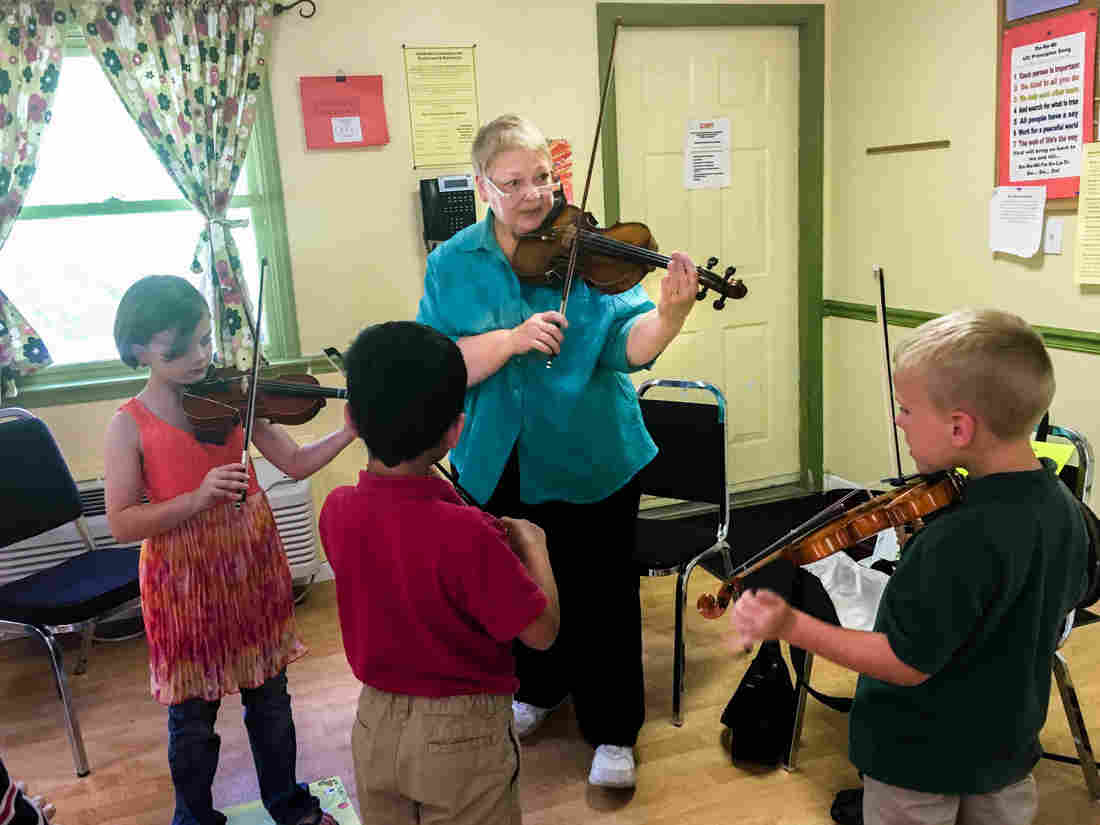
    (From left to right) Mackenzie Stamper, Adrian Rodriguez and Luke Ryan attend weekly Suzuki violin lessons with instructor Sara Johnson, part of a training program called MILEStone, or Music Impacting Language Expertise. Andrea Hsu/NPR hide caption

    toggle caption

    Andrea Hsu/NPR

    (From left to right) Mackenzie Stamper, Adrian Rodriguez and Luke Ryan attend weekly Suzuki violin lessons with instructor Sara Johnson, part of a training program called MILEStone, or Music Impacting Language Expertise.

    Andrea Hsu/NPR

    Patel answered, “He thinks the dog is barking at something that’s, that’s not there.” A child with atypical language development might answer the same prompt with just a couple of words.

    In one rhythm test, kids listen to several musical rhythms and say whether they are the same or different. In another, they mimic a string of spoken syllables, with variations in timing and intonation.

    Gordon and her team invite families of children who show weaknesses in these assessments to take part in a training program called MILEStone, or Music Impacting Language Expertise. It’s a 5-month program the lab created that involves weekly Suzuki violin lessons and a weekly movement class.

    “There may be something that music training can do to help boost things. Maybe we’re able to boost their auditory processing skills in the brain, or something about their rhythm sensitivity in their everyday listening to language, ” Gordon says. “We don’t know yet, so we actually have a whole series of questions to look at. And while we’re in these initial stages I think that music is a fun thing, and if the families are enjoying it, it’s a good program to do.”

    Gordon and her colleagues plan to present some initial findings from their research at a conference on music, sound and health in Boston this summer.

    Read the article here

    Share this Post

    Share Explaining Medicine Share Explaining Medicine

    Using Music And Rhythm To Help Kids With Grammar And Language was last modified: June 7th, 2017 by NPR

    Related

    Children's HealthgrammarLanguagemusic
    0 comment
    0
    Facebook Twitter Google + Pinterest
    NPR

    previous post
    Cracking The Code That Lets The Brain ID Any Face, Fast
    next post
    Many COPD Patients Struggle To Pay For Each Breath

    Related Articles

    Seniors Slow to Embrace Online Access to Doctors

    May 30, 2018

    10 surprising things you need to know about the hospital

    January 11, 2019

    CDC: Cases of Polio-Like Illness May Have Peaked

    December 4, 2018

    Heart Attacks Rising Among Younger Women

    February 19, 2019

    Teen Obesity, Later Pancreatic Cancer Risk Linked?

    November 14, 2018

    Excellent surgeons are those who are quick to recognize their mistakes

    December 27, 2018

    3 of 4 Black Americans Have Hypertension by 55

    July 11, 2018

    New Drug Could Help Kids With MS

    September 12, 2018

    Study: Care at For-Profit Nursing Homes Is Worse

    October 23, 2018

    New Antibiotic Treats Pneumonia, Skin Infections

    February 6, 2019

    Recent Posts

    • Is It Dry Skin or Atopic Dermatitis?

      April 24, 2024
    • Atopic Dermatitis: How to Get Enough Sleep

      April 24, 2024
    • Atopic Dermatitis: Help for Broken Skin

      April 24, 2024
    • Atopic Dermatitis and Food Triggers

      April 24, 2024
    • What’s at stake as the Supreme Court hears Idaho case about abortion in emergencies

      April 23, 2024

    Keep in touch

    Facebook Twitter Google + RSS

    Recent Posts

    • Is It Dry Skin or Atopic Dermatitis?

      April 24, 2024
    • Atopic Dermatitis: How to Get Enough Sleep

      April 24, 2024
    • Atopic Dermatitis: Help for Broken Skin

      April 24, 2024
    • Atopic Dermatitis and Food Triggers

      April 24, 2024
    • What’s at stake as the Supreme Court hears Idaho case about abortion in emergencies

      April 23, 2024
    • Terms of Service
    • Privacy Policy

    @2025 - Explaining Medicine. All Right Reserved.


    Back To Top
    Explaining Medicine
    Proudly powered by WordPress Theme: soledad child.