 Enlarge this image
Anton Petukhov/Getty Images
Veterinarian Karen Fine continues to be amazed by her patients, despite the fact that she’s been in practice for 30 years. Take, for instance, the feral cat she had to capture in a net, who was suffering from an overgrown claw that had punctured and infected his paw pad.
“I knew that I could give him antibiotics for the infection, but it wasn’t going to stop until I trimmed that claw,” Fine said.
Just as Fine was contemplating how to best access the infected paw, her feline patient stretched it out to her through the net, spreading his toes and staying perfectly still. It was as if the cat knew what he needed and was asking for help — which she provided.
“I think there’s so much we don’t know and understand about animals, she says. “And I think there’s a lot that we sort of assume that we know, but that they really have skills and senses that we don’t. I feel that I learn from my patients all the time.”
Fine notes that one common veterinarian abbreviation — ADR — stands simply for “ain’t doing right,” which she describes as “can’t put my finger on it. They’re not themselves.” She says she prefers to visit her patients in their homes, because it gives her a more complete picture of their lives and their owners’ habits.
“And at the clinic, people don’t remember the name of the food,” she says. “You can’t tell how much [the pets are being fed]. At home someone might say, ‘Oh, he only gets a little bit.’ And I can look across the kitchen and see three overflowing food bowls.”
Shots – Health News
It’s not just doctors and nurses. Veterinarians are burning out, too
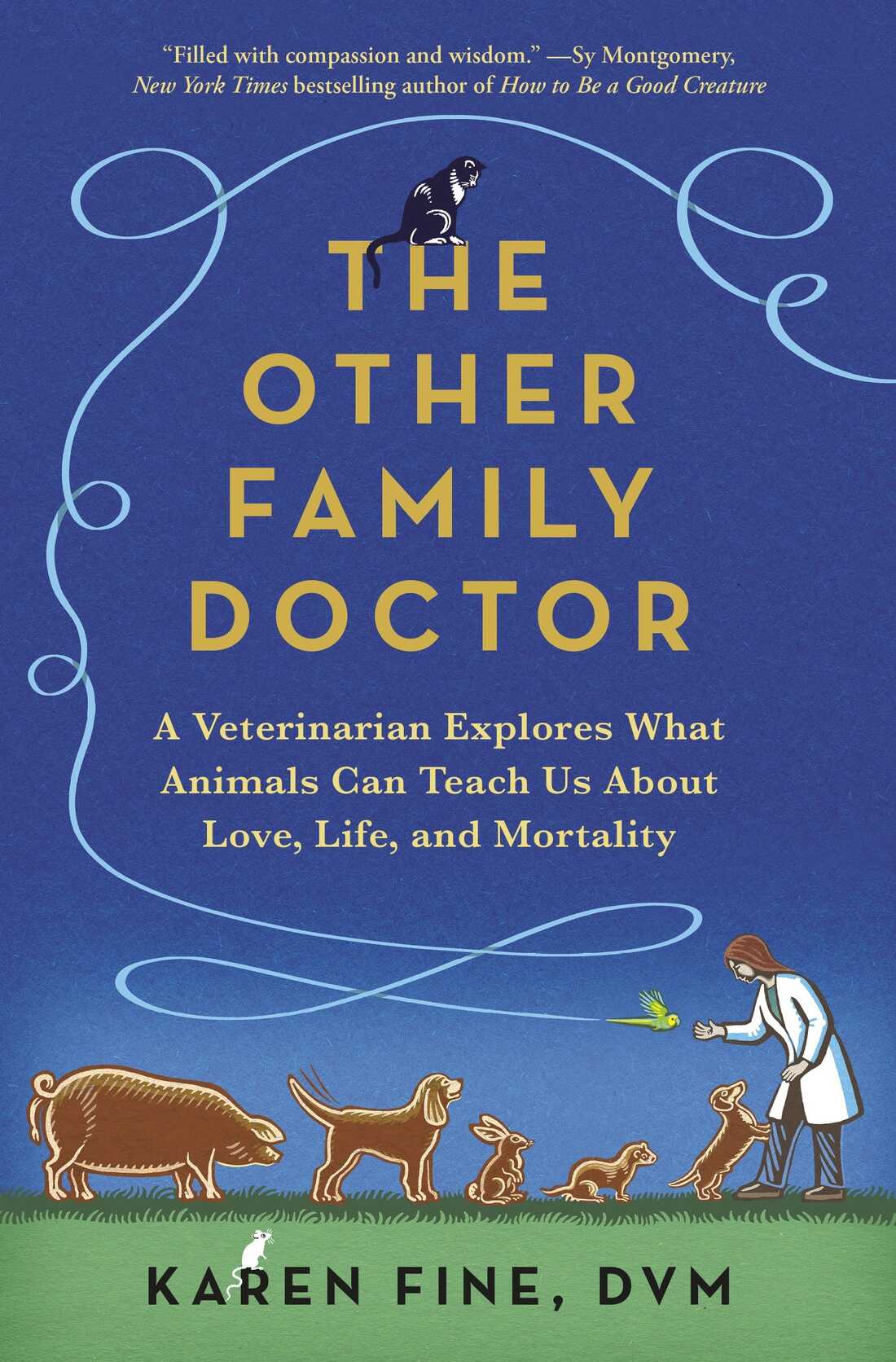
Fine reflects on her experience treating pets and counseling their owners in her new memoir, The Other Family Doctor. A big part of the job, Fine says, is witnessing suffering — not just of animals, but also of their owners. It can take an emotional toll; suicide rates among veterinarians are disproportionately higher than those of other professions.
“There’s been a big focus on wellness, that veterinarians should try to take good care of ourselves and get enough sleep and eat right and exercise,” Fine says. “And I kind of feel like that’s a very good start. But we also need to try to focus on why this work is so difficult and how bonded people are to their animals and how intense some of these interactions are. … I think people, too, need to maybe understand how difficult this work can be.”
Interview highlights
Enlarge this image
Penguin Random House
Penguin Random HouseOn practicing acupuncture and Chinese medicine on animals
I use acupuncture quite a bit and I find that it works well for a lot of chronic conditions [that] Western veterinary medicine maybe either can’t really address well, or can address with medications that have other side effects. And in some cases, acupuncture just works better — like, often, for arthritis. That’s one of the main things that I use it for, and I really enjoy using it. I feel like it’s another way to look at the patient. …
I use some Chinese herbal formulas and supplements. And the theory is pretty much there’s not a magic bullet that we’re looking for. We’re not saying, take this supplement, it’s going to fix everything. It’s sort of a holistic approach, looking at everything in the animal’s life — let’s look at lifestyle and let’s look at diet and those types of things. So sometimes I’ll use Chinese medicine and Western medicine together with the same goal, and sometimes I’ll be able to use less Western medication or no Western medication because of the Chinese medicine, because of the acupuncture.
On how she figured out her cat had headaches
The first thing he did was he attacked my dog, which was incredibly out of character. He was a very gentle cat. And he was 15 at the time. And when my husband and I talked about it afterward, we realized we had seen him, what we call, “head-pressing.” So he had sort of put his head down and pressed his head into her body before he attacked her. And she may have just moved away or something like that. … Headaches are so universal among people that we would think, why wouldn’t animals have headaches? And they’re not going to kind of put their paw on their head or something like that. What they’re going to do is they’re going to isolate themselves. They’re going to close their eyes. They’re going to go to a quiet, dark place. So when people say, “My animal’s hiding,” sometimes we think, OK, they’re not feeling well. But it may be a headache. … It’s not a very common symptom, this head-pressing. But I think that’s what he was doing and that’s why he attacked my dog. So then I took him for an MRI and he was diagnosed with a brain tumor.
On helping people make hard decisions about how much to pay for care
Shots – Health News
The human sensory experience is limited. Journey into the world that animals know
That is one of the main curses of veterinary practice and pet ownership, really. It’s very difficult. And I myself have been in situations, as have most of my clients, where you’re trying to consider, do I have this money? Is it worth spending? And there are so many factors. One is, whether you have it or not, but also how old is the animal? Is it likely to give them a short amount of quality time, a long amount of quality time?
If you have an animal with a broken leg, say [a] cat that had an amputation: Now that cat’s likely to live a normal life span, and cats do fine with three legs. So that’s a very fixable problem. If someone doesn’t have the money for that, then a lot of times you’re looking at euthanasia and that is one of the reasons, I think, why veterinary practice is so stressful — even though we may want to, if it’s our clinic, maybe do things for less cost or whatever, our bills are very expensive and our debts are expensive. The student loan is incredible and we have to pay bills. And there’s almost an expectation, I think, among some clients that we should be doing things for free. And these services, even, say, the blood work, the costs have gone up a lot. It costs us money. So there’s very little that’s really free and it’s a very difficult thing.
On her 16-year-old cat, Daiquiri, being ready to die
We had a little half-bathroom upstairs, which had no windows, and he retreated there. But unlike when he was sick before and I felt that he was having headaches, he seemed comfortable. He was lying there. He was purring. He had stopped eating, which, for him — this was a cat who would eat the house. So the fact that he stopped eating, that’s when I really knew that something was wrong. And he just was so calm and serene. And I really felt that he was ready.
And I’ve felt that from many animals, when I see animals that are near death, that I feel like I see this recognition in them, that there’s this process going on. And it made me really think, you know, that they’re having this mind-body connection and that their body’s breaking down and their mind is accepting that, and that’s what they’re experiencing.
Sort of like — if you think of an animal giving birth. No one’s explained to them, “You’re pregnant and you’re going to have puppies and this is what’s going to happen.” They listen to their body and they kind of intuit what to do. And I think death is a similar situation for animals, and that is my opinion after watching so many animals die and be near death.
On the euthanasia process
Animals
Who Says You Can’t Train A Cat? A Book Of Tips For Feline-Human Harmony
One of the things I do is I often ask the person: “Have you seen this done before?” I’m trying to gauge their comfort level with it. And some people say, “Oh yeah,” and they kind of know what to expect. Some people say no, and then I kind of walk them through it a little bit, that I’ll often give [the pet] a tranquilizer injection first, and then the other injection goes right into the vein. It’s usually a painless injection. but sometimes they don’t like the needle, or their leg being held, or whatever.
It’s a strange situation to be euthanizing your patients, I have to say, even after all these years.
It’s a whole different thing when their person isn’t there. Then it’s just me giving an injection and the person holding (usually there’s a staff member holding them), and we are very much aware that this is not like any other injection. We’re very much aware this is a euthanasia — and there’s sort of a respectful silence. It’s a strange situation to be euthanizing your patients, I have to say, even after all these years. It’s a strange thing. And I feel like I have a lot of respect for that. I want people to feel supported. I know that even though this injection may bring this animal so much peace, if they’re suffering, it may bring the person in the room with me or the people much pain and anguish. So it’s really sort of a delicate dance in terms of supporting the person. I certainly want to make sure that the animal is comfortable, but we really try hard … for it to be a good experience, certainly for the animal, but also for any people that are watching.
On when pets grieve a fellow pet
They’re very deeply affected, I think sometimes more than people, because we often leave and go to work or go take a walk or socialize or whatever. And our animals are often more confined to the house and they’re not watching TV, they’re not listening to podcasts. So they are more, maybe, in tune with their environment. And, just like some people, some animals adjust more easily and some really have a difficult time with it. …
We often see animals grieving. [I recommend keeping] them on a schedule. And sometimes it’s a new schedule, sometimes it’s keeping up a little bit with an old schedule. If it’s a dog, say, get them out of the house. If they don’t have their playmate anymore, try to go somewhere where they can see another dog so that they can kind of keep doing a little bit of what they’re doing and just allowing them that time and space to grieve, because it is a normal process.
On how to change veterinary medicine to ease the mental health strain
Many of us are perfectionists and, if you’re an animal [physician] — just like a human physician — you think, well, if your patient dies, is that a failure? So, kind of, really talking about some of these things and reflecting on them [can help you process that]. And I really feel that reflection, and looking at some of our work, is important. And in human medicine, there’s more of a history of that.
Certainly not every physician is necessarily reflective, but you have the medical humanities, which really looks at “What does it mean to be a doctor; what does it mean to be sick?” And we don’t have that with veterinary medicine. We’re just starting to have a couple of people talking about veterinary humanities and that sort of thing, and about how we can reflect upon our work.
Audio interview produced and edited by: Lauren Krenzel and Thea Chaloner. Audio interview adapted to NPR.org by: Bridget Bentz, Molly Seavy-Nesper and Deborah Franklin.
Share this Post
