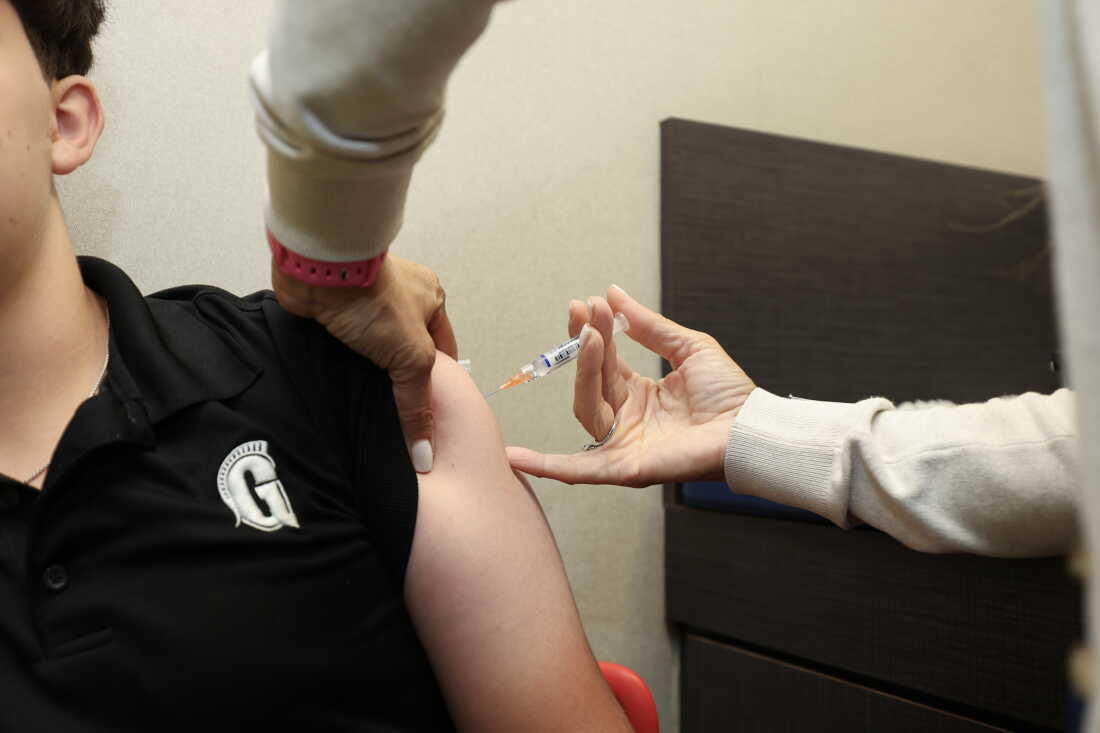

A bandage is seen on a child’s arm after she received a COVID vaccine on November 3, 2021 in Shoreline, Washington. David Ryder/Getty Images hide caption
toggle caption i
David Ryder/Getty Images
The federal government has drastically scaled back the number of recommended childhood immunizations, sidelining six routine vaccines that have safeguarded millions from serious diseases, long-term disability, and death.
This story was produced in partnership with KFF Health News.
Just three of the six immunizations the Centers for Disease Control and Prevention says it will no longer routinely recommend — against hepatitis A, hepatitis B, and rotavirus — have prevented nearly 2 million hospitalizations and more than 90,000 deaths in the past 30 years, according to the CDC’s own publications.
Vaccines against the three diseases, as well as those against respiratory syncytial virus, meningococcal disease, flu, and COVID, are now recommended only for children at high risk of serious illness or after “shared clinical decision-making,” or consultation between doctors and parents.
Sponsor MessageThe CDC maintained its recommendations for 11 childhood vaccines: measles, mumps, and rubella; whooping cough, tetanus, and diphtheria; the bacterial disease known as Hib; pneumonia; polio; chickenpox; and human papillomavirus, or HPV.
Federal and private insurance will still cover vaccines for the diseases the CDC no longer recommends universally, according to a Department of Health and Human Services fact sheet; parents who want to vaccinate their children against those diseases will not have to pay out-of-pocket.
Experts on childhood disease were baffled by the change in guidance. HHS said the changes followed “a scientific review of the underlying science” and were in line with vaccination programs in other developed nations.
HHS Secretary Robert F. Kennedy Jr., an anti-vaccine activist, pointed to Denmark as a model. But the schedules of most European countries are closer to the U.S. standard upended by the new guidance.
For example, Denmark, which does not vaccinate against rotavirus, registers around 1,200 infant and toddler rotavirus hospitalizations a year. That rate, in a country of 6 million, is about the same as it was in the United States before vaccination.
“They’re OK with having 1,200 or 1,300 hospitalized kids, which is the tip of the iceberg in terms of childhood suffering,” said Paul Offit, the director of the Vaccine Education Center at the Children’s Hospital of Philadelphia and a co-inventor of a licensed rotavirus vaccine. “We weren’t. They should be trying to emulate us, not the other way around.”
Sponsor MessagePublic health officials say the new guidance puts the onus on parents to research and understand each childhood vaccine and why it is important.
Here’s a rundown of the diseases the sidelined vaccines prevent:
RSV. Respiratory syncytial virus is the most common cause of hospitalization for infants in the U.S.
The respiratory virus usually spreads in fall and winter and produces cold-like symptoms, though it can be deadly for young children, causing tens of thousands of hospitalizations and hundreds of deaths a year. According to the National Foundation for Infectious Diseases, roughly 80% of children younger than 2 who are hospitalized with RSV have no identifiable risk factors. Long-awaited vaccines against the disease were introduced in 2023.
Hepatitis A. Hepatitis A vaccination, which was phased in beginning in the late 1990s and recommended for all toddlers starting in 2006, has led to a more than 90% drop in the disease since 1996. The foodborne virus, which causes a wretched illness, continues to plague adults, particularly people who are homeless or who abuse drugs or alcohol, with a total of 1,648 cases and 85 deaths reported in 2023.
Hepatitis B. The disease causes liver cancer, cirrhosis, and other serious illnesses and is particularly dangerous when contracted by babies and young children. The hepatitis B virus is transmitted through blood and other bodily fluids, even in microscopic amounts, and can survive on surfaces for a week. From 1990 to 2019, vaccination resulted in a 99% decline in reported cases of acute hepatitis B among children and teens. Liver cancer among American children has also plummeted as a result of universal childhood vaccination. But the hepatitis B virus is still around, with 2,000-3,000 acute cases reported annually among unvaccinated adults. More than 17,000 chronic hepatitis B diagnoses were reported in 2023. The CDC estimates about half of people infected don’t know they have it.
Rotavirus. Before routine administration of the current rotavirus vaccines began in 2006, about 70,000 young children were hospitalized and 50 died every year from the virus. It was known as “winter vomiting syndrome,” said Sean O’Leary, a pediatrician at the University of Colorado. “It was a miserable disease that we hardly see anymore.”
Sponsor MessageThe virus is still common on surfaces that babies touch, however, and “if you lower immunization rates it will once again hospitalize children,” Offit said.
Meningococcal vaccines. These have been required mainly for teenagers and college students, who are notably vulnerable to critical illness caused by the bacteria. About 600 to 1,000 cases of meningococcal disease are reported in the U.S. each year, but it kills more than 10% of those it sickens, and 1 in 5 survivors have permanent disabilities.
Flu and covid. The two respiratory viruses have each killed hundreds of children in recent years — though both tend to be much more severe in older adults. Flu is currently on the upswing in the United States, and last flu season the virus killed 289 children.
What is shared clinical decision-making?
Under the changes, decisions about vaccinating children against influenza, covid, rotavirus, meningococcal disease, and hepatitis A and B will now rely on what officials call “shared clinical decision-making,” meaning families will have to consult with a health care provider to determine whether a vaccine is appropriate.
“It means a provider should have a conversation with the patient to lay out the risks and the benefits and make a decision for that individual person,” said Lori Handy, a pediatric infectious disease specialist at the Children’s Hospital of Philadelphia.
In the past, the CDC used that term only in reference to narrow circumstances, like whether a person in a monogamous relationship needed the HPV vaccine, which prevents a sexually transmitted infection and certain cancers.
The CDC’s new approach doesn’t line up with the science because of the proven protective benefit the vaccines have for the vast majority of the population, Handy said.
In their report justifying the changes, HHS officials Tracy Beth Høeg and Martin Kulldorff said the U.S. vaccination system requires more safety research and more parental choice. Eroding trust in public health caused in part by an overly large vaccine schedule had led more parents to shun vaccination against major threats like measles, they said.
Sponsor MessageThe vaccines on the schedule that the CDC has altered were backed up by extensive safety research when they were evaluated and approved by the FDA.
“They’re held to a safety standard higher than any other medical intervention that we have,” Handy said. “The value of routine recommendations is that it really helps the public understand that this has been vetted upside down and backwards in every which way.”
Eric Ball, a pediatrician in Orange County, Calif., said the change in guidance will cause more confusion among parents who think it means a vaccine’s safety is in question.
“It is critical for public health that recommendations for vaccines are very clear and concise,” Ball said. “Anything to muddy the water is just going to lead to more children getting sick.”
Ball said that instead of focusing on a child’s individual health needs, he often has to spend limited clinic time reassuring parents that vaccines are safe. A “shared clinical decision-making” status for a vaccine has no relationship to safety concerns, but parents may think it does.
HHS’ changes do not affect state vaccination laws and therefore should allow prudent medical practitioners to carry on as before, said Richard Hughes IV, an attorney and a George Washington University lecturer who is leading litigation against Kennedy over vaccine changes.
“You could expect that any pediatrician is going to follow sound evidence and recommend that their patients be vaccinated,” he said. The law protects providers who follow professional care guidelines, he said, and “RSV, meningococcal, and hepatitis remain serious health threats for children in this country.”
This story comes from NPR’s health reporting partnership with KFF Health News, a national newsroom that produces in-depth journalism about health issues. KFF Health News is one of the core operating programs at KFF, the independent source for health policy research, polling, and journalism.
Share this Post
