 Enlarge this image
Abortion-rights protesters march on Market Street in San Francisco on June 24, the day the Supreme Court overturned Roe v. Wade, which provided a federal right to abortion. Josie Lepe/Josie Lepe/AP hide caption
toggle caption
Josie Lepe/Josie Lepe/AP
Abortion-rights protesters march on Market Street in San Francisco on June 24, the day the Supreme Court overturned Roe v. Wade, which provided a federal right to abortion.
Josie Lepe/Josie Lepe/AP
The Nov. 8 election in California includes a ballot measure asking voters whether they should amend the state constitution to explicitly protect abortion rights.
A majority of Californians support reproductive rights, so the measure, known as Proposition 1, is expected to pass. But the Supreme Court’s Dobbs decision last June overturning the federal right to abortion, has increased the urgency and raised the stakes.
But what exactly Californians are voting for isn’t totally clear. Some lawmakers say the amendment would merely enshrine abortion rights in the state, while others say the amendment would expand abortion rights.
This story was produced in partnership with Kaiser Health News.
Current state law allows abortion up to the point of fetal viability, generally about 24 weeks into a pregnancy. But the proposed constitutional amendment doesn’t address the issue of timing, raising the possibility that abortions would be permitted at any point in pregnancy — and, critics contend, permitted for any reason.
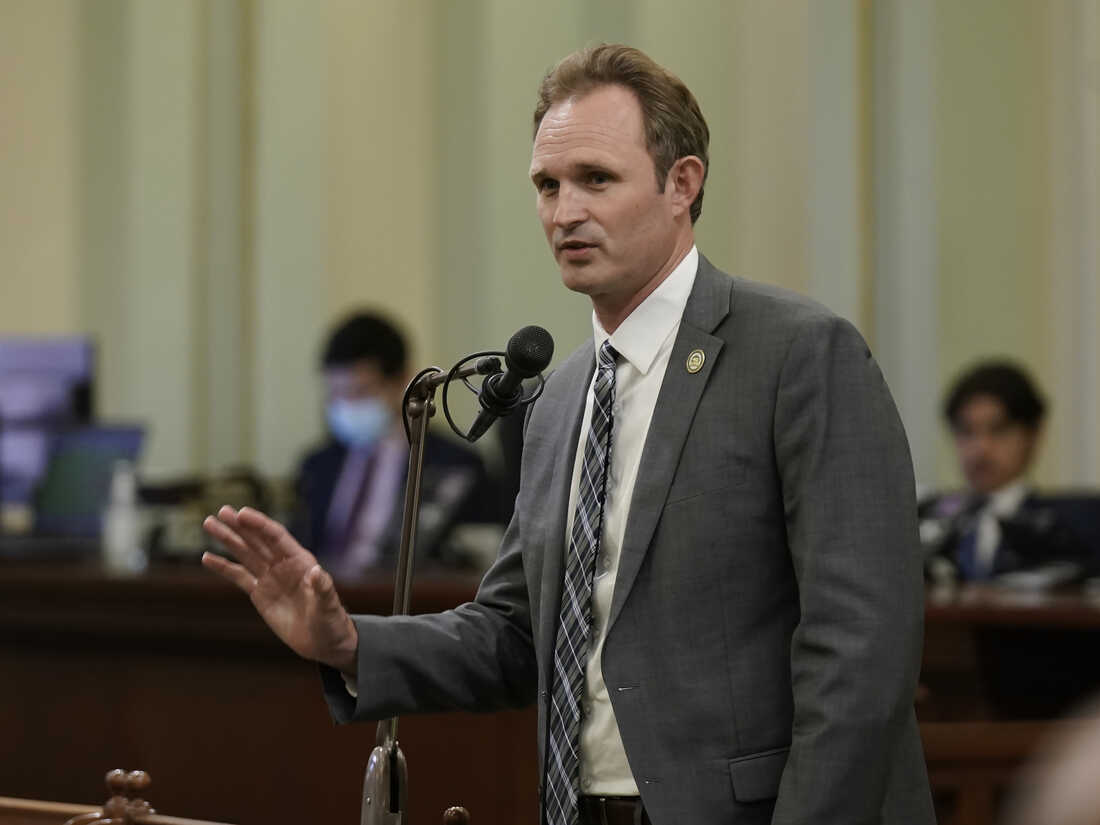
This uncertainty emerged during the legislative debate over the ballot amendment and how it would be worded. There were several awkward moments when Democrats were stumped by this question from Republicans — most notably when Assembly member Kevin Kiley (R-Rocklin) posed the question point-blank before the final Assembly vote in June.
“California law generally bars the performance of an abortion past the point of fetal viability,” Kiley said. “Would this constitutional amendment change that?”
The floor went quiet. For a full 30 seconds, no one said anything.
Assembly Speaker Anthony Rendon whispered with Democratic colleagues, asked to have the question repeated, and then promised to answer later.
He never did.
Enlarge this image
Three Democratic legislators in California just after the June 27 vote to finalize language for a state constitutional amendment supporting reproductive rights. (L-R: State Senate President Pro Tempore Toni Atkins, state Sen. Nancy Skinner, and Assembly Speaker Anthony Rendon) Rich Pedroncelli/AP hide caption
toggle caption
Rich Pedroncelli/AP
Three Democratic legislators in California just after the June 27 vote to finalize language for a state constitutional amendment supporting reproductive rights. (L-R: State Senate President Pro Tempore Toni Atkins, state Sen. Nancy Skinner, and Assembly Speaker Anthony Rendon)
Rich Pedroncelli/AP
Fetal viability has long been a controversial concept, plaguing ethicists on both sides of the abortion debate since it was embedded in the Roe v. Wade decision in 1973.
In that ruling, the Supreme Court justices wrote that a woman’s right to privacy was protected only up to viability — the point when a fetus is capable of “meaningful life outside the mother’s womb.” The court said that occurs between 24 and 28 weeks after conception.
Since then, many doctors have bemoaned the legal and political bastardization of the medical concept, arguing that viability is much more complex than gestational age alone. But the public has clung to it, and both opponents and supporters of abortion rights have looked favorably on restricting access to the procedure later in pregnancy.
Current California law incorporates the viability limit from Roe, allowing abortion for any reason through most of the second trimester, and after that only if the patient’s or fetus’s health is in danger.
But the constitutional amendment outlined in Proposition 1 doesn’t contain the word “viability.” Even among legal scholars, there is no consensus about whether that means the viability standard in place now will remain if Proposition 1 is approved, or if time limits on abortion will be eradicated in California.
“It at least opens the door,” says Mary Ziegler, law professor at the University of California-Davis, with courts likely making the final interpretation of Proposition 1 after the vote, if it’s approved.
The debate over ‘viability’ is revived
When Assembly member James Gallagher (R-Chico) spoke during the final floor debate in June, his voice wavered with emotion. He could not support the constitutional amendment, he said, “because of what’s missing from it.”
He choked up at one point talking about his twin boys, who were born 2½ months premature and almost needed heart surgery in utero. “They were alive, and they were people,” he repeated throughout his speech, pointing at the lectern for emphasis each time, as he recounted his wife’s pregnancy at 18 weeks, 23 weeks, and 30 weeks.
Enlarge this image
California Assemblyman James Gallagher, the Republican minority leader, called on lawmakers to reject the proposed constitutional amendment on abortion rights for the November ballot, during a final debate on June 27 at the Capitol in Sacramento, Calif. Rich Pedroncelli/AP hide caption
toggle caption
Rich Pedroncelli/AP
California Assemblyman James Gallagher, the Republican minority leader, called on lawmakers to reject the proposed constitutional amendment on abortion rights for the November ballot, during a final debate on June 27 at the Capitol in Sacramento, Calif.
Rich Pedroncelli/AP
Without any time limits on abortion, Gallagher said, the amendment got the balance wrong between the rights of the mother and the fetus.
“We can do better,” he said.
Proponents of Proposition 1 have said the intention was only to preserve the status quo. But in various committee hearings, supporters at times seemed confused by the language of their own bill and scrambled to answer definitively when asked whether the amendment would preserve the viability limit or discard it.
But physicians involved in drafting the amendment, like Dr. Pratima Gupta, said no mistake was made: The word viability was left out on purpose.
“Every pregnancy is individual, and it’s a continuum,” says Gupta, an OB-GYN in San Diego. People come into pregnancy with a range of preexisting health conditions, including diabetes, anemia, high blood pressure, and obesity, she explains. They may not have much money or access to good medical care, with the latest technology. All these very nuanced factors determine whether a fetus is viable, she says, not some arbitrary number.
“If I see a patient who has broken their bag of water at 23 weeks of pregnancy, that doesn’t mean that it’s viable or not viable,” Gupta says, explaining that the fetus may survive premature delivery at this stage in some cases, but not in others.
Doctors who consulted on the amendment were following the lead of the American College of Obstetricians and Gynecologists, the leading advisory group for OB-GYNs, which removed the term viability from its guidance on abortion in May. The group explained that the term has become so politicized that it barely has any medical meaning anymore, and deciding whether and when to have an abortion should be left to the patient and doctor.
Strangely, the demise of Roe v. Wade has freed doctors from the vagaries of the viability framework, as it was outlined in that ruling.
“In a world where there is no Roe, I think you’re seeing California legislators trying to write into law a kind of blank slate, a better idea of what reproductive autonomy could be that isn’t just Roe Part 2,” Ziegler says.
Why women get abortions later in pregnancy
In recent years, at least three other states — Colorado, New Jersey, and Vermont — and Washington, D.C., have removed gestational age limits from their abortion laws.
Abortion opponents argue that if California follows suit, it will be a free-for-all, with women lining up for abortions when they’re eight months pregnant.
“We already currently have abortion up to 24 weeks. Why do we need to push it beyond that?” says Jonathan Keller, president and CEO of the California Family Council, a religious nonprofit. “Aren’t we able to say that that is a step too far, even for California?”
Research indicates such scenarios are highly unlikely. Abortions at or after 21 weeks represent only 1.2% of all abortions, according to data from the Centers for Disease Control and Prevention. And studies show the reasons women seek abortions at that point vary, from medical complications that threaten the life of the patient or fetus to, increasingly, legal and logistical barriers.
“It may be that they’re delayed because there are lots of restrictions they have to comply with; it may be because they need to travel for an abortion,” says Elizabeth Nash, a policy analyst at the Guttmacher Institute, a research organization that supports abortion rights. “It may be that they can’t get time off of work. Or, it was a wanted pregnancy and something happened.”
Still, even in California, which positions itself as an abortion sanctuary, voters become more uncomfortable with the procedure the later a pregnancy gets. An August poll found that only 13% of likely voters said they were OK with abortion through the third trimester.
But a different poll found that on the question of securing abortion rights in general, 71% of California voters said they would vote for Proposition 1.
“The politics of viability have changed,” law professor Ziegler says.
With the Supreme Court toppling the federal right to abortion, and more than half the states banning or trying to ban the procedure, Ziegler says “these viability arguments — that had obviously been compelling for decades — don’t land the same way.”
The polls indicate that California voters are not inclined to nitpick. Ziegler predicted they’ll accept the ambiguity in Proposition 1, and then let the courts sort out the details later.
This story comes from NPR’s reporting partnership with KQED and KHN (Kaiser Health News).
Share this Post
