 Enlarge this image
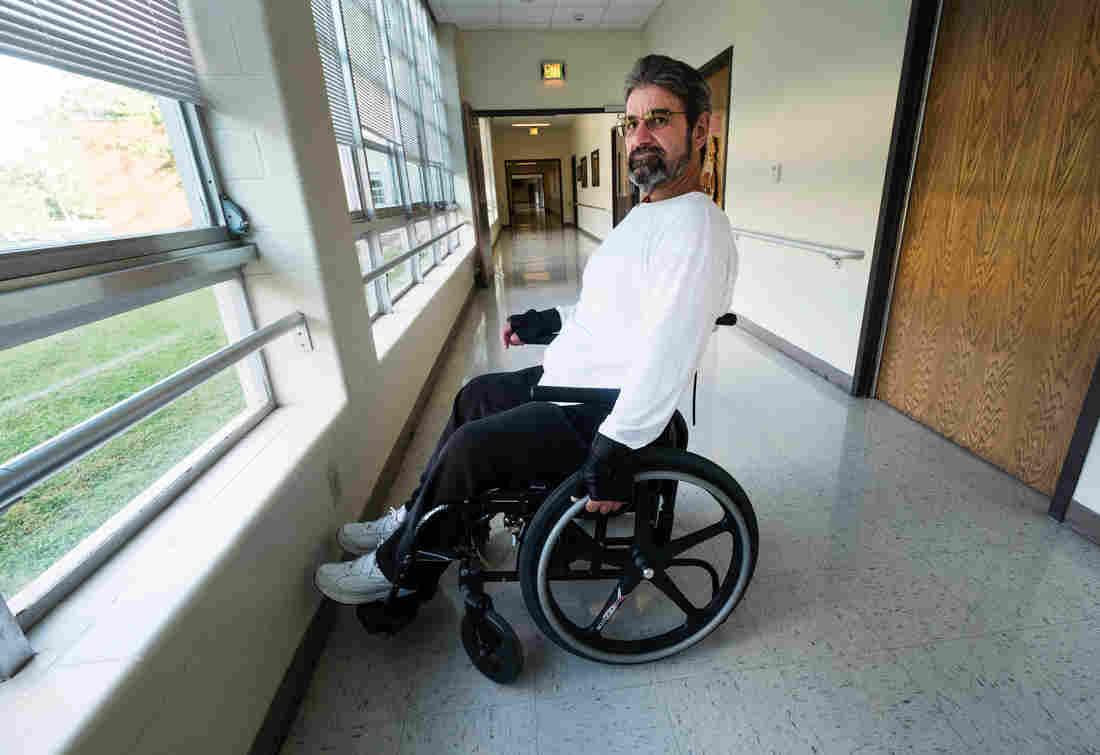
Francis Brauner was instrumental in helping launch a class-action lawsuit on behalf of current inmates at Louisiana’s Angola prison, suing for care that allegedly caused them “needless pain and suffering.” Charles A. Smith hide caption
toggle caption
Charles A. Smith
Francis Brauner was instrumental in helping launch a class-action lawsuit on behalf of current inmates at Louisiana’s Angola prison, suing for care that allegedly caused them “needless pain and suffering.”
Charles A. Smith
In 2005, Francis Brauner was a quarter of the way through a 20-year prison sentence at Dixon Correctional Institute in Louisiana, when he had an accident.
Brauner was imprisoned for a rape conviction, which he maintains was wrongful and part of a setup by a corrupt judge.
His sentence involved hard labor, and one day he was out in the fields, cutting the grass and he bent over to pick something up from the ground. He felt a sharp pain in his back.
“There’s no words to describe how bad the pain was, really,” he says. A few days later, it got worse. “It felt like I was hit by a bolt of lightning or something, I mean the pain just shot from my head to my toes.”
Years before, he’d been in a car accident, so it was not the first time he had had back trouble. But this time, he could barely stand up.
Prison authorities rushed him to Charity Hospital in New Orleans, but then Hurricane Katrina struck. In the chaos, Brauner found himself re-routed to Louisiana State Penitentiary, better known as Angola prison. There he was told he’d find a larger facility with better resources to treat inmates needing medical attention. But he says he was denied the surgery that might have helped.
Instead, when he arrived he was left in a bed for a month, largely unattended. He developed wounds on his backside that became so infected, they nearly killed him.
“My wounds got severe,” says Brauner, showing a photo of a large, circular gash on his backside. “It actually ate all of my muscle tissue and left gaping open wounds.”
Brauner became paralyzed from the waist down and was stationed in the hospital ward of Angola prison.
Lapses in care
Angola prison is the largest maximum security prison in the country. There are over 6,000 men incarcerated there, most of them serving life sentences.
The prison is more than 130 miles from New Orleans. Because of its remote location, most of the medical needs of the inmates are met by a small team of doctors, nurses and EMTs who also live on the grounds.
Brauner started to notice that the medical staff were careless about their treatment. He decided to keep a journal to record what he perceived as lapses in medical care.
“I started documenting,” Brauner says. “Everything that they did, that they said, day by day. I documented every day.” If a nurse gave out the wrong medication, he wrote that down. If a doctor failed to order a biopsy, he entered it in his journal.
That documentation was shared with Nick Trenticosta, a lawyer who represents death penalty cases and was visiting Brauner for an unrelated case. Even though Trenticosta has been going to the prison practically every month for the past three decades, he didn’t recall ever seeing the hospital ward before. He was shocked.
“There were open garbage containers,” Trenticosta recounted. “Fly tape hanging from the ceiling with a lot of dead flies on it. Over men’s beds who had open bedsores.”
Taking legal action
Since then, the number of complaints about the medical care has increased. Then in 2015, a lawsuit was filed, Lewis v. Cain, accusing Angola prison of causing “needless pain and suffering.” Late last month, Judge Shelly Dick said the case could proceed as a class action lawsuit on behalf of Angola’s prisoners.
After repeated requests, the prison’s lawyers would not comment. So to understand how the hospital ward works from the inside, we contacted former employees like Sandy Netherland-Roberts, a paramedic at Angola prison who later ran the hospice.
“Budgetary wise, medical-wise, the place gives awesome care,” Netherland-Roberts says. “Do I feel that there is a better health care there than some people get in the outside world? One hundred percent.”
According to Dr. Tobe Momah, who worked there for a year, many challenges stem from how long the men stay at Angola.
Related NPR Stories
Arizona Prisons Face Federal Sanctions Over Prisoners’ Health Care“They’re going to be there for 40, 50 years, so they’re going to develop cancer, hypertension, diabetes…” Momah says. “So every time they have a need that is outside the scope of us five doctors, they have to leave the site.”
Investigations
Lawsuit Says Lewisburg Prison Counsels Prisoners With Crossword Puzzles
Leaving the site is prohibitively expensive. And it’s costing the prison even more since Louisiana overhauled its safety net hospital system. Momah says under the circumstances, the medical staff was doing their best to care for the prison’s 6,000-plus inmates.
“Well, I don’t know what he means by ‘the circumstances,’ ” says Nick Trenticosta, the lawyer, of Momah’s assessment. “If ‘the circumstances’ means, ‘We don’t have proper medication. We don’t have proper equipment. But we do the best we can,’ It’s like talking like a MASH unit. You know?”
Prisoners are the only group in the United States who have a constitutional right to health care. At the core of this lawsuit is the question of what quality of health care prisoners deserve. To Dr. Momah, that is not up for debate.
“The first law of medicine is, serve humanity irrespective of who they are,” says Dr. Momah. “So no doctor, as far as I know, will diminish care based on a person’s crime.”
As resources have dried up, however, the prison is struggling to provide even basic care. The lawsuit demands more oversight, reforms and a bigger budget for medical care.
As for Francis Brauner, he says that most of the men he was with on the chronic care ward at Angola prison have passed away. He was lucky.
“I mean… I’m not sentenced to death and that’s the bottom line,” Brauner says. “I’m not sentenced to death.”
Since finishing his sentence in 2015, Brauner has been living at a medical facility not far from the prison, waiting for surgery to help heal his wounds.
This story was produced in collaboration with In These Times, and Katie Rose Quandt’s reporting was made possible by a grant from the Leonard C. Goodman Institute for Investigative Reporting.
Share this Post
