 Enlarge this image
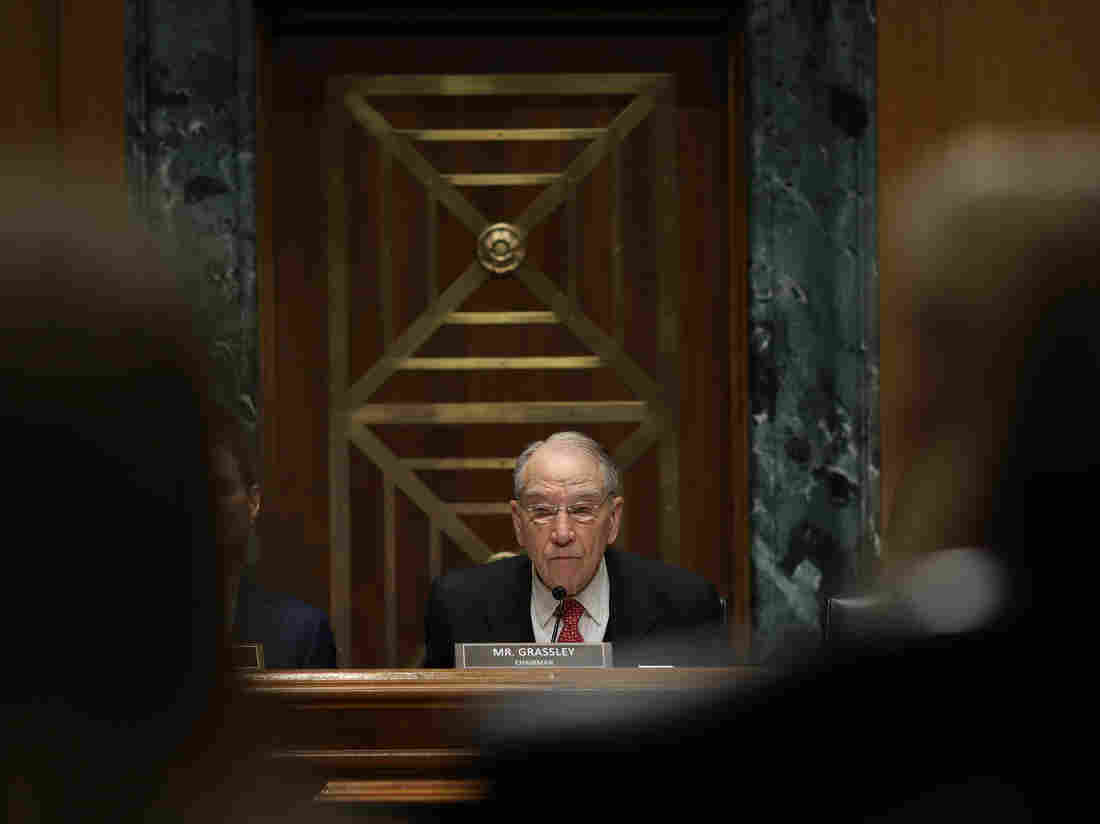
Sen. Chuck Grassley, R-Iowa, will lead the Senate Finance Committee’s questioning Tuesday of executives from pharmacy benefit managers about drug costs. Win McNamee/Getty Images hide caption
toggle caption
Win McNamee/Getty Images
Sen. Chuck Grassley, R-Iowa, will lead the Senate Finance Committee’s questioning Tuesday of executives from pharmacy benefit managers about drug costs.
Win McNamee/Getty Images
Consumers, lawmakers and industry players all seem to agree that prescription drugs prices are too high. What they can’t always agree on is whom to blame.
On Tuesday, though, fingers are expected to point toward pharmacy benefit managers, the industry’s mysterious middlemen.
The Senate Finance Committee will hear from executives from the biggest pharmacy benefit managers, led by CVS Caremark and Cigna’s Express Scripts.
“They’re kind of a secret organization,” says Sen. Chuck Grassley, R-Iowa, of the pharmacy benefit managers. “I ask people to explain what they’re doing and nobody seems to give you the same answer twice.” Grassley is chairman of the Finance Committee and Tuesday’s hearing is its third on drug prices this year.
Pharmacy benefit managers, or PBMs, manage prescription drug benefits for insurance companies and employers. And because they control the medication purchases of millions of patients, they are tremendously powerful.
“They exist only because pharmaceutical prices got so high and they were a way to get some market power in there that was on the consumer side,” says Len Nichols, a health economist at George Mason University. “Now they’ve become so big and dominant that they are hurting pharma.”
Shots – Health News
VIDEO: Little-Known Middlemen Save Money On Medicines — But Maybe Not For You
How dominant? CVS Caremark negotiates drug prices, copayments and which drugs are preferred options for more than 92 million people in the U.S. Express Scripts covers another 83 million.
The companies are hired by insurance companies, or self-insured employers, to control spending on prescription drugs. The PBMs negotiate discounts with pharmaceutical manufacturers, but those discounts come in the form of confidential rebates that are paid to the PBMs after the drugs are purchased.
PBMs pass most of the rebates on to their clients, but they often keep a slice for themselves.
The PBMs dispute that they are withholding savings from their clients. “While drug manufacturers would have people believe that PBMs are retaining these discounts, virtually all rebates and discounts are passed on to clients,” said Tom Moriarty, executive vice president at CVS Health, in a February speech.
Some analyses show that PBMs actually do help reduce drugs prices.
“PBMs have saved money over the last decade by encouraging use of generics,” says Dr. Walid Gellad, director of the Center for Pharmaceutical Policy and Prescribing at the University of Pittsburgh.
A report from SSR Health, an investment research firm, says the net prices of brand-name prescription drugs fell 4.8 percent in the last quarter of 2018, even while list prices rose 4 percent. The declines came as pharmacy benefit managers refused to pay for some drugs altogether, opting for a competing brand that offered a better price.
Gellad says that evidence is murky, because the rebate system means that many drugs start at prices that are artificially high.
But critics say the system creates perverse incentives for drugmakers to set high prices for their products so they can offer larger percentage rebates. And they say sometimes PBMs benefit more when patients buy expensive drugs than when they buy cheaper ones.
Now the entire business model is under attack. Health and Human Services Secretary Alex Azar in February proposed eliminating the rebate system that underpins the work of companies like CVS Caremark and Express Scripts.
Instead, Azar proposed, the companies would use their market power to negotiate discounts from drugmakers upfront that would be passed on in full to patients.
In comments on HHS’ proposal to get rid of rebates, CVS said drugmakers — not PBMs — are to blame. “Our data show that it is not rebates that are causing drug prices to soar and, in fact, list price is increasing at a faster rate for many drugs with small rebates than for drugs with substantial rebates,” CVS wrote. “The elimination of rebates may not only lead to higher net drug prices, but will undoubtedly lead to higher premiums across the Medicare Part D program.”
Tuesday’s hearing comes six weeks after the leaders of seven pharmaceutical manufacturers appeared before the same committee to defend their pricing practices.
Those CEOs acknowledged that their prices are high for many patients, but they deflected blame onto pharmacy benefit managers.
“We want these rebates, which lower net prices, to benefit patients,” said Olivier Brandicourt, CEO of Sanofi, which makes Lantus, one of the highest priced brands of insulin. Its list price has risen from $244 to $431 since 2013, according to the committee.
Shots – Health News
‘We’re Fighting For Our Lives’: Patients Protest Sky-High Insulin Prices
“Unfortunately, under the current system, savings from rebates are not consistently passed through to patients in the form of lower deductibles, co-payments or coinsurance amounts,” Brandicourt said in testimony prepared for the hearing.
Sen. Ron Wyden, D-Oregon, who is the ranking member of the Finance Committee, had harsh words for the drug makers at the February hearing.
“I think you and others in the industry are stonewalling on the key issue, which is actually lowering list prices,” he said. “Lowering those list prices is the easiest way for consumers to pay less at the pharmacy counter.”
Grassley is also frustrated.
“The pharmaceutical companies pointed the finger at the PBMs. The PBMs point their finger at the pharmaceuticals. And then both of those are pointing their fingers at the at the health insurance companies,” Grassley said.
“I’m not announcing another hearing,” he continued. “But it might be that if we get this finger-pointing going on all the time, we may want to get those three groups all at the same table to stop the finger-pointing.”
Share this Post
