 Enlarge this image
Biophysicist He Jiankui addressed the last international summit on human genome editing in Hong Kong in 2018. His experiments in altering the genetic makeup of human embryos was widely condemned by scientists and ethicists at the time, and still casts a long shadow over this week’s summit in London. Anthony Wallace/AFP via Getty Images hide caption
toggle caption
Anthony Wallace/AFP via Getty Images
Biophysicist He Jiankui addressed the last international summit on human genome editing in Hong Kong in 2018. His experiments in altering the genetic makeup of human embryos was widely condemned by scientists and ethicists at the time, and still casts a long shadow over this week’s summit in London.
Anthony Wallace/AFP via Getty Images
Hundreds of scientists, doctors, bioethicists, patients, and others started gathering in London Monday for the Third International Summit on Human Genome Editing. The summit this week will debate and possibly issue recommendations about the thorny issues raised by powerful new gene-editing technologies.
The last time the world’s scientists gathered to debate the pros and cons of gene-editing — in Hong Kong in late 2018 — He Jiankui, a biophysicist and researcher at Southern University of Science and Technology in Shenzhen, China, shocked his audience with a bombshell announcement. He had created the first gene-edited babies, he told the crowd — twin girls born from embryos he had modified using the gene-editing technique CRISPR.
He, who had trained at Rice University and Stanford, said he did it in hopes of protecting the girls from getting infected with the virus that causes AIDS. (The girls’ father was HIV-positive.) But his announcement was immediately condemned as irresponsible human experimentation. Far too little research had been done, critics said, to know if altering the genetics of embryos in this way was safe. He ultimately was sentenced by a Chinese court to three years in prison for violating medical regulations.
In the more than four years since He’s stunning announcement, scientists have continued to hone their gene-editing powers.
“A lot has happened over the last five years. It’s been a busy period,” says Robin Lovell-Badge from the Francis Crick Institute in London, who led the committee convening the new summit.
Doctors have made advances using CRISPR to try to treat or better understand many diseases, including devastating disorders like sickle cell disease, and conditions like heart disease and cancer that are even more common and influenced by genetics.
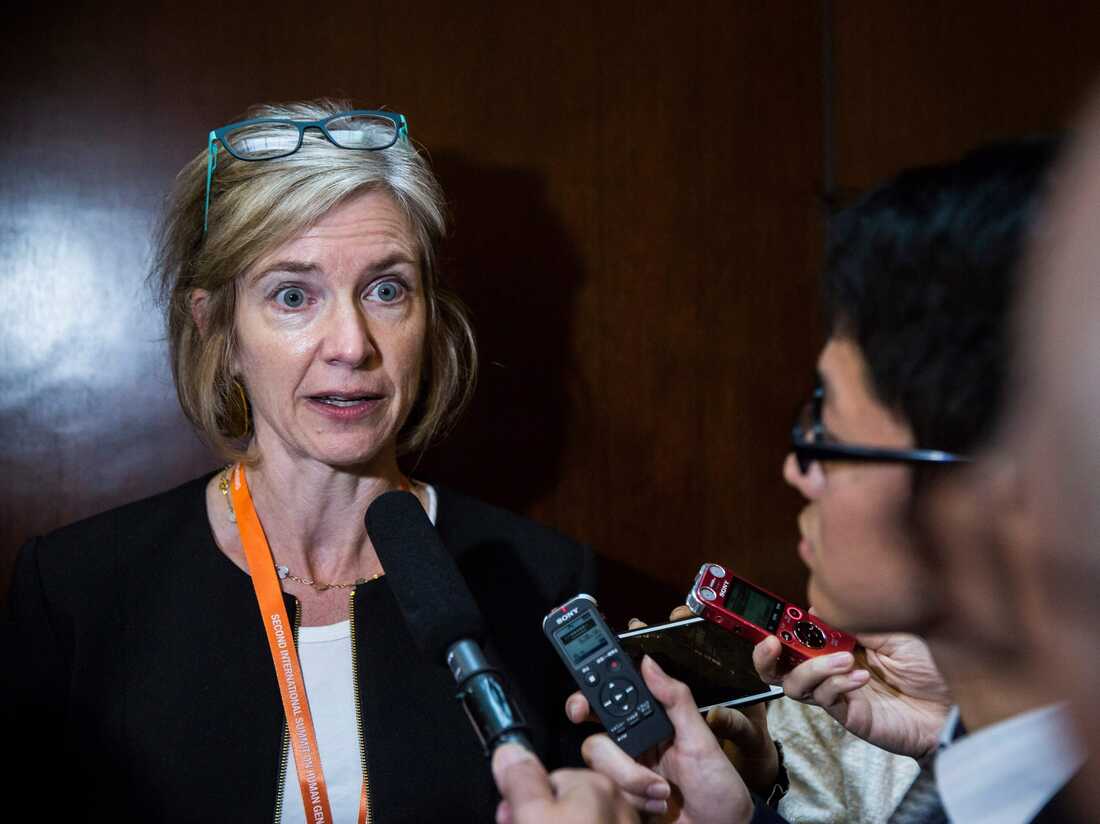
Enlarge this image
Jennifer Doudna, a biochemist at the University of California, Berkeley and one of the pioneers in the discovery and use of CRISPR, speaking with reporters at the scientific summit in Hong Kong in 2018. Despite exciting advances, genome-editing still faces technical and ethical challenges, she says. Isaac Lawrence/AFP via Getty Images hide caption
toggle caption
Isaac Lawrence/AFP via Getty Images
Jennifer Doudna, a biochemist at the University of California, Berkeley and one of the pioneers in the discovery and use of CRISPR, speaking with reporters at the scientific summit in Hong Kong in 2018. Despite exciting advances, genome-editing still faces technical and ethical challenges, she says.
Isaac Lawrence/AFP via Getty Images
In recent years, scientists have produced new evidence about the risks and possible shortcomings of gene-editing, while also developing more sophisticated techniques that could be safer and more precise.
“We’re at an exciting moment for sure with genome-editing,” says Jennifer Doudna at the University of California, Berkeley, who helped discover CRISPR. “At the same time, we certainly have challenges.”
“We could help a lot of people”
One big remaining challenge and ethical question is whether scientists should ever again try to make gene-edited babies by modifying the DNA in human sperm, eggs or embryos. Such techniques, if successful could help families that have been plagued by devastating genetic disorders.
“There are more than 10,000 single genetic mutations that collectively affect probably hundreds of million of people around the world,” says Shoukhrat Mitalipov, a biologist at the Oregon Health and Science University in Portland who’s been trying to find ways to safely gene-edit human embryos. “We could help a lot of people.”
Shots – Health News
A Year In, 1st Patient To Get Gene Editing For Sickle Cell Disease Is Thriving
But the fear is a mistake could create new genetic diseases that could then be passed down for generations. Some scientists are also concerned about opening a slippery slope to “designer babies” — children whose parents try to pick and choose their traits.
“If we were to allow parents to genetically modify their children, we would be creating new groups of people who are different from each other biologically and some would have been modified in ways that are supposed to enhance them,” says Marcy Darnovsky heads the Center for Genetics and Society in San Francisco. “And they would be — unfortunately I think — considered an enhanced race — a better group of people. And I think that could really just super-charge the inequities we already have in our world.”
The debate among many scientists seems to have shifted to how to edit a genome safely
Despite those concerns, some critics say the debate over the last five years has shifted from whether a prohibition on inheritable genetic modifications should ever be lifted to what technical hurdles need to be overcome to do it safely — and which diseases doctors might try to eradicate.
As evidence of that, the critics point to the fact that the subject of genetically modifying embryos, sperm or eggs to engineer modifications that would then be passed along to every subsequent generation is the focus of only one of three days of this summit — the first such conference since the CRISPR babies were announced.
“This is quite an ironic outcome,” says Sheila Jasanoff is a professor of science and technology studies at Harvard’s Kennedy School of Government.
Shots – Health News
New U.S. Experiments Aim To Create Gene-Edited Human Embryos
“Instead of rejuvenating the calls to say: ‘We should be much more careful,’ ” Jasanoff says, “it was as if the whole scientific community heaved a kind of sigh of relief and said: ‘Well, look, of course there are limits. This guy has transgressed the limits. He’s clearly outside the limits. And therefore everything else is now open for grabs. And therefore the problem before us now is to make sure that we lay out the guidelines and the rules.'”
Ben Hurlbut, a bioethicist at Arizona State University, agrees.
“There was a time when this was considered taboo,” he says. “But since the last summit, there’s been a shift from asking the question of ‘whether’ to asking the question of ‘how.’ “
It was too easy to scapegoat He, some ethicists say
Hurlbut and others also say scientists have failed to fully come to terms with the high-pressure environment of biomedical research that they say encouraged He to do what he did.
“It just feels easier to condemn He and say all bad resides in his person and he should be ostracized forever as we proceed apace. Not reckoning with what happened and why fosters a certain thoughtlessness, and I would say recklessness,” Hurlbut says.
Shots – Health News
2 Chinese Babies With Edited Genes May Face Higher Risk Of Premature Death
Shots – Health News
A Russian Biologist Wants To Create More Gene-Edited Babies
That lack of reckoning with what happened could be dangerous, critics say. It could, they fear, encourage others to try make more gene-edited babies, at a time when the public may never have been more skeptical about scientific experts.
“We have seen in recent years a sense that the experts have taken on too big a role and that they have tried to run roughshod over our our day-to day-lives,” says Hank Greely, a longtime Stanford University bioethicist. But whether or not inheritable genetic modifications should be allowed is “ultimately a decision for societies and not a decision for science.”
A new lab in Beijing
Meanwhile, He Jiankui appears to be trying to rehabilitate himself after serving his three-year prison sentence. He’s set up a new lab in Beijing, is promising to develop new gene-therapies for diseases like muscular dystrophy, is giving scientific presentations, and is trying to raise money.
He’s not expected to join the London summit this week, and is no longer talking about creating more gene-edited babies. Still, his activities are raising alarm in the scientific and bioethics communities. He declined NPR’s request for an interview. But in a recently published interview with The Guardian the only regret he mentioned was in moving too fast.
“I’m concerned,” Lovell-Badge says. “I’m surprised that that he’s being allowed to practice science again. It just scares me.”
Others agree.
“What he did was atrocious,” says Dr. Kiran Musunuru, a professor of medicine at the University of Pennsylvania. “He shouldn’t be allowed anywhere near a patient again. He’s proven himself to be utterly unqualified.”
Lovell-Badge and other organizers of the summit dispute criticisms that scientists are assuming gene-edited babies are inevitable and that the agenda for this week’s conference short-changes a debate about the ethical and societal landmines that remain in this field of study.
Shots – Health News
Gene Therapy Shows Promise For Hemophilia, But Could Be Most Expensive U.S. Drug Ever
Summit leaders say they’ll dedicate the last day of the meeting to genetic modifications that can be passed down through generations; panel participants will feature scientists as well as a broad array of watchdog groups, patient advocates, bioethicists, sociologists and others.
Conference organizers say they have good reasons for focusing the first two-thirds of the meeting on the use of gene-editing to treat people who have already been born.
“The summit is a chance to really hear about what’s happening in the field that has the greatest potential for improving human health,” says R. Alta Charo, a professor emerta of law and bioethics from the University of Wisconsin, who helped organize the summit.
Questions of equity have moved center stage
But those current treatments raise their own ethical concerns — including questions of equity. Will the the current and coming gene therapies be widely available, given how expensive and technologically complicated they can be to create and administer?
Goats and Soda
Why Astronomical Drug Prices Are Bad For Health — And Profits
“We’re not moving away from the conversation around heritable genome editing, but we are trying to shift some of that focus,” says Francoise Baylis, a bioethicist who recently retired from Dalhousie University in Canada and helped plan the meeting. “Really important in this context is the issue of cost, because we have been seeing gene-therapies come onto the market with million-dollar price tags. That’s not going to be available to the average person.”
The availability of gene-therapy treatments in lower-income countries must be a focus of concern, Baylis says.
“We’re going to be asking questions about where are the people who are most likely to be benefit,” she says, “and are they going to have access?”
Share this Post
