 Enlarge this image
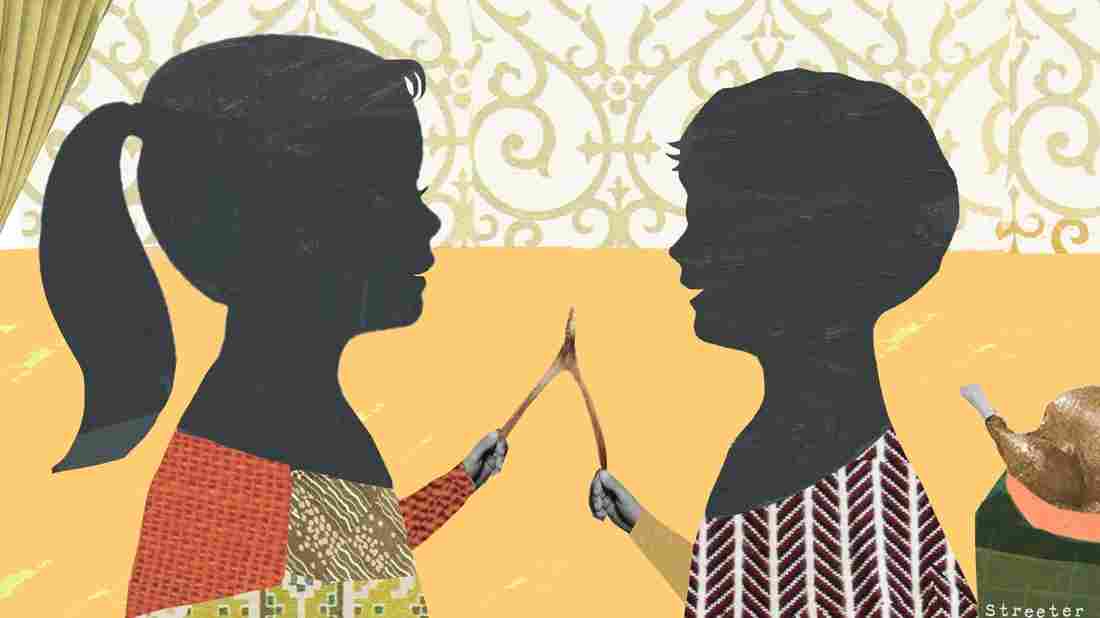
Katherine Streeter for NPR
Somehow we’re squeezing 18 people into our apartment for Thanksgiving this year, a year when too many people are worrying about fraught post-election conversations. My relatives, who luckily are all cut from the same political cloth, range in age from my mother, aged 92, to my 32-year-old nephew (my 17-month-old granddaughter’s political leanings are still unfolding.)
I love them all, but in a way the one I know best is the middle-aged man across the table whose blue eyes look just like mine: my younger brother Paul.
Paul and I irritated each other when we were kids; I would take bites out of his precisely made sandwiches in just the spot I knew he didn’t want me to, and he would hang around the living room telling jokes when he knew I wanted to be alone with the boy on the couch.
But as adults we’ve always had each other’s backs, especially when it comes to dealing with our mother’s health crises, which have become more frequent in the past few years. Paul is the first person I want to talk to when there’s something that worries me about Mom; I know he’ll be worried, too.
Article continues after sponsorshipThere’s probably a biological explanation for the intensity of the sibling bond. Siblings share half their genes, which evolutionary biologists say should be motivation enough for mutual devotion. “I would lay down my life,” British biologist J.B.S. Haldane once said, applying the arithmetic of kin selection, “for two brothers or eight cousins.” Siblings are a crucial part of a child’s development, too, teaching one another socialization skills and the rules of dominance and hierarchy, all part of the eternal struggle for parental resources.
When psychologists study siblings, they usually study children, emphasizing sibling rivalry and the fact that brothers and sisters refine their social maneuvering skills on one another. The adult sibling relationship has only sporadically been the subject of attention. Yet we’re tethered to our brothers and sisters as adults far longer than we are as children; our sibling relationships, in fact, are the longest-lasting family ties we have.
Most such relationships are close — two-thirds of people in one large study said a brother or sister was one of their best friends. One thing that can scuttle closeness in adulthood is a parent who played favorites in childhood; this sense of resentment can last a lifetime.
Jill Suitor, a sociologist at Purdue University, and her colleagues polled 274 families with 708 adult children (ages 23 to 68) in 2009 and found that the majority had good feelings toward their siblings. Most didn’t remember much favoritism when they were kids, but those who did reported feeling less loved and cared for by their siblings. It didn’t matter whether they felt themselves to be the favored or the unfavored child. The simple perception of parental favoritism was enough to undermine their relationship.
That’s one thing Paul and I have going for us: We’re pretty sure our parents treated us the same when we were growing up. Yet we’re very different people. Paul is gregarious while I’m shy, funny while I’m not, a terrific amateur saxophonist while I can’t read music or carry a tune. This isn’t unusual. In families with more than one child, every sibling seems to get a label in contrast to every other sibling.
So if your kid sister is the queen bee in any social gathering, you might get labeled “the quiet one” even if you’re not especially quiet, just quiet in comparison. And if you’re a bright child who always gets good grades, you might not get much credit for that if your big brother is a brilliant child with straight A’s. There’s only room for one “smart one” per family — you’ll have to come up with something else. (I was smart, but Paul was smarter; I ended up being the “good one.”)
The very presence of siblings in the household can be an education. When a new baby is born, writes psychologist Victor Cicirelli in the 1995 book Sibling Relationships Across the Life Span, “the older sibling gains in social skills in interacting with the younger” and “the younger sibling gains cognitively by imitating the older.”
They learn from the friction between them, too, as they fight for their parents’ attention. Mild conflict between brothers and sisters teaches them how to interact with peers, co-workers and friends for the rest of their lives.
The benefits can carry into old age. The literature on sibling relationships shows that during middle age and old age, indicators of well-being — mood, health, morale, stress, depression, loneliness, life satisfaction — are tied to how you feel about your brothers and sisters.
In one Swedish study, satisfaction with sibling contact in one’s 80s was closely correlated with health and positive mood — more so than was satisfaction with friendships or relationships with adult children. And loneliness was eased for older people in a supportive relationship with their siblings, no matter whether they gave or got support.
That’s why it’s so sad when things between siblings fall apart. This often happens when aging parents need care or die — old feelings of rivalry, jealousy and grief erupt all over again, masked as petty fights ostensibly over who takes Mom to the doctor or who calls the nursing home about Dad.
Many families get through their parents’ illnesses just fine, establishing networks where the workload is divided pretty much equally. So far, Paul and I have done fine, too. But about 40 percent of the time, according to one study, there is a single primary caregiver who feels like she (and it’s almost always a she) is not getting any help from her brothers and sisters, which can lead to serious conflict.
And because of the particular intensity of sibling relationships, such conflict cuts to the bone. People grieve for the frayed ties to their siblings as though they’ve lost a piece of themselves.
Throughout adulthood, the sibling relationship “is powerful and never static,” said Jane Mersky Leder, author of The Sibling Connection. Whether we are close to our siblings or distant, she writes, they remain our brothers and sisters — for better or for worse.
So let this all percolate as you sit down to turkey with your sometimes-complicated family. And remember the immortal words of folksinger Loudon Wainwright III, in a song called Thanksgiving. It’s about spending the holiday with a brother and a sister he rarely sees but still has intense feelings about:
On this auspicious occasion, this special family dinner
If I argue with a loved one, Lord, please make me the winner.
Science writer Robin Marantz Henig is a contributing writer for The New York Times Magazine and the author of nine books. This is an updated version of an article that we originally published on Nov. 27, 2014.
Share this Post
