 Enlarge this image
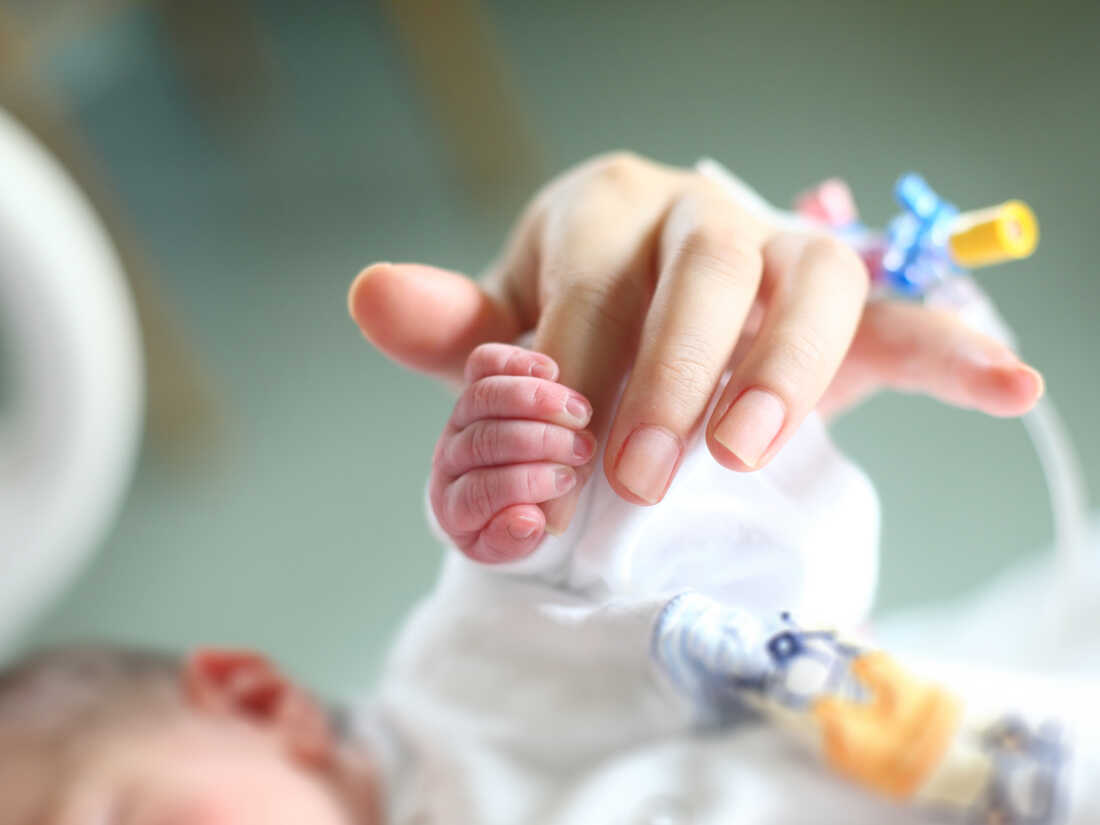
The new analysis of death certificates says the U.S. maternal mortality rate is in line with other wealthy countries, contradicting an earlier report from the CDC. muratkoc/Getty Images hide caption
toggle caption
muratkoc/Getty Images
The new analysis of death certificates says the U.S. maternal mortality rate is in line with other wealthy countries, contradicting an earlier report from the CDC.
muratkoc/Getty Images
This story has been updated to include additional comment from the Centers for Disease Control and Prevention.
The CDC’s National Center for Health Statistics’ most recent report put the U.S. maternal mortality rate at a whopping 32.9 deaths per 100,000 births. That number garnered a great deal of attention, including being covered by NPR and other news outlets.
A new study suggests the national U.S. maternal mortality rate is actually much lower than that: 10.4 deaths per 100,000 births.
The widely reported issue of racial disparities in U.S. maternal mortality persists, even with the lower overall rate. Black pregnant patients are still three times more likely to die than white patients, according to data in the study published in the American Journal of Obstetrics and Gynecology on Wednesday.
“We have to prevent these deaths,” says K.S. Joseph, a physician and epidemiologist in the OB-GYN department of the University of British Columbia. Joseph is the lead author of the peer-reviewed paper. “Even if we say that the rate is 10 per 100,000 and not 30 per 100,000, it does not mean that we have to stop trying.”
The fact that the rate of maternal mortality in the U.S. seems to have been significantly inflated may be disconcerting. Experts NPR spoke with about the data explain that measuring maternal deaths is complex, and that CDC was not intentionally misleading the public. They also emphasize that most maternal deaths are preventable.
Shots – Health News
Health department medical detectives find 84% of U.S. maternal deaths are preventable
The trouble with the data started about 20 years ago, when the national death certificate was updated to include a pregnancy checkbox that the person certifying someone’s death could tick. This checkbox created problems, which CDC analysts have acknowledged in their own papers, and changes were made in 2018 to CDC’s methods for calculating maternal deaths. But Joseph and other researchers suspected the data was still not reliable.
“We felt that the pregnancy checkbox was misclassifying a lot of such deaths and adding them to maternal deaths,” he explains.
In the new paper, Joseph and colleagues redid the CDC’s National Center for Health Statistics analysis of data from 1999-2002 and 2018-2021, skipping over years when the data was in flux. Then they disregarded the deaths with only the pregnancy checkbox ticked. “We would only consider deaths to be a maternal death if there was a pregnancy-related cause mentioned by the physician who was certifying the death,” he explains. “There are several lines in the certificate where a pregnancy-related cause can be mentioned, and if any of those lines mentioned a pregnancy-related cause, we would call it that.”
That approach yielded a rate of 10.4 per 100,000. It also showed that the rate did not change much between 1999 and 2021. That rate is much closer to those reported in other wealthy countries, although Joseph warns that every country uses a different process and so international comparisons are unreliable.
“I think it’s a very important study – I was happy to see it,” says Steven L. Clark, an OB-GYN at Baylor College of Medicine who was not involved in the research. “It confirms statistically what most of us who actually deal with critically ill pregnant women on a regular basis thought for years. We are bombarded with these statistics saying how horrible maternal care is in the United States, and yet we just don’t see it.”
Clark does not blame the CDC for putting the maternal mortality rate so high. “They can only analyze the data that they’re provided with, and that data starts at the individual hospitals and individual places in the United States,” Clark says. “CDC gets these numbers, and I think they probably do a great job – I don’t think there’s any conspiracy here to hide anything from the public.”
Joseph agrees. “The point I would like to make is that, yes, the [National Vital Statistics System] is overestimating rates and that’s because of the pregnancy checkbox,” Joseph says. “But this issue of assessing the actual maternal mortality rate is not a simple issue.”
Deciding what time frame to consider, which conditions to include, and more, makes the task challenging. Joseph’s study does not count suicides in the post-partum period, for instance.
The CDC’s National Center for Health Statistics declined NPR’s initial request for comment on the study. After publication, a spokesperson for the agency emailed a written statement. “CDC disagrees with the findings,” the statement reads, and goes on to assert that the methods used by the researchers “are known to produce a substantial undercount of maternal mortality.” The CDC declined to provide anyone for an interview.
Dr. Veronica Gillispie-Bell is an OB-GYN and the medical director of Louisiana’s maternal mortality review committee. She also was not involved in the study. She says the findings do not surprise her – her committee finds checkbox errors all the time. “When we’re validating the cases, it’s very common that a 70 year old man – somebody checked the pregnancy checkbox and it will appear that that was a pregnancy-associated death when it was more of a clerical error.”
She says in committees like hers in states all over the country – supported and funded by CDC – experts are looking closely at each of these maternal deaths and validating them. “We don’t just look at the numbers,” she says. “We review cases to determine, first of all, was this death pregnancy-related or not? Was this death preventable? And if so, what could we have done to prevent the death?”
She worries this new study will encourage some to dismiss the issue. “Anybody that was doubting is going to be like, ‘I knew it wasn’t that bad of a problem.'” She thinks the study should instead be a “call to action” to support state review committees like hers that validate the data and investigate each death.
Dr. Louise King, an OB-GYN and bioethicist at Harvard Medical School, agrees. “It’s really important to dig down into this,” she says. “Maternal deaths may be related to poor health coming into pregnancy, but that’s still on us.”
King notes that maternal mortality rates are still too high in the U.S., and the disproportionate effect on Black patients “is just plain scary,” she says.
Joseph agrees that the racial disparities in the data make clear that there’s a long way to go before the problem of maternal mortality is addressed. He adds, “this study does not mean that you can take your eye off the ball.”
Share this Post
