 Enlarge this image
Kate Manne Simon Wheeler/Simon Wheeler for Cornell University hide caption
toggle caption
Simon Wheeler/Simon Wheeler for Cornell University
Kate Manne
Simon Wheeler/Simon Wheeler for Cornell University
“Where did I learn to hate my fat body?”
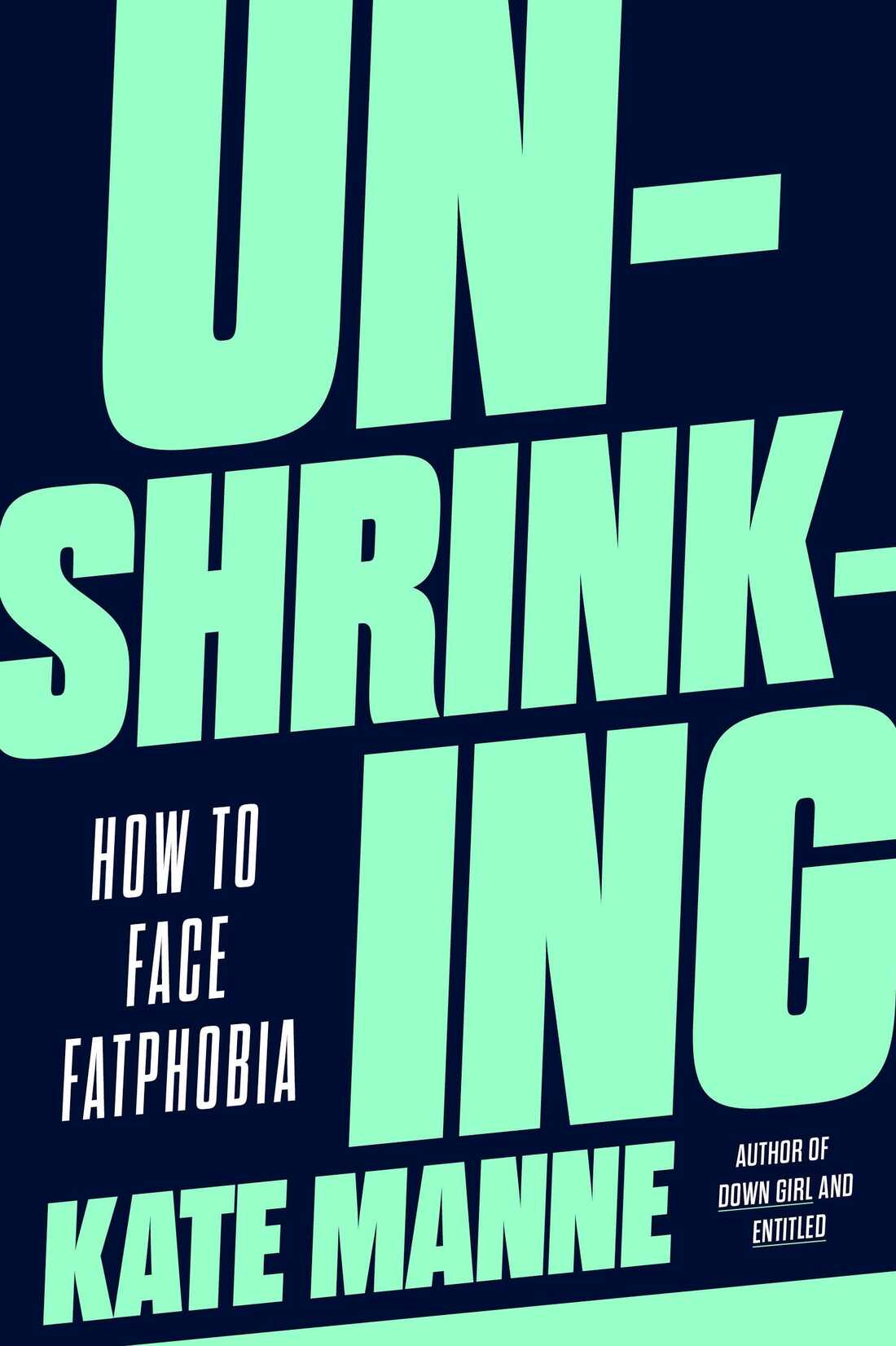
That’s the devastating question philosopher Kate Manne asks in her new book, Unshrinking: How To Face Fatphobia. In it, she explores the myriad ways that people who live in larger bodies are taught that they must make themselves smaller, no matter the cost.
Starting with herself.
“You might expect that as a lifelong feminist, not to mention the author of now two books on misogyny, I would be one of the last people to be suckered into policing my own body,” she writes. “You’d be wrong about that, sadly. Since my early twenties, I have been on every fad diet. I have tried every weight-loss pill. And I have, to be candid, starved myself, even not so long ago.”
Manne details the history of discrimination against fat people and the ways it manifests in the workplace, at school, in relationships, and perhaps most prominently, in health care. She argues the link between health and weight is far from definitive and explores why doctors‘ offices continue to be one of the most stigmatizing places to have a bigger body.
She spoke with NPR contributor and primary care physician Mara Gordon about Unshrinking.
Shots – Health News
I try to be a body-positive doctor. It’s getting harder in the age of Ozempic
This interview has been edited for clarity and length.
Mara Gordon: This book is very personal. You write about the fat phobia you’ve experienced and the ways you’ve tried to hide your body from public view. What was it like “coming out” as a fat person with this book?
Kate Manne: It was very scary, on the one hand, because I had been dreading being called fat on the Internet and subjected to fat phobic, misogynistic trolling as a public facing feminist for a really long time. And it had, to some extent, controlled my life in various ways. I had avoided TV appearances where I couldn’t just control the camera angle myself, I’d avoided in-person appearances.
On the other hand, it was very liberating, because I’d voraciously consumed the early 2000s writing of activists like Kate Harding and Marianne Kirby and Lesley Kinzel. But even though I had been really convinced of the politics of their views, the personal piece of divesting myself from diet culture, really reckoning with my internalized fat phobia, and coming out as fat myself – that felt like a liberating step, to stand in solidarity with other fat people.
Random House
MG: Why do you use the word “fat” to describe yourself?
KM: I’m really following in the footsteps of many people in the fat activist tradition, who want to reclaim the word “fat,” much like people in queer liberation spaces have reclaimed the word “queer” as not a negative, not a pejorative, not a shameful term, but as a description.
So similarly, I see the word “fat” as describing one way of having a body that is part of natural, normal, and in fact, valuable human variation. And so I use it much like terms like “short” and “tall” and, for that matter, “thin,” as a merely neutral description.
MG: You start Unshrinking by debunking the idea that being fat is synonymous with being unhealthy, arguing that the relationship between weight and health is more complex. For instance, you cite research that suggests being “overweight” or “mildly obese” — a BMI between 30 and 34.9 – is linked with lower mortality than being “normal” weight. Why did you feel you needed to address that topic?
KM: The point of the book is not to litigate the issue of whether fatness is unhealthy. But I feel like it’s such a common, thought-terminating cliche, that I felt like for most readers, in order to get to my analysis of fat phobia in an open-minded way, we really needed to clear away some of the very prevalent myths.
There are people who are fat – even very fat – who are metabolically healthy. And there are also people who are thin, or in normal or average weight or overweight BMI categories, who are subject to health problems. So these are correlations that play out on a population level, but they’re not reliable indicators of individual health.
I think it’s also worth emphasizing that whatever the case, people deserve adequate health care, they deserve compassion, they deserve to be treated not like human failures, but like human beings who deserve adequate, compassionate, humane health care.
Shots – Health News
Diet culture can hurt kids. This author advises parents to reclaim the word ‘fat’
MG: You talk about “concern trolling” in the book, when people cloak discrimination in fake concern about fat people’s health. Doctors are the worst at this! Fat people consistently describe the doctor’s office as one of the most stigmatizing places they go. Why do you think that is?
KM: There is so much discourse around fat bodies being automatically unhealthy, that if you see your job as safeguarding the health and well being of people, [concern trolling behavior] can be very tempting … People who are in the medical field see themselves as almost professional concern trolls, having to protect fat people from ourselves and point out that we’re fat. As if we don’t already know it.
MG: How is that different from the actual efforts doctors make to help their patients live healthy lives? What would you want to experience when you go to the doctor?
KM: I think that one of the things that really helps is physicians being aware of the fact that fat patients have heard it all before. I mean, you would have to be a fat, rock-sheltered Martian not to have heard that diet and exercise are options to lose weight in the short term. But in the long term, really robust evidence suggests that most people lose weight temporarily, but gain it back in the vast majority of cases. Between one third and two thirds of cases will end up heavier than they started.
Focusing on behaviors, rather than a bodily state, can be really helpful. But berating someone for the way that their body is as a state, rather than discussing practical, feasible humane steps to improve someone’s behaviors – that’s a very different story.
MG: There’s good evidence that engaging in regular exercise can improve a person’s health, even if it doesn’t result in weight loss.
KM: Totally. And for people like me, who have been put off exercise by a sense that we’re failing to be thinner as a result of it, I think that reframing can be very powerful. To say: look, weight loss doesn’t generally follow from exercise, but exercise is really good for you.
MG: I find that discussion very challenging in my clinical practice. I say the word “exercise,” and my patients hear “weight loss.” Exercise is so entangled in diet culture.
KM: Fitness, rather than fatness, is the most important factor that is within people’s control to try to work on as a patient. Once we reframe what fitness is meant to do, and think of it not as meant to shrink our bodies, but as meant to safeguard our health, regardless of our weight – that reframe can be really useful.
MG: Most people can’t sustain weight loss with diet and exercise. But now we have medications like Ozempic that effectively help people lose weight. Do they change the conversation at all?
KM: I am a big proponent of bodily autonomy. I think that people have the right, the entitlement, to take these drugs if they want to lose weight. But I think what is often going on in the discourse surrounding these drugs is the ever increasing sense that people are not just entitled to, but obligated, to lose weight now that these [treatments] are available. Many people who take them will be paying enormous costs, undergoing serious side effects … I think there’s something worrisome about this trend that is pushing people to pursue thinness at great cost, even if they would have been happy and healthier in a fat body without these medications.
MG: It’s so hard to separate discussions about health from discrimination against fat people. It’s a form of bigotry that’s been medicalized. How did we get here?
KM: One of the things that is distinctive about fat phobia is that it comes with all of this medical, institutional backing that legitimates it. And in many ways that’s quite misleading. We know from brilliant sociological research by Sabrina Strings that fat phobia is a fairly recent form of prejudice. It existed in dribs and drabs throughout human history, but it didn’t really become systemic until the mid-18th century, when it was used as a pretext to justify the brutal, burgeoning transatlantic slave trade. Fatness and Blackness were associated, and then fatness fell into ill repute.
And it wasn’t until the early 20th century, when health insurance companies got involved, that there was this medicalization of having a fat body, which has often then been used as a pretext to justify racism … and misogyny. Now fat phobia wears a lab coat, because it’s dressed up as medical fact, in ways that I don’t think reflect the complex relationship between weight and health. It gives it a kind of legitimacy that makes it very hard to push back against.
MG: As a philosopher, do you think we have a moral obligation to try to be healthy, to avoid burdening the system if we get sick?
KM: We are often told that fat people are a burden on the health care system … But we regard people as entitled to go rock climbing or deep sea diving, or do Grand Prix racing. And they may then need more health care if they get into trouble. And we regard them as entitled to engage in these behaviors and to have humane and fitting health care if they run into health problems as a result … This is an expression of a particular bigotry where fat people are being represented as a burden in ways that people who engage in risky behaviors are not regarded as a burden – when they have presumptively thin, fit, nondisabled bodies.
MG: A majority of Americans are classified overweight or obese, so fat phobia is an issue that touches almost everyone. What makes fat phobia so ubiquitous even though fat people are everywhere?
KM: There are real failures of political solidarity, which affect fat people themselves. Oftentimes, we view ourselves as a thin person in a fat body waiting to emerge victoriously with the next diet or exercise program or weight loss drug, rather than standing in solidarity with other fat people, and lobbying for greater compassion and greater social progress on this issue. We work on changing our bodies rather than the world.
Share this Post
