 Enlarge this image
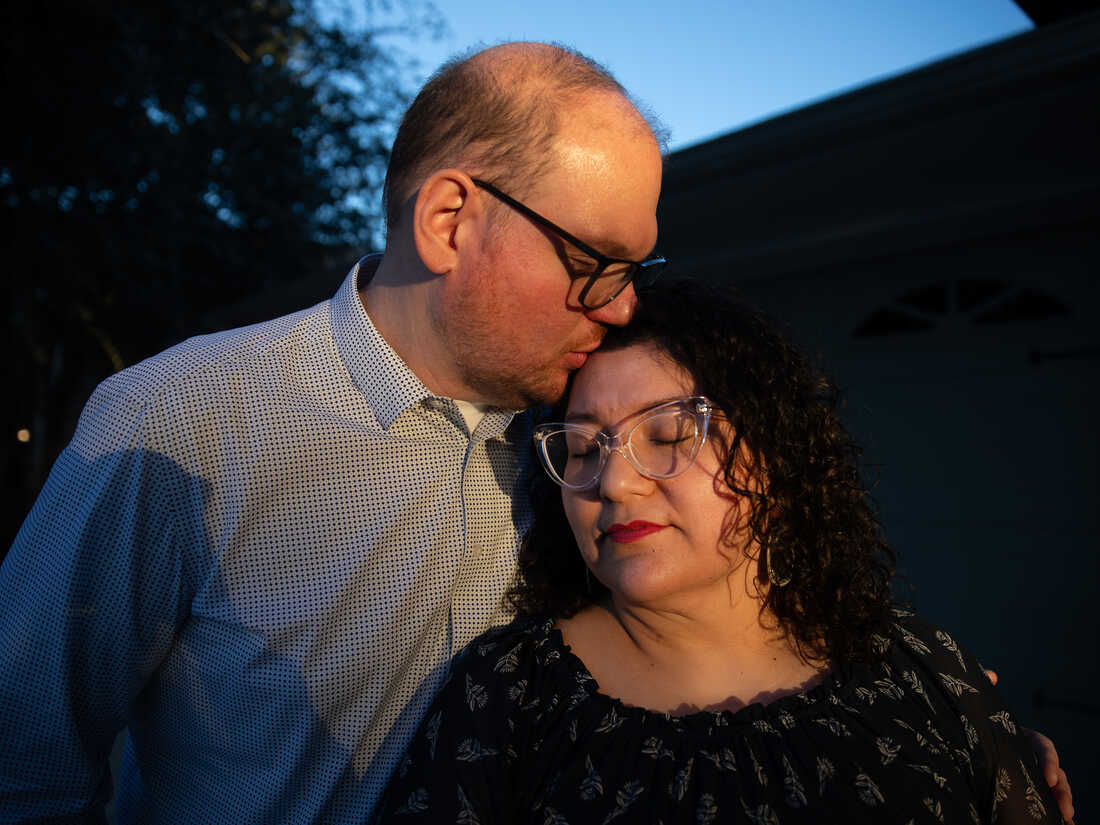
Diana and Paul Zucknick have tried repeatedly and unsuccessfully to have children. The Austin, Texas, couple are intrigued by scientific research that may someday make it possible to create eggs and sperm from their skin cells. Montinique Monroe for NPR hide caption
toggle caption
Montinique Monroe for NPR
Diana and Paul Zucknick have tried repeatedly and unsuccessfully to have children. The Austin, Texas, couple are intrigued by scientific research that may someday make it possible to create eggs and sperm from their skin cells.
Montinique Monroe for NPR
When Diana and Paul Zucknick built their dream house on a quiet street in Austin, Texas, more than a decade ago, the couple made sure it was big.
“We bought and built this house with the intention of filling it up with lots of children,” says Paul, a computer engineer who’s now 39.
But after about a year of trying to conceive, the Zucknicks discovered something that changed their lives: They were both infertile.
“We had sort of just imagined that it would happen naturally. And then to find out that it can’t ever happen naturally? It was really hard,” says Diana, who recently turned 41. “I guess you just don’t realize how important it is to you until you’re faced with the reality that it might not be possible.”
So Diana and Paul started searching for anything that could help them. Diana even retired from the job she loved teaching elementary school to focus on getting pregnant. She was also finding it increasingly hard to spend her days around children when she couldn’t have kids of her own.
“We just feel really strongly about trying our best to make a child that is genetically related to the both of us,” Diana says.
But so far the couple has experienced nothing but disappointment.
“It’s been painful — physically, emotionally — basically in every way,” Diana says. “It’s like torture. It feels like torture.”
A new way to make eggs and sperm in the lab
The Zucknicks haven’t given up, though. They scour the latest infertility research, looking for possible treatments.
Earlier this year, they stumbled across a new technology scientists are trying to develop that gave them fresh hope: in vitro gametogenesis. With IVG, scientists hope to create eggs or sperm from any cell in the human body, such as a single skin cell.
Japanese researchers have used IVG to make mouse eggs in the lab that eventually led to the birth of healthy mouse pups. The scientists have even managed to create very primitive human eggs.
For people who prize a genetic connection to their children, IVG could offer a something that could more easily and reliably help them realize their dreams than current infertility treatments. The technology hasn’t been tried in humans yet, but laboratories around the world are racing toward that goal.
Enlarge this image
Diana Zucknick says she and her husband, Paul, would be “perfect candidates” for in vitro gametogenesis, if scientists can get it to work in humans. Montinique Monroe for NPR hide caption
toggle caption
Montinique Monroe for NPR
Diana Zucknick says she and her husband, Paul, would be “perfect candidates” for in vitro gametogenesis, if scientists can get it to work in humans.
Montinique Monroe for NPR
“If it does become a reality, it’s going to help so many people just like us — people who really want to be genetically related to their future children,” Diana says. “My husband and I would be perfect candidates for that. If there was a way to make sperm with his DNA and eggs with my DNA, we would 100% sign up for it.”
The Zucknicks know that scientists could hit a dead end and never get IVG to work, or that it could come too late for them. Some scientists think IVG could be at least five to 10 years away.
Others are more optimistic.
Already, though, even the possibility of IVG is stirring excitement among some people struggling with infertility, as well as gay and trans couples who long to have children genetically related to both partners.
At the same time, the prospect of IVG is also raising many fears, including the possibility that the technology could someday be used to create “designer babies.”
“Like so many new technologies, it holds a lot of promise but also a lot of threats,” says Sonia Suter, a bioethicist and law professor who studies reproductive technologies at George Washington University.
Struggling with infertility
In the hopes of having genetically related kids, the Zucknicks have endured years of difficult, expensive and so far unsuccessful treatments.
“It’s been brutal,” Diana says.
Paul underwent two surgeries and took medication to help him produce viable sperm.
“It’s some sort of primal kind of coding in our DNA — this impulse that you want to procreate to help proliferate life with a partner that you love to create this amazing being that’s just a representation of you,” Paul says.
Enlarge this image
Paul Zucknick prepares a syringe to give his wife, Diana, an IVF injection. Montinique Monroe for NPR hide caption
toggle caption
Montinique Monroe for NPR
Paul Zucknick prepares a syringe to give his wife, Diana, an IVF injection.
Montinique Monroe for NPR
Diana has gone through seven rounds of in vitro fertilization. The couple has sought advice or treatment at seven IVF clinics, including traveling to a New York City clinic for experimental treatments.
Each round included almost-daily blood tests, ultrasounds, powerful hormone shots that affected her physically and emotionally, and painful procedures to extract eggs from her ovaries to try to make IVF embryos in the lab.
She tried to keep her sense of humor, even nicknaming her ovaries Mona and Lisa.
But every step has been wrenching. “I didn’t realize how attached we were going to be to our eggs. And then when we would make embryos, we were so attached to the possibility that those embryos could one day be our future children,” Diana says. “But those cells could potentially be your child one day.”
Finally, Diana, who has felt deep shame about her infertility, got pregnant for the first time this summer.
“It was the first time ever that a pregnancy test said I was pregnant. I surprised my husband when I came home from work. We were superexcited. And we were just ecstatic. It was wonderful,” Diana says.
But the couple soon discovered Diana was having a miscarriage.
“It was incredibly hard and sad,” she says. “And, it’s like a death in the family. A death you can’t even really acknowledge. Because you weren’t even really pregnant for that long. And you didn’t get to meet them. And you won’t. “I was in a darker place than I’ve ever been.”
“It was devastating,” Paul adds. “I don’t have another word for it besides devastating.”
Enlarge this image
Paul Zucknick gives his wife, Diana, an injection as part of their latest round of fertility treatment. Montinique Monroe for NPR hide caption
toggle caption
Montinique Monroe for NPR
Paul Zucknick gives his wife, Diana, an injection as part of their latest round of fertility treatment.
Montinique Monroe for NPR
The couple is still trying, and would be open to adopting children or embryos, or foster parenting. But they wish there was a better way to treat infertility.
“We really hope that IVG becomes available to everyone at some point,” Diana says. “If we could find a way to keep people from suffering the way Paul and I have over the past decade, that would be such a beautiful thing.”
IVG could offer a new option for gay and trans couples
“Wow! What a cool technology,” says Tara Ferguson, 30, an account manager at an insurance agency who lives in the Dallas-Fort Worth area with her wife, Delilah, 35. “That could really be a game changer.”
Tara says she has “always wanted to have a biologically related child. It’s not that I would require it to be a parent. But it would be a preference. And same with the preference of the child being biologically related to my partner. But we don’t just get to try it the old-fashioned way.”
The couple is planning to start a family soon with a sperm donor. But if IVG were an option, they’d jump at it.
Shots – Health News
Japanese scientists race to create human eggs and sperm in the lab
“I would really love being able to say, ‘Oh, look, they have your eyes and my nose and XYZ,'” Tara says. “And not just the physical attributes, but the emotional and the mental attributes as well. Because I feel like there are certain things that despite being raised a certain way you’re going to be genetically inclined, predisposed, to be a certain way.”
IVG would also be a dream come true for Brenda Trinh, 23, and her partner, Amber Mauer, 24, who live in San Francisco. The couple recently got engaged, after being together for nine years. Both want kids. But Brenda’s a transgender woman. So they’ll have to use a sperm donor too. That means Brenda would have no genetic connection to their children.
“Knowing that it’s half-me half-her, to me that’s special,” Brenda says. “And it’s very obviously family. You can definitely tell it’s ours.”
Amber, who works helping families care for children with autism, agrees.
“I love Brenda and I just want more of her in the world,” Amber says. “I’m just so lucky to be with her, and I’d love to see her passion and drive continue on through biological children.”
How IVG might backfire
But some fear that if IVG is successful it could have unintended consequences, such as undermining society’s acceptance of nontraditional families, like gay couples adopting or using donor eggs and sperm to have babies.
“Same-sex couples could say things like: ‘Well, look, we’re having families just like yours. We’re genetically connected to the children.’ But that could potentially backfire,” says Suter, of George Washington University.
“Conservative states could say: ‘Sorry, we are not willing to recognize that. That’s not natural. Nature doesn’t allow this,’ ” Suter says. “And it could undermine a lot of efforts just to be recognized as parents in the first place.”
IVG could also open the door to creating virtually unlimited numbers of human embryos, which would make it much easier to screen embryos for genes for disabilities like deafness and blindness. That stirs fears of discrimination against disabled people.
Enlarge this image
Diana and Paul Zucknick say they’re aware of the some peoples concerns about how in vitro gametogenesis could be misused. But they see the technology’s promise for people like them. Montinique Monroe for NPR hide caption
toggle caption
Montinique Monroe for NPR
Diana and Paul Zucknick say they’re aware of the some peoples concerns about how in vitro gametogenesis could be misused. But they see the technology’s promise for people like them.
Montinique Monroe for NPR
“IVG raises fundamental questions about the sort of people who we actively welcome versus who we want to avoid coming into the world,” says Joel Michael Reynolds, who studies disability issues at Georgetown University. “This could in many ways exacerbate some of the worries around questions of disability justice.”
The capacity to genetically screen mass-produced human embryos could also hasten the day when parents can hand-pick “designer babies” with the traits they want and society values.
“Imagine a world where reproduction starts to look a lot more like manufacturing,” says I. Glen Cohen, faculty director of Harvard Law School’s Petrie-Flom Center for Health Law Policy, Biotechnology & Bioethics. “That’s what I’m concerned about.”
People like the Zucknicks, the Fergusons, Trinh and Mauer understand the fears that IVG raises. But they just want children that share their genes.
“I completely understand the potential unethical uses that it could lead to,” Diana says. “But I don’t want a designer baby. I just want a baby that is a little bit of me and a little bit of my husband. I just wish that it was easier, and possible, for us. And, who knows? Maybe one day, maybe one day, it will be.”
Share this Post
