 Enlarge this image
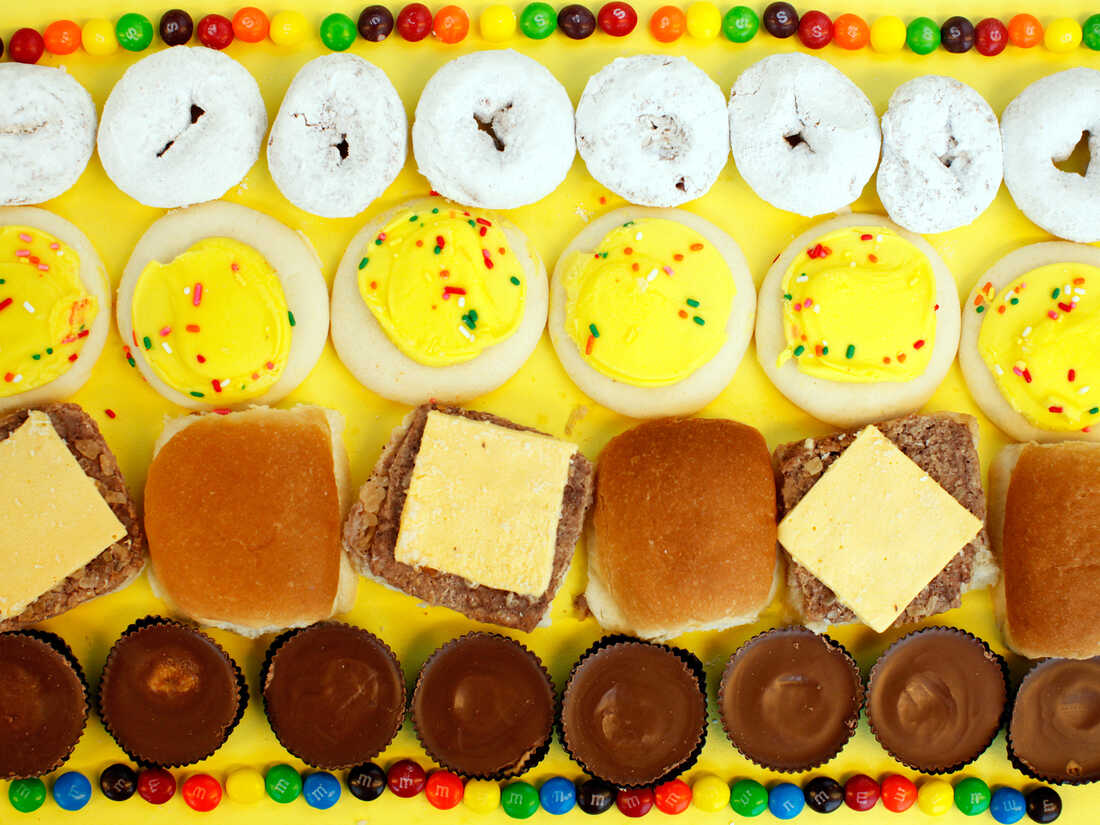
Child influencers have a huge following on social media. Now a new study from the University of Connecticut’s Rudd Center for Food Policy and Health finds these videos are frequently exposing young viewers to junk foods like candy, salty snacks and sugary drinks. Morgan McCloy/NPR hide caption
toggle caption
Morgan McCloy/NPR
Child influencers have a huge following on social media. Now a new study from the University of Connecticut’s Rudd Center for Food Policy and Health finds these videos are frequently exposing young viewers to junk foods like candy, salty snacks and sugary drinks.
Morgan McCloy/NPR
Blonde and charismatic, 9-year-old Nastya, as she’s known on YouTube, has a big grin and an even bigger social media presence. She has more than 100 million subscribers on YouTube, where she posts videos that show her engaged in activities like singing, imaginative role playing with friends or unboxing.
Nastya is part of a world of kid influencers, pint-sized social media stars who, like their adult counterparts, create digital content to generate views and engagement among their young followers. They are hugely popular: Research has found that 27% of 5-to-8-year-olds in the U.S. follow certain YouTube influencers.
But a study published this month finds that the YouTube videos these young influencers create frequently showcase junk food, which raises concerns that they are actually influencing kids’ food choices in an unhealthy direction.
“Kids as young as age 3 are spending time on YouTube,” notes Frances Fleming-Milici, the director of marketing initiatives at the Rudd Center for Food Policy and Health at the University of Connecticut.
Fleming-Milici and her colleagues wanted to know what kind of food and drink brands kids see when they watch these videos. So they analyzed hundreds of videos produced by some of the top kid influencers on YouTube. Turns out, food was often a co-star.
“Four out of every 10 videos that we viewed had food or beverage branded products, and most common were candy, sweet and salty snacks, sugary drinks and ice cream and branded toppings,” she says of their findings, which appear in the journal Pediatric Obesity.
The study found that about a third of the time, the kids starring in these videos were shown eating junk foods and sugary drinks – those low in nutrition but densely packed with calories.
Often, the foods were woven into storylines. For example, one video – with 23 million views – from the Like Nastya Show features two young girls engaged in a wordless battle over who can bring the least healthy, most sugar-laden lunch.
YouTubeAnother video, from Kids Play, a channel with 16 million subscribers, featured two tiny kid influencers frantically searching for soda.
And Fleming-Milici says that’s a problem, because prior research has found that, when young kids are exposed to food marketing — especially when they see someone they admire eating a product — it can strongly impact what they want to eat. And that in turn influences what they ask – and often convince – their parents to buy for them. It’s a concept called “pester power.”
“Most parents, or anyone who spent any time with a child, knows and has felt the pester power,” Fleming-Milici says.
YouTubeDr. Jenny Radesky, a developmental behavioral pediatrician at the University of Michigan and a leading researcher on children and digital media, says young children are particularly susceptible to advertising because their executive functioning hasn’t fully developed, and they have weaker impulse control than adults.
Kids also learn by watching others, including YouTube influencers, Radesky notes.
“By watching other people doing things, whether they’re healthy things or unhealthy things, they’re building norms or they’re internalizing rules about how the world works and what they should do,” says Radesky, who was the lead author of the the American Academy of Pediatrics’ latest policy statement on digital advertising to children.
Now, YouTube actually banned all food advertising on channels with content made for kids back in 2020. But Fleming-Milici and her colleagues found that the prohibition hadn’t stopped unhealthy foods from showing up quite frequently. The study didn’t look at whether child influencers are actually being paid to feature these foods — and only one video out of hundreds acknowledged sponsorship. By law, such relationships must be disclosed.
“Perhaps these are unpaid, but it doesn’t mean that the effect is different,” Fleming-Milici says.
Radesky’s research has found that YouTube videos often create an environment of what she calls “vicarious wish fulfillment,” where kids can watch other kids live out their wishes.
“Content creators are kind of packing their videos with these highly desirable, highly pleasurable items – you know, huge pieces of candy and cake and M&Ms all over the place – because they know that that gets more engagement from child viewers,” Radesky says.
A YouTube spokesperson told NPR that the company has put measures in place that make it harder for creators of kid content to profit from videos that focus on food brands. Those measures also include quality guidelines for creators.
Radesky says those measures are a step in the right direction, but her research has not found dramatic signs of improvement.
She says unlike the traditional TV and film industry, which has ratings boards that determine what content is appropriate for different age groups, the Internet has no real equivalent.
And that’s why “it’s a little bit riskier [for parents] to choose a free platform that has endless amounts of content, but with no guarantee that any human has ever reviewed that content to make sure that it’s OK for your 3-year-old.”
“It feels a bit more like the Wild West,” she says.
Enlarge this image
YouTube actually banned all food advertising on channels with content made for kids back in 2020. But Fleming and her colleagues found that the prohibition hadn’t stopped unhealthy foods from showing up quite frequently. Morgan McCloy/NPR hide caption
toggle caption
Morgan McCloy/NPR
YouTube actually banned all food advertising on channels with content made for kids back in 2020. But Fleming and her colleagues found that the prohibition hadn’t stopped unhealthy foods from showing up quite frequently.
Morgan McCloy/NPR
Share this Post
