 Enlarge this image
Hospice provides vital end-of-life support and palliative care to terminally ill patients. But it’s costing Medicare billions. A new approach would eliminate waste in the program. Westend61/Getty Images hide caption
toggle caption
Westend61/Getty Images
Hospice provides vital end-of-life support and palliative care to terminally ill patients. But it’s costing Medicare billions. A new approach would eliminate waste in the program.
Westend61/Getty Images
Hospice doctor Bethany Snider sees the writing on the wall: “The hospice care we’ve known and loved won’t be the same 10 years from now.”
Hosparus Health, the Louisville-based hospice agency where Snider serves as chief medical officer, is one of more than 100 provider organizations partnering with some of the country’s largest health insurers on a federal experiment that could transform hospice care for millions of people.
For the last four decades, Medicare has covered hospice services — including grief counseling, spiritual support and pain management — for terminally ill people. The benefit has helped more than 25 million Americans die more on their own terms, often at home, with the support of chaplains, social workers, nurses and others.
Research shows hospice can reduce unwanted medical interventions, improve families’ satisfaction and, in some cases, save Medicare thousands of dollars.
Now Snider and others believe this popular benefit, whose structure has remained largely unchanged since its debut in 1983, is in the early days of an inexorable overhaul. Critical aspects of the 40-year-old policy no longer fit the needs of the people using the service — or the providers delivering it. Concerns about access, fraud and runaway costs, which topped $20 billion in 2019, dog the program.
In response, Medicare has begun a federal pilot project to test handing the reins of some hospice care over to private insurers, giving them more flexibility to control costs while also expanding access. The experiment, which began in 2021, involved several thousand patients in its first year, but multiple experts told Tradeoffs that they believe it is likely to eventually become national policy and reshape the hospice care available to roughly 30 million Americans.
Shots – Health News
Patients Want To Die At Home, But Home Hospice Care Can Be Tough On Families
In an email to Tradeoffs, Liz Fowler, deputy administrator at the Centers for Medicare and Medicaid Services, said the agency hopes the effort will help ensure all beneficiaries have “access to high quality and coordinated care.”
The changes to hospice are “inevitable,” said Torrie Fields, a consultant who has advised Medicare and private insurers. “The hope is this pilot sheds some light on the guidelines and guardrails needed.”
One sign Medicare is seriously considering the policy: an announcement on March 23 that the pilot, initially slated to end in 2024, will continue through 2030.
Enlarge this image
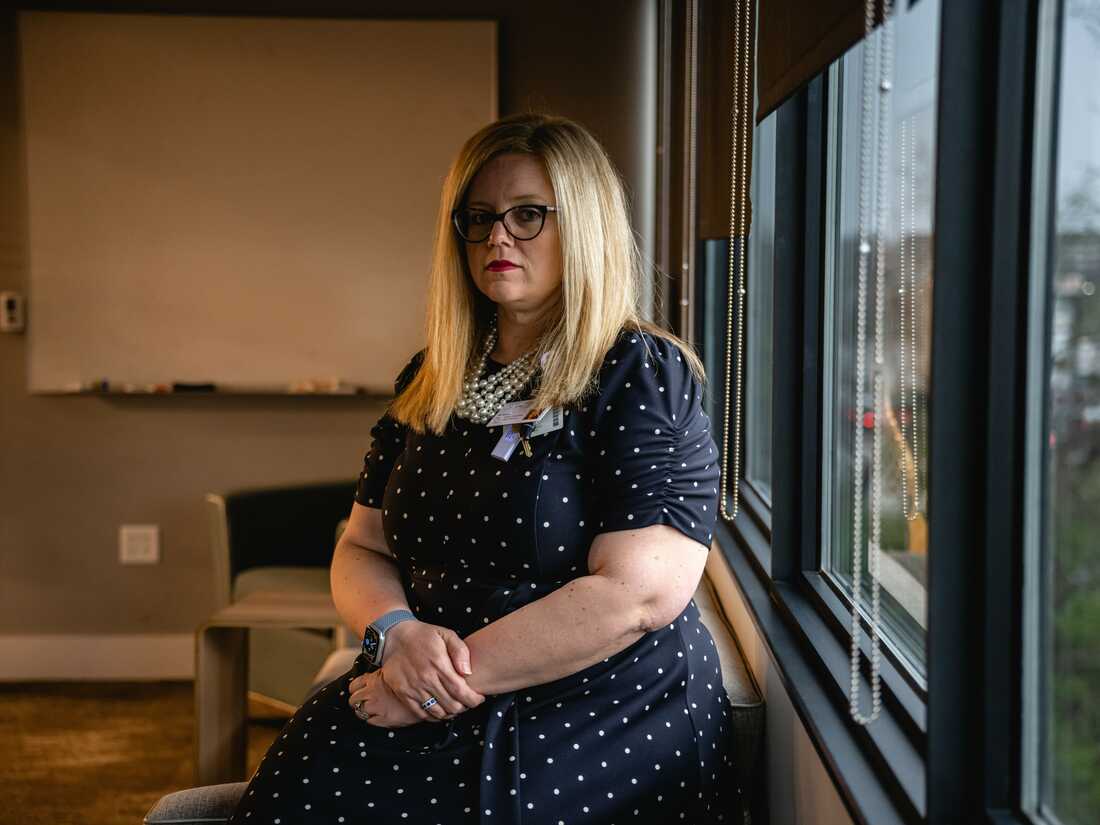
Bethany Snider encouraged her nonprofit hospice agency to participate in a federal experiment to revamp Medicare’s 40-year-old hospice policy, but she worries about its potential unintended consequences. Jon Cherry for Tradeoffs hide caption
toggle caption
Jon Cherry for Tradeoffs
Bethany Snider encouraged her nonprofit hospice agency to participate in a federal experiment to revamp Medicare’s 40-year-old hospice policy, but she worries about its potential unintended consequences.
Jon Cherry for Tradeoffs
Medicare pilots a makeover for its 40-year-old hospice benefit
This federal experiment, known by wonks as “the hospice carve-in,” is designed to revitalize a pair of particularly outdated hospice policies: how the program determines patient eligibility and the way it pays providers. Neither has changed significantly since 1983.
Here’s how the traditional program works now: To become eligible for hospice, patients must have two doctors certify they have less than six months to live and agree to stop all attempts at curing their terminal illness.
Many experts believe that harsh choice between giving up hope and getting help from hospice — along with the arbitrary six-month cutoff — combine to repel many patients who could otherwise benefit. Only about one-third of Native, Asian, Black and Hispanic patients elect hospice compared to about half of white patients.
“One of the reasons that Black people shy away from hospice is because there isn’t room to reevaluate,” said Karen Bullock, a licensed clinical social worker and a professor at Boston College. “It’s too finite.”
Medicare covers much less at-home medical or social support for people who decline hospice. “They’re still ill. They’re still struggling,” Snider said. “But Medicare does not offer us a great way to serve that population.”
An outdated payment policy leaves hospice vulnerable to waste and abuse
For those who do enter hospice, Medicare has historically paid providers a flat rate for every day a person is enrolled in their care — even on days when they need little or no help.
That payment policy, experts say, made more fiscal sense in the early days of hospice when most patients had cancer and died within two months. Since then, hospice has become more popular with a wider range of patients with diseases that are generally less predictable, such as dementia and heart failure. People, on average, now use hospice for almost 100 days.
Experts blame the program’s antiquated flat day rate as one reason for its ballooning costs, which are up more than 50% over the last decade. More than half of that budget is now consumed by stays longer than six months.
“The way Medicare pays for this benefit has not evolved to meet the changing needs of the people who use it,” said David Stevenson, a health policy professor at Vanderbilt. Adding to those doubts is the flood of for-profit hospice businesses that have poured into the market.
About three-quarters of all providers are now for-profit and data suggests some are exploiting the program’s payment structure, averaging much longer stays and profits three times higher than nonprofit providers. Reports, including by ProPublica and the federal government, have also highlighted hundreds of millions of dollars in fraud and disturbing anecdotes of abuse.
Shots – Health News
Black-owned hospice seeks to bring greater ease in dying to Black families
Medicare banks on insurers’ incentives to reduce waste and improve care
Medicare’s experiment gives private insurers the flexibility to both expand eligibility and rein in costs. The same insurers already manage most other care for roughly 30 million Medicare beneficiaries through the program known as Medicare Advantage.
The hope is they can take that experience and those skills, like coordinating care and vetting the quality of providers, and apply them to improve hospice. Because private insurers get paid a lump sum to manage each Medicare patient, they are also motivated to keep costs down.
“There’s a natural alignment here,” said Susanne McComic, who’s overseeing the health insurer Humana’s involvement in the hospice demonstration. McComic said Humana had two main reasons for participating. First, it wanted to deliver better care to vulnerable members, and second, it made business sense: It owns 40% of Gentiva, a large hospice chain.
A larger role for private insurers makes some experts uneasy, especially when it comes to end of life care. Joan Teno, a Brown University researcher and former hospice medical director, points to the United Kingdom’s experiment known as the Liverpool Care Pathway as a cautionary tale.
That program used financial incentives to encourage doctors to enroll more hospital patients in hospice-like services. Some families reported clinicians rushed their loved ones down a path toward death that they did not want or understand. Public outrage erupted, and the government ultimately ended the initiative in 2013.
While Medicare’s hospice pilot has many differences, its reliance on financial incentives to change behavior still gives some experts pause.
In other areas of care, some Medicare Advantage insurers have aggressively declined requests for medical services — as much as 13% of the time, according to one federal report.
Insurers’ early efforts include cutting rates, cleaning carpets and expanding eligibility
Bethany Snider of Hosparus Health is also wary of what the pilot portends for nonprofit hospice agencies like hers — and their patients. But she encouraged Hosparus to take the leap and partner up with Humana. She valued the chance to shape — or at least glimpse — the likely future of hospice care for most Americans.
“I wanted us to have as much time as possible to plan,” she said.
The first big change providers like Hosparus are adapting to is the need to negotiate. The pilot lets insurers abandon Medicare’s day rate and pay providers however they want. An evaluation of the pilot’s first year by the Rand Corp. showed some insurers had already slashed payment rates by up to 12%.
The pilot also lets private insurers decline to contract with hospices that, for example, don’t meet certain quality standards. Soon, insurers can begin requiring patients to use only preferred providers.
The hope is this new power helps insurers weed out waste and bad actors. But Snider and others also worry that it could put some nonprofit hospices with thinner margins out of business and lead to further consolidation of the industry.
In an email to Tradeoffs, Medicare’s Liz Fowler emphasized the demonstration’s guardrails designed to protect patient choice. She also pointed to the agency’s “comprehensive monitoring strategy to address and track any unintended consequences.”
The other major shift being tested is an expansion of hospice’s eligibility criteria. Private insurers can choose to offer hospice care to people still pursuing chemotherapy or other curative treatments, and they can offer some services to seriously ill people with more than six months left to live. They can even give patients additional funds for nontraditional help, like carpet cleaning and rent — two uses Humana’s McComic said the insurer has tested.
Together, these experimental changes to who receives and who delivers hospice care, when, and at what cost represent relatively large shifts for a program that’s seen little change over the last 40 years. The overall effect on the cost and quality of care remains to be seen. Participation in the pilot was slow to start but has grown over time. The experiment, which this year includes 15 insurers serving patients across 23 states and Puerto Rico, was slated to end in 2024.
In a surprise announcement, Medicare made public on March 23 that it is extending the pilot through 2030. By then, private insurers are projected to manage the care of nearly 70% of Medicare beneficiaries — including, if this pilot becomes national policy, how they spend their final days.
This story comes from the health policy podcast Tradeoffs. Dan Gorenstein is Tradeoffs’ executive editor, and Leslie Walker is a senior producer for the show. Tradeoffs’ coverage of Medicare sustainability is supported, in part, by Arnold Ventures.
Share this Post
