 Enlarge this image
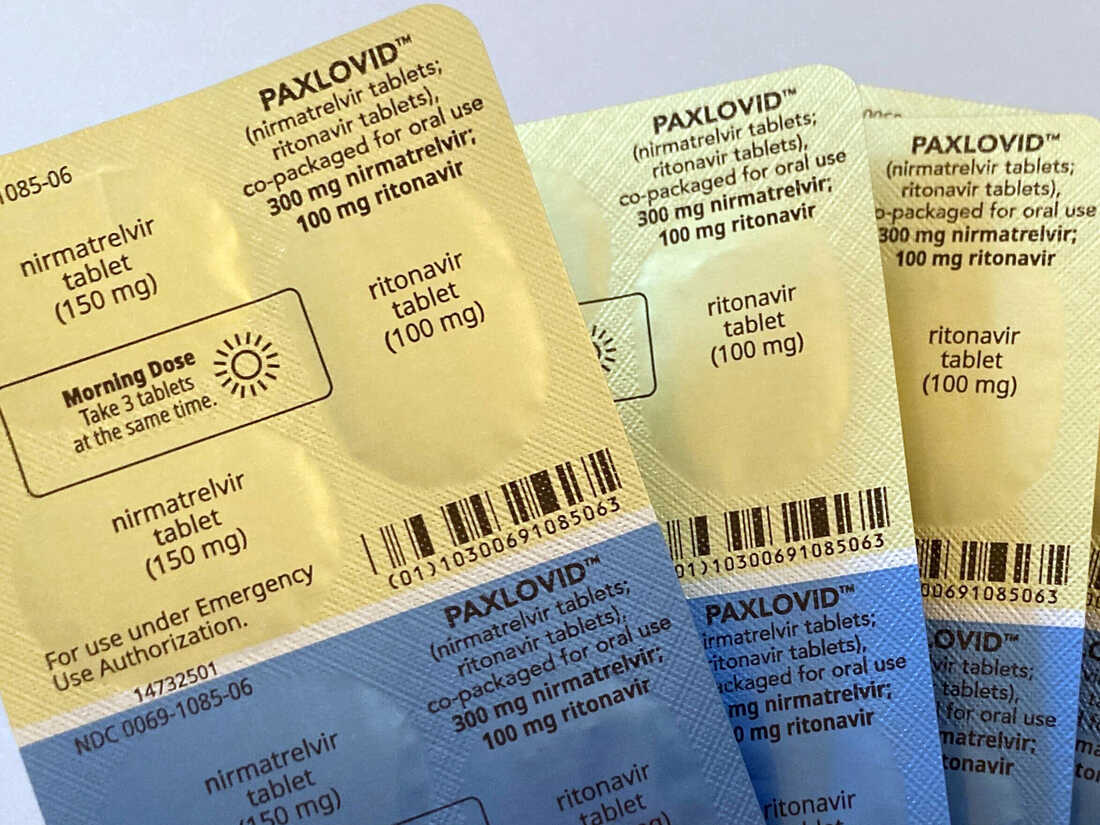
Patients had a reduced risk of developing long COVID after taking Paxlovid, and the benefits were seen among those who were vaccinated and unvaccinated. Stephanie Nano/AP hide caption
toggle caption
Stephanie Nano/AP
Patients had a reduced risk of developing long COVID after taking Paxlovid, and the benefits were seen among those who were vaccinated and unvaccinated.
Stephanie Nano/AP
It’s well-documented that Paxlovid — a 5-day course of antiviral pills from Pfizer — can reduce the risk of hospitalization in COVID-19 patients who are more likely to develop severe illness.
Now, researchers from the Veterans Health Administration find that taking the medication may also reduce the risks of later developing long COVID, according to a new study that was posted online this weekend and has not yet undergone peer review.
“We’ve already known for some time now that Paxlovid reduces the risk of acute problems,” says Dr. Ziyad Al-Aly, chief of research and development at the VA Saint Louis Healthcare System, and co-author of the study, “Now we are adding the observation that Paxlovid also reduces the risk of long COVID.”
The drug, which has been available in the U.S. for almost a year, is provided for free by the federal government at pharmacies across the country. It requires a prescription, and patients with COVID-19 must start it within five days of symptom onset.
Less virus, less long COVID?
In the study, long COVID was defined as developing one or more symptoms — including heart issues, blood disorders, fatigue and trouble breathing — one to three months after testing positive. By these metrics, patients that took Paxlovid were 26% less likely to develop long COVID.
To get to this finding, the researchers combed through electronic health records from more than 56,000 patients in the VA health system who tested positive for COVID-19 between March and June 2022, and had at least one risk factor for severe disease. They compared health outcomes of 9,000 patients that had taken Paxlovid early in their course of illness, with 47,000 patients that had not.
The benefits of taking Paxlovid didn’t just apply to those who were unvaccinated. Patients who were vaccinated or boosted, or had repeat COVID-19 infections, had a similar reduction in the risk of developing long COVID, the study found.
The study is a preprint, meaning it was shared publicly before being reviewed and vetted by outside researchers. But experts who were not involved in the study tell NPR the findings make sense, given how Paxlovid works.
The antiviral drug stops the virus from replicating in cells. “We know that one of the key factors that predict long COVID is detectable virus in the bloodstream at the time of infection,” Dr. Peter Chin-Hong, an infectious disease physician at the University of California, San Francisco, wrote in an email. “So it stands to reason that interventions that prevent the virus from making more copies of itself would therefore lead to a lower risk of long COVID.”
Past studies have shown that Paxlovid reduces the risks of hospitalization and death from COVID-19. “Since the trigger of long COVID is acute infection with SARS-CoV-2, it makes intuitive sense that anything that lowers the severity of this infection would reduce the risk of long COVID, whether it’s Paxlovid or other antiviral treatments,” Dr. Paul Sax, an infectious disease physician at Brigham and Women’s Hospital in Boston, wrote in an email.
A starting point
Still, experts view the study as only a starting point for exploring the potential uses of Paxlovid. The VA study was observational, based on data entered into patient health records – in Sax’s view, “the imprecision of the [long COVID] diagnosis makes definitive conclusions from this study challenging, especially with a retrospective review.”
But the value of the study is that it points researchers down promising pathways for more research, says Dr. Monica Gandhi, an infectious disease physician at UCSF. “It’s hypothesis-generating,” she says, “It’s exciting and hopeful [to think] that if you reduce the viral load… down to undetectable [early in the illness], maybe you can prevent post-COVID symptoms” altogether – a theory she thinks researchers could pursue.
Both Sax and Gandhi say they would feel more confident in the results if they were replicated in additional studies, especially in experimental, randomized controlled trials that compare long COVID outcomes in patients who took either Paxlovid or a placebo. The VA study’s findings are also limited by the fact that the participants were predominantly white men, raising the possibility that the benefits of Paxlovid could be different in other groups of patients.
Currently, Paxlovid is only authorized for use in patients who have risk factors – like being older or having underlying health conditions – that put them at high risk of developing severe disease. Al-Aly says the reduction in long COVID risk, raised in his study, suggests others might benefit from taking Paxlovid, too. But many patients who currently have long COVID were relatively young and healthy before they got COVID-19 and may not have qualified for Paxlovid when they tested positive, he says.
“Does Paxlovid use in a lower-risk population reduce the risk of acute problems and subsequently reduce the risk of long COVID?” Al-Aly wonders, “I think that’s a question that we all need to solve over the next several months.”
It’s also an open question whether a higher dose or a longer treatment course could provide a greater benefit, Chin-Hong says.
Side effects that include nausea and an off-putting taste have given patients pause about using the product. Reports of COVID rebound in Paxlovid patients, where the illness flares up after a seeming respite, has made some prescribers ambivalent about the product. These are real considerations, Al-Aly says, but they should be weighed against the benefits of Paxlovid treatment, including reduced risks of hospitalization and death in the acute phase, and the potential for avoiding long COVID in the months after.
Gandhi says the study’s findings may now factor into clinicians’ decisions, even if the results are preliminary and have not yet been replicated.
“This study is pushing me to use [Paxlovid] in people who are over 65, vaccinated and boosted, because it’s probably going to have other benefits beyond preventing hospitalization,” she says.
Share this Post
