 Enlarge this image
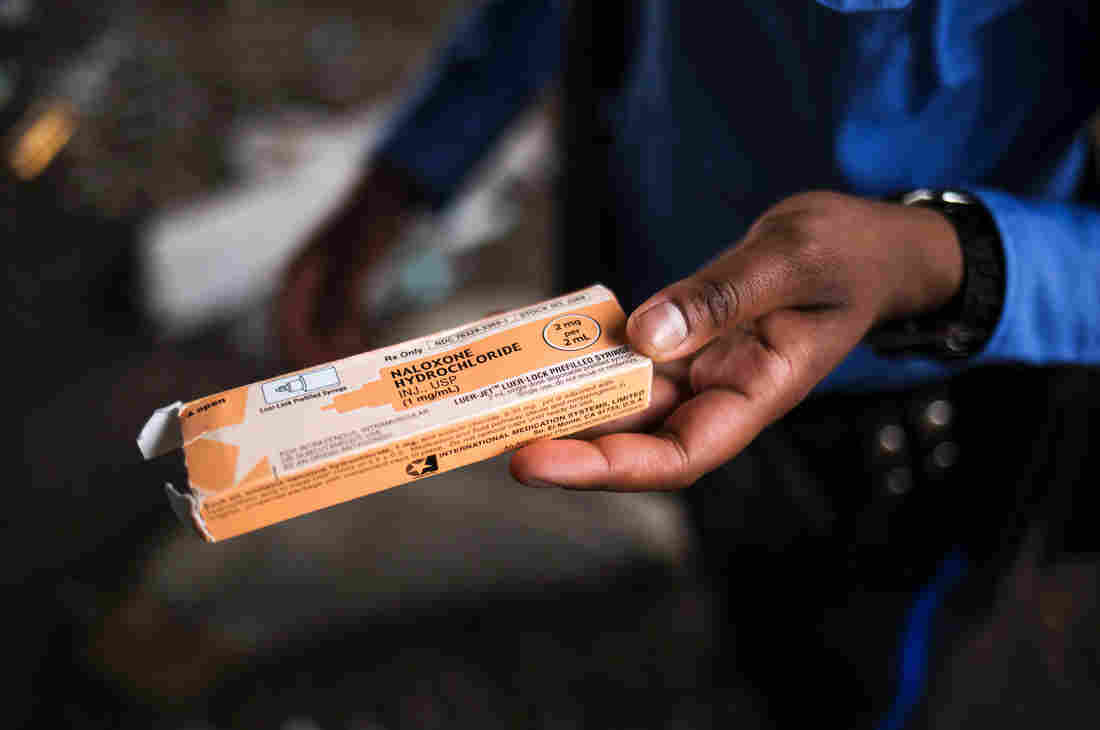
A Philadelphia police officer holds a package of the overdose antidote naloxone while on patrol in the Kensington neighborhood of Philadelphia in April 2017. Dominick Reuter/AFP/Getty Images hide caption
toggle caption
Dominick Reuter/AFP/Getty Images
A Philadelphia police officer holds a package of the overdose antidote naloxone while on patrol in the Kensington neighborhood of Philadelphia in April 2017.
Dominick Reuter/AFP/Getty Images
On a 90-degree afternoon in July, under the shade of a tree in Philadelphia’s McPherson Square Park, I watched a couple sit down, prepare syringes and inject drugs.
The man injected in his arm, the woman in her neck.
I observed them from about a hundred feet away, where I was getting ready to film an interview with someone else.
After they had finished, the woman rested against the man. She was splayed out on top of the man with her neck tilted back, her mouth open.
The next time I glanced over, her skin looked pale. The man supported her head, rubbing her breastbone, and checked her pulse.
The city has cleaned up the park — which used to be known as “Needle Park” — and ramped up the police presence there. There was even a group of kids playing on a nearby Slip ‘N Slide that day. But drug use remains commonplace in the park and in Kensington, the surrounding neighborhood.
The woman I was there to interview, Jasmine Johnson, is in recovery now. But she was in active addiction on the streets of Kensington for six years.
I looked to her face for cues, to see if my rising concern about the couple was warranted.
Shots – Health News
Poll: Most Americans Know About Opioid Antidote And Are Willing To Use It
I had done enough reporting on overdoses that I thought I would know how to respond when I saw one. Plus, the city’s health department makes it sound simple. In Pennsylvania, anyone can pick up naloxone (also known by the brand name Narcan) at a local pharmacy without a prescription.
Billboards in subway stations and along the highway advertise naloxone, the overdose-reversal drug: “Saving a life can be this easy.”
But in the face of a possible emergency, it seemed more complicated to me.
Johnson, who carries naloxone in her purse, went over to check on the woman and offer her the antidote.
The man angrily refused it.
Johnson tapped the woman lightly on the cheek, to see if she would wake up. She didn’t.
The man insisted again that she was fine. “She’s breathing!” he yelled. He told Johnson he didn’t need Narcan, and that he already had some. “Do not give her Narcan,” he mumbled. “She would be so mad.”
To understand why someone who uses drugs might not want naloxone during a suspected overdose, it helps to understand how the medicine works.
The antidote quickly blocks the effects of opioids — both the euphoria and dangerous side effects, such as slowed breathing that cuts off oxygen to the brain.
In the process, it can send someone into instant withdrawal. Many people who use drugs say withdrawal is like having the worst flu of your life, complete with cold sweats, shakes and vomiting.
The man likely didn’t want the woman to suffer Narcan-induced withdrawal and end up mad at him.
While I knew all of this in theory, it hadn’t registered with me until that moment that someone would risk death to avoid withdrawal.
As Johnson and I wrapped up our interview, the woman still looked pale and unconscious. I didn’t know what to do, and Johnson could tell.
“That’s all you can do, is ask and keep moving,” she said with a shrug.
But was that really all we could do?
“It’s not easy,” said Allison Herens, the harm-reduction coordinator at Philadelphia’s Public Health Department.
She conducts regular training sessions about naloxone and how to administer it. She started a recent session for about two dozen people at the South Philadelphia Library on Broad Street by describing naloxone as “as harmless as water.”
But Herens said the overdose antidote can be a little tricky to use. “There are lots of different kinds of emergencies that happen on the street in any moment, and it can be hard to discern if it’s actually an emergency or not,” she told the group.
It’s important to make sure someone is actually overdosing before giving naloxone, she said.
A person might be nodding out, coming in and out of consciousness. “The big thing to keep in mind with that person is, are they breathing?” she said. “How does their color look? So they’ll start to get pale, gray – depending on the complexion, blue.”
Now, with the increased presence of fentanyl in the drug supply, Herens said the signs of an overdose are even more varied. Fentanyl often causes muscle spasms, or locked jaws in addition to the traditional signs she described.
She also confirmed that sending a drug user into withdrawal is a real concern. “If they wake up in full-blown withdrawal, they are not going to the hospital. They just are not,” Herens said. “They are going to go run as fast as they can to try to use again, and I know because I’ve seen it happen.”
If you suspect someone is overdosing, call 911 right away, Herens said.
Jeremiah Laster, a deputy chief at the Philadelphia Fire Department, agreed. “Sometimes you have people that when you administer Narcan to them, they become combative because they’re upset because you sort of blew their high,” he said. “You have to be prepared to protect yourself.”
There are other reasons to call for help. Narcan, a nasal spray, starts to wear off after about 30 minutes, and nearly dissipates after 90, depending on a person’s metabolism and the strength of the drugs used.
It can take multiple doses of Narcan to reverse a fentanyl overdose. And once you’ve given the nasal spray to someone who has stopped breathing, it helps if you perform rescue breathing to hasten the flow of oxygen to the brain.
For these reasons, Herens said it’s important to know from the start that you have paramedics coming to help.
Shots – Health News
Reversing An Overdose Isn’t Complicated, But Getting The Antidote Can Be
Ultimately on that day in McPherson Square Park, I called 911.
Once I did, another woman nearby told the woman who was passed out that the police were on their way with Narcan. Hearing this, the woman bolted straight upright and started to leave with the man. They got angry with the woman who told her the police were coming — there was some pushing and shoving — but soon all three were gone.
Herens estimates she has given Narcan about seven or eight times — mostly during a recent spike in overdoses this summer, not long after the day I was in the park.
She said she understands it can be hard to wrap your head around the fact that someone might get angry with you for trying to prevent them from dying of an overdose.
“I always just try to remember that in this moment I am saving this person’s life,” she said. “They don’t have to like me.”
Herens tries to keep it in perspective. Irritating people is a small price to pay if it means they survive, she said.
Nina Feldman covers health for WHYY. She’s on Twitter: @ncannellf.
Share this Post
