Explaining Medicine
  • News
  • Health & Lifestyle
    • Diet & Weight Management
    • Exercise & Fitness
    • Nutrition, Food & Recipes
    • Prevention & Wellness
  • Conditions
    • Custom1
      • Conditions A-Z
      • Procedures A-Z
      • Allergies
      • Alzheimer’s
      • Arthritis
      • Asthma
      • Blood Pressure
      • Cholesterol
      • Cancer
    • Custom2
      • Chronic Pain
      • Cold Flu
      • Depression
      • Diabetes
      • Digestion
      • Eyesight
      • Health Living
      • Healthy Kids
      • Hearing Ear
    • Custom3
      • Heart
      • HIV/AIDS
      • Infectious Disease
      • Lung Conditions
      • Menopause
      • Men’s Health
      • Mental Health
      • Migraine
      • Neurology
    • Custom4
      • Oral Health
      • Pregnancy
      • Senior Health
      • Sexual Health
      • Skin Problems
      • Sleep
      • Thyroid
      • Travel Health
      • Women’s Health
  • Medications
    • Medications
    • Supplements and Vitamins
  • Medical Dictionary
  • Health Alerts
Flu shot recommendation for kids dropped just as...
The CDC just sidelined these childhood vaccines. Here’s...
Your next primary care doctor could be online...
In Lodge Grass, Montana, a Crow community works...
RFK Jr.’s new dietary guidelines go all in...
More seniors are becoming homeless. Shelters are trying...
Health officials slash the number of vaccines recommended...
Wegovy obesity pill now available at pharmacies
In the U.S., hunger is often hidden. But...
One doctor’s experience shows the battle for the...
Top Posts

Explaining Medicine

  • News
  • Health & Lifestyle
    • Diet & Weight Management
    • Exercise & Fitness
    • Nutrition, Food & Recipes
    • Prevention & Wellness
  • Conditions
    • Custom1
      • Conditions A-Z
      • Procedures A-Z
      • Allergies
      • Alzheimer’s
      • Arthritis
      • Asthma
      • Blood Pressure
      • Cholesterol
      • Cancer
    • Custom2
      • Chronic Pain
      • Cold Flu
      • Depression
      • Diabetes
      • Digestion
      • Eyesight
      • Health Living
      • Healthy Kids
      • Hearing Ear
    • Custom3
      • Heart
      • HIV/AIDS
      • Infectious Disease
      • Lung Conditions
      • Menopause
      • Men’s Health
      • Mental Health
      • Migraine
      • Neurology
    • Custom4
      • Oral Health
      • Pregnancy
      • Senior Health
      • Sexual Health
      • Skin Problems
      • Sleep
      • Thyroid
      • Travel Health
      • Women’s Health
  • Medications
    • Medications
    • Supplements and Vitamins
  • Medical Dictionary
  • Health Alerts
  • News

    Opioid Use Lower In States That Eased Marijuana Laws

    by Richard Harris April 2, 2018

    Enlarge this image

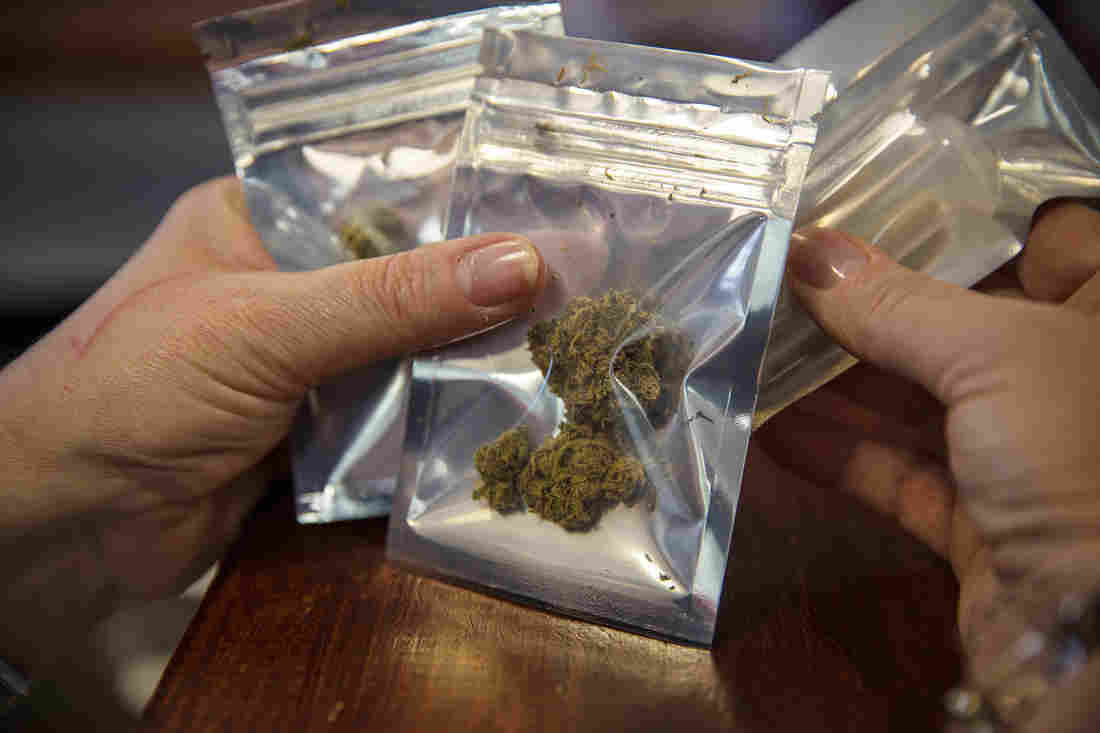
    Researchers looked at states with medical marijuana dispensaries and those that allow home cultivation. Evelyn Hockstein/The Washington Post/Getty Images hide caption

    toggle caption

    Evelyn Hockstein/The Washington Post/Getty Images

    Researchers looked at states with medical marijuana dispensaries and those that allow home cultivation.

    Evelyn Hockstein/The Washington Post/Getty Images

    Medical marijuana appears to have put a dent in the opioid abuse epidemic, according to two studies published Monday.

    The research suggests that some people turn to marijuana as a way to treat their pain, and by so doing, avoid more dangerous addictive drugs. The findings are the latest to lend support to the idea that some people are willing to substitute marijuana for opioids and other prescription drugs.

    Many people end up abusing opioid drugs such as oxycodone and heroin after starting off with a legitimate prescription for pain. The authors argue that people who avoid that first prescription are less likely to end up as part of the opioid epidemic.

    “We do know that cannabis is much less risky than opiates, as far as likelihood of dependency,” says W. David Bradford, a professor of public policy at the University of Georgia. “And certainly there’s no mortality risk” from the drug itself.

    The National Academy of Sciences, Engineering and Medicine says there’s good evidence that cannabis is effective at treating pain for some conditions. So Bradford and three colleagues — including his scientist daughter — decided to see whether people who can get easy access to medical marijuana are less likely to get prescription opioids. The answer, they report in JAMA Internal Medicine, is yes.

    “There are substantial reductions in opiate use” in states that have initiated dispensaries for medical marijuana, he says.

    After Medical Marijuana Legalized, Medicare Prescriptions Drop For Many Drugs

    Shots – Health News

    After Medical Marijuana Legalized, Medicare Prescriptions Drop For Many Drugs

    The researchers studied data from Medicare, which mostly covers people over the age of 65. (It was a convenient set of data and available to them at no cost.) They found a 14 percent reduction in opioid prescriptions in states that allow easy access to medical marijuana.

    They estimate that these dispensary programs reduced the number of opioid prescriptions by 3.7 million daily doses. States that allowed homegrown marijuana for medical use saw an estimated 1.8 million fewer pills dispensed per day. To put that in perspective, from 2010 to 2015 Medicare recipients received an average of 23 million daily doses of opioids, the researchers say.

    Because opioid use nationwide was rising during the study period, their estimate of reduced uses reflects a slowing of the increase, rather than an actual decline in opioid use in these states, Bradford says.

    The analysis found a correlation and can’t prove that marijuana use led to a reduction in the growth of opioid use. There might be other factors at work.

    Even so, the findings suggest that expanding access to medical marijuana could help ease the opioid epidemic.

    Hefei Wen at the University of Kentucky College of Public Health was lead author on another study in the same journal that reached similar conclusions. Wen, with Jason Hockenberry at Emory University, used Medicaid data. Medicaid is primarily a health insurance program for low-income people.

    The authors write that laws that permit both medical marijuana and recreational marijuana for adults “have the potential to reduce opioid prescribing for Medicaid enrollees, a segment of population with disproportionately high risk for chronic pain, opioid use disorder and opioid overdose. Nevertheless, marijuana liberalization alone cannot solve the opioid epidemic.”

    Bradford agrees that medical marijuana laws could have a role to play. “But it is not without risks,” he says. “Like any drug in our FDA-approved pharmacopeia, it can be misused. There’s no question about it. So I hope nobody reading our study will say ‘Oh, great, the answer to the opiate problem is just put cannabis in everybody’s medicine chest and we are good to go.’ We are certainly not saying that.”

    One concern is marijuana use might encourage people to experiment with more dangerous drugs. Dr. Mark Olfson, a professor of psychiatry and epidemiology at Columbia University, authored a study that found marijuana users were six times more likely than nonusers to abuse opioids.

    “A young person starting marijuana is maybe putting him — or herself at increased risk,” Olfson says. “On the other hand there may be a role — and there likely is a role — for medical marijuana in reducing the use of prescribed opioids for the management of pain.”

    This is a question of balancing risks and benefits. And that’s difficult to do with the current studies based on broad populations — and in this case, populations that are not representative of the at-risk population as a whole.

    Olfson says what they really need is studies that follow individuals, to see whether marijuana use really does supplant opioids. It’s hard to do a study in this area because the federal government regards marijuana as a very dangerous drug and puts tight controls on research.

    “That does make this a difficult area to study, and that’s unfortunate because we have a large problem with the opioid epidemic,” Olfson says. “And at the same time, with an aging population, we have lots of people who have pain conditions and who will benefit from appropriate management.”

    You can contact Richard Harris at rharris@npr.org.

    Read the article here

    Share this Post

    Share Explaining Medicine Share Explaining Medicine

    Opioid Use Lower In States That Eased Marijuana Laws was last modified: April 12th, 2018 by Richard Harris

    Related

    Marijuanaopioid epidemicopioids
    0 comment
    0
    Facebook Twitter Google + Pinterest
    Richard Harris

    previous post
    Abandoning Your Workouts May Bring on the Blues
    next post
    Seeking Better Sleep Under a Weighted Blanket

    Related Articles

    Annette Bening Opens Up on Family, Charity, Aging

    May 30, 2018

    The Promise of Menstrual Blood Diagnostics

    January 9, 2018

    Millions Could Lose Medicaid Coverage Under Trump Plan

    November 10, 2016

    Research at the heart of a federal case against the abortion pill has been retracted

    February 9, 2024

    How I Manage Relapsing-Remitting MS

    February 21, 2024

    Stay-At-Home Dads Still Struggle With Diapers, Drool, Stigma And Isolation

    June 17, 2018

    The lesson every medical student can learn from emergencies

    January 11, 2019

    Take the naloxone challenge

    March 26, 2019

    What the FDA forgets in the battle against e-cigarettes

    December 20, 2018

    Do patients pay less for less expensive care? Why the CVS/Aetna deal matters.

    February 25, 2018

    Recent Posts

    • Flu shot recommendation for kids dropped just as the illness rages

      January 12, 2026
    • The CDC just sidelined these childhood vaccines. Here’s what they prevent

      January 9, 2026
    • Your next primary care doctor could be online only, accessed through an AI tool

      January 9, 2026
    • In Lodge Grass, Montana, a Crow community works to rebuild from meth’s destruction

      January 8, 2026
    • RFK Jr.’s new dietary guidelines go all in on meat and dairy

      January 7, 2026

    Keep in touch

    Facebook Twitter Google + RSS

    Recent Posts

    • Flu shot recommendation for kids dropped just as the illness rages

      January 12, 2026
    • The CDC just sidelined these childhood vaccines. Here’s what they prevent

      January 9, 2026
    • Your next primary care doctor could be online only, accessed through an AI tool

      January 9, 2026
    • In Lodge Grass, Montana, a Crow community works to rebuild from meth’s destruction

      January 8, 2026
    • RFK Jr.’s new dietary guidelines go all in on meat and dairy

      January 7, 2026
    • Terms of Service
    • Privacy Policy

    @2026 - Explaining Medicine. All Right Reserved.


    Back To Top
    Explaining Medicine
    Proudly powered by WordPress Theme: soledad child.