 Enlarge this image
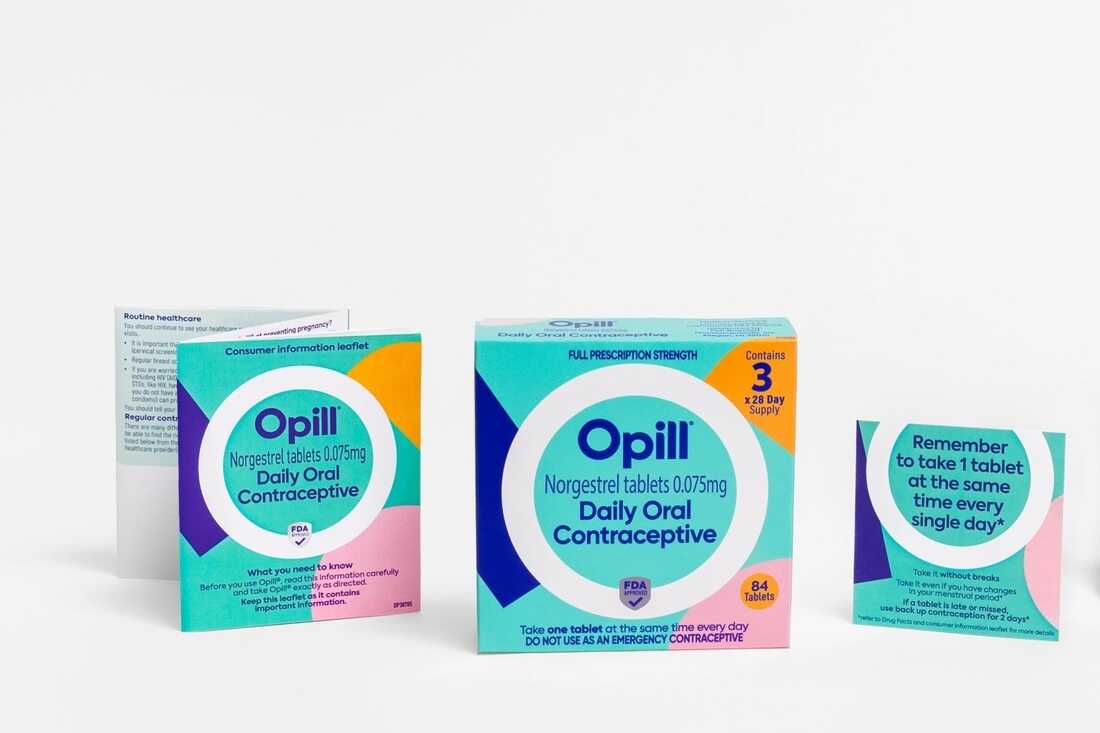
Opill, the first daily oral contraceptive that will be available for sale over the counter in stores as well as online, was approved by the FDA last week. Perrigo Co. hide caption
toggle caption
Perrigo Co.
Opill, the first daily oral contraceptive that will be available for sale over the counter in stores as well as online, was approved by the FDA last week.
Perrigo Co.
Last week, the FDA approved Opill, the first daily oral contraceptive that will be available for sale over the counter in stores as well as online. Reproductive health advocates hailed the groundbreaking approval as a step that can help millions of people avoid pregnancy, which is unintended nearly half the time in the United States.
They long have argued that eliminating the often-time-consuming step of requiring women to get a prescription before they can get birth control pills would expand access and give women more control over their contraceptive decisions.
Advocates want the FDA approval to signal a trend.
Your Health
FDA approves Opill, the first daily birth control pill without a prescription
“We hope that this is only the beginning for expanding access to a range of over-the-counter contraceptive options,” said Kelly Blanchard, president of Ibis Reproductive Health, part of a coalition of advocacy groups that have worked for decades to make contraception available over the counter.
For example, a company called Cadence is working on getting FDA approval for a birth control pill with a different formulation that would also be available over the counter without a prescription.
But many details related to cost and coverage of an OTC pill still need to be sorted out. Here are answers to common questions and concerns people may have about the new pill and how to use it with their insurance.
1. Who is most likely to be interested in an over-the-counter oral contraceptive like Opill?
Anyone might be interested, depending on their circumstances. In a survey conducted last year, more than three-quarters of women of reproductive age said they were in favor of making birth control available over the counter as long as research showed it to be safe and effective.
For people who are uninsured, the new pathway will allow them to save the cost of a visit to a health care provider for a prescription, and the expense of taking time off work or getting child care in some cases.
But even people with health coverage might be very interested, experts say. For example, young people who are insured under a parent’s plan might not want insurance notices sent to their parents’ home.
“We were particularly thrilled that the FDA approval came with no age restriction,” Blanchard said.
Similarly, women whose partners don’t want them to take birth control might choose to sidestep their coverage.
Simple convenience might be a factor if you’re on vacation and there’s no in-network pharmacy nearby, for example, or if you can’t get an appointment to see your primary care doctor for a few weeks to discuss your options but don’t want to be unprotected.
2. Is this pill safe for most people?
Opill (norgestrel) contains only one hormone, progestin, while most of the 60 or so contraceptive pill formulations on the market contain both estrogen and progestin.
Life Kit
There are so many types of birth control. Here’s how to choose what works for you
Progestin-only pills, sometimes called mini-pills, have very few contraindications, meaning there are few medical circumstances when taking them would be ill-advised. For Opill, a key contraindication is if someone has breast cancer or a history of breast cancer.
“Since they don’t contain estrogen, they have very few and quite rare contraindications, so they’re safe and appropriate for a broader population to use to prevent pregnancy,” said Stephanie Sober, a physician and the global lead of medical affairs for women’s health at Perrigo Co., which makes the pill.
Both progestin-only pills and combination pills that contain progestin and estrogen are more than 90% effective during normal use.
3. When can I get Opill and how much will it cost?
The drugmaker says Opill will be available in stores and online in early 2024 but has not revealed how much it will charge for a monthly pack of pills.
The average monthly cost for oral contraceptives ranges from $0 for people with health insurance to about $50, said Regan Clawson, senior director of health care access strategy at Planned Parenthood Federation of America.
Perrigo said the company will have a consumer assistance program that allows some people to get Opill free of charge, but no details are yet available.
4. Do health plans have to cover the new pill?
Not necessarily. Under the Affordable Care Act’s preventive services guidelines, most health plans have to cover the full range of contraceptives approved by the FDA, including progestin-only oral contraceptives, without requiring any out-of-pocket spending by members.
But that doesn’t mean plans must cover every single type of pill. Since there is more than one progestin-only pill on the market, it’s possible that Opill may not be the one your plan picks to cover, said Mara Gandal-Powers, director of birth control access at the National Women’s Law Center.
However, if you and your doctor determine that Opill is medically the best oral contraceptive for you, health plans are required to have a process in place that permits you to get that pill without cost sharing, even if it’s not on your plan’s formulary, or list of covered drugs.
5. I have health insurance, and I don’t normally have to pay anything for my birth control pills. Will I be able to pick up Opill off the shelf and not pay for it?
That’s the goal, advocates agree, but at first you’ll probably need a prescription from your doctor to get Opill without paying for it (assuming your plan covers it). Under the health law, health plans can require a prescription for oral contraceptives.
It’s a barrier that defeats the objective of making the pills easier to get, advocates said.
“If you buy something off the shelf and then have to submit it for reimbursement, that to me is not ‘no out-of-pocket costs,'” Gandal-Powers said.
A recent federal directive, however, might offer clues to how this could unfold. In that guidance, the government reiterated that health plans must cover — without cost sharing — emergency contraception purchased over the counter when it is prescribed. It encouraged but did not require health plans to do so without a prescription.
Advocates are pushing for the federal government to make no-cost coverage without a prescription an explicit requirement for all over-the-counter contraceptives.
“There’s nothing in the law that requires a prescription to invoke the no-cost-sharing requirement for preventive services and drugs,” said Dana Singiser, co-founder of the Contraceptive Access Initiative, which has published a white paper on the subject.
“CMS is collaborating closely with the Departments of Labor and the Treasury and is considering ways to ensure that private health insurance under the ACA market reforms covers all Food and Drug Administration (FDA) approved, granted, or cleared contraceptives without cost sharing, even when available OTC and purchased without being prescribed,” Sara Lonardo, press secretary at the Centers for Medicare & Medicaid Services, said in a statement.
Eight states already require health plans to cover, without a prescription or copayment, at least one contraceptive method sold over the counter, such as condoms or spermicide, said Tara Mancini, director of public policy at Power to Decide, an advocacy group that has analyzed state laws. An additional three states and the District of Columbia require coverage of over-the-counter contraception without a prescription but don’t specify whether a copayment may be required. Those laws apply only to health plans regulated by the states.
“That’s why federal regulation is so critical,” Singiser said.
KFF Health News, formerly known as Kaiser Health News (KHN), is a national newsroom that produces in-depth journalism about health issues and is one of the core operating programs at KFF — the independent source for health policy research, polling, and journalism.
Share this Post
