Explaining Medicine
  • News
  • Health & Lifestyle
    • Diet & Weight Management
    • Exercise & Fitness
    • Nutrition, Food & Recipes
    • Prevention & Wellness
  • Conditions
    • Custom1
      • Conditions A-Z
      • Procedures A-Z
      • Allergies
      • Alzheimer’s
      • Arthritis
      • Asthma
      • Blood Pressure
      • Cholesterol
      • Cancer
    • Custom2
      • Chronic Pain
      • Cold Flu
      • Depression
      • Diabetes
      • Digestion
      • Eyesight
      • Health Living
      • Healthy Kids
      • Hearing Ear
    • Custom3
      • Heart
      • HIV/AIDS
      • Infectious Disease
      • Lung Conditions
      • Menopause
      • Men’s Health
      • Mental Health
      • Migraine
      • Neurology
    • Custom4
      • Oral Health
      • Pregnancy
      • Senior Health
      • Sexual Health
      • Skin Problems
      • Sleep
      • Thyroid
      • Travel Health
      • Women’s Health
  • Medications
    • Medications
    • Supplements and Vitamins
  • Medical Dictionary
  • Health Alerts
Flu shot recommendation for kids dropped just as...
The CDC just sidelined these childhood vaccines. Here’s...
Your next primary care doctor could be online...
In Lodge Grass, Montana, a Crow community works...
RFK Jr.’s new dietary guidelines go all in...
More seniors are becoming homeless. Shelters are trying...
Health officials slash the number of vaccines recommended...
Wegovy obesity pill now available at pharmacies
In the U.S., hunger is often hidden. But...
One doctor’s experience shows the battle for the...
Top Posts

Explaining Medicine

  • News
  • Health & Lifestyle
    • Diet & Weight Management
    • Exercise & Fitness
    • Nutrition, Food & Recipes
    • Prevention & Wellness
  • Conditions
    • Custom1
      • Conditions A-Z
      • Procedures A-Z
      • Allergies
      • Alzheimer’s
      • Arthritis
      • Asthma
      • Blood Pressure
      • Cholesterol
      • Cancer
    • Custom2
      • Chronic Pain
      • Cold Flu
      • Depression
      • Diabetes
      • Digestion
      • Eyesight
      • Health Living
      • Healthy Kids
      • Hearing Ear
    • Custom3
      • Heart
      • HIV/AIDS
      • Infectious Disease
      • Lung Conditions
      • Menopause
      • Men’s Health
      • Mental Health
      • Migraine
      • Neurology
    • Custom4
      • Oral Health
      • Pregnancy
      • Senior Health
      • Sexual Health
      • Skin Problems
      • Sleep
      • Thyroid
      • Travel Health
      • Women’s Health
  • Medications
    • Medications
    • Supplements and Vitamins
  • Medical Dictionary
  • Health Alerts
  • News

    Poll: Most Americans Know About Opioid Antidote And Are Willing To Use It

    by Scott Hensley August 21, 2018

    Enlarge this image

    A man holds a sample of the opioid antidote Narcan during a training session at a New York City Department of Health and Mental Hygiene office in March. Kena Betancur/AFP/Getty Images hide caption

    toggle caption

    Kena Betancur/AFP/Getty Images

    A man holds a sample of the opioid antidote Narcan during a training session at a New York City Department of Health and Mental Hygiene office in March.

    Kena Betancur/AFP/Getty Images

    U.S. Surgeon General Jerome Adams made a plea in April for more Americans to be prepared to administer naloxone, an opioid antidote, in case they or people close to them suffer an overdose.

    “The call to action is to recognize if you’re at risk,” Adams told NPR’s Rachel Martin. “And if you or a loved one are at risk, keep within reach, know how to use naloxone.”

    Nearly every state has made it easier for people to get naloxone by allowing pharmacists to dispense the drug without an individual prescription. Public health officials are able to write what are called standing orders, essentially prescriptions that cover everyone in their jurisdiction.

    Some states require training in how to use naloxone, typically given as a nasal spray called Narcan or with an EpiPen-like automatic injection, in order for someone to pick up naloxone. But the medicine is simple to use either way.

    After the surgeon general called for more people to be prepared with naloxone, we decided to ask Americans about their knowledge about the opioid antidote’s availability, attitudes toward using it and experience with the medicine in the latest NPR-IBM Watson Health Health Poll. The survey queried more than 3,000 households nationwide in May.

    We wondered how many people know about naloxone and the fact that someone doesn’t have to be a medical professional to administer it. Fifty-nine percent of respondents said they were aware of the antidote and that it could be given by laypeople; 41 percent said they weren’t.

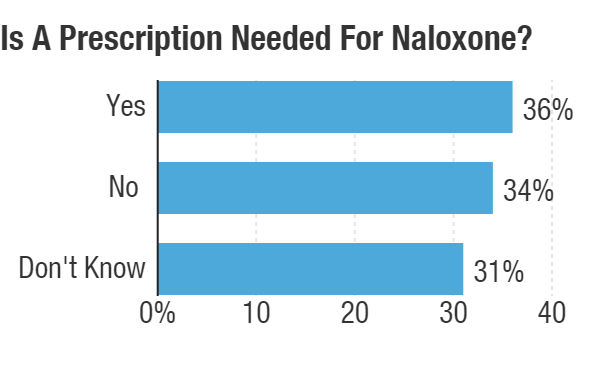
    (Responses sum to more than 100 because of rounding.) NPR-IBM Watson Health hide caption

    toggle caption

    NPR-IBM Watson Health

    We then asked people who knew about naloxone if they would need a prescription to get it. The answers were pretty evenly divided among three options: yes, no and not sure/no response.

    “Why, with all the attention we’ve had in the media, why don’t more Americans know about naloxone?” asks Dr. Anil Jain, vice president and chief health information officer for IBM Watson Health. “When people did know, why did people think they needed a prescription?” While the survey doesn’t get at the causes, Jain says, the findings underscore the need for greater public awareness.

    Baltimore Health Commissioner Dr. Leana Wen says the lack of knowledge among Americans at large isn’t all that surprising. “Policy alone is necessary but not sufficient,” she says. “People still don’t know to go to the pharmacy to get access to naloxone, especially individuals at the highest risk.”

    To change that, she says, “you have to have continued education and the delivery of services” where people need them.

    In Baltimore, the health department maps where overdoses are happening and sends outreach workers to the areas. But money is an issue, even at a negotiated cost of $75 per naloxone kit, Wen says. There isn’t enough naloxone to go around. “Every week we take stock of how many naloxone kits we have for the rest of fiscal year,” she says. “Who’s at most risk? Those are who we give the naloxone to.”

    The NPR-IBM Watson Health Poll asked people if they would be willing to use Narcan, the nasal spray form of naloxone, to help a person who had overdosed. Fifty-eight percent said they would and 29 percent said no. Thirteen precent weren’t sure or didn’t respond. Only 47 percent of people 65 and older said they would be willing to do it.

    When asked about the auto-injector option, 68 percent of respondents said they would be willing to administer naloxone that way and 22 percent of people said they wouldn’t be.

    Finally, we asked whether people had obtained naloxone, and 10 percent said they or someone in their household had. Among those people, 81 percent said the naloxone had been used, but the sample size for this question was small, making interpretation difficult.

    The nationwide poll has an overall margin of error of plus or minus 1.8 percentage points. You can find the questions and full results here.

    Read the article here

    Share this Post

    Share Explaining Medicine Share Explaining Medicine

    Poll: Most Americans Know About Opioid Antidote And Are Willing To Use It was last modified: August 29th, 2018 by Scott Hensley

    Related

    NaloxoneNarcanNPR-IBM Watson Health PollNPR-Truven Health Analytics Health Pollopioid epidemicopioid overdoses
    0 comment
    0
    Facebook Twitter Google + Pinterest
    Scott Hensley

    previous post
    For Cervical Cancer Screening, Women Over 30 Can Now Choose The HPV Test Only
    next post
    Ketamine A ‘Lifesaving’ Aid for Depression?

    Related Articles

    Most U.S. Babies Start Solid Foods Too Soon

    January 4, 2018

    Why many doctors live paycheck to paycheck

    March 18, 2019

    Dr Anjali Malpani has been honoured with the Times Healthcare Achiever Award 2018 in Mumbai

    May 31, 2018

    What we can learn from the tragic deaths of CEOs

    October 26, 2018

    Medical clinicians are being stress fractured

    December 9, 2018

    All About ALS , Understanding a Devastating Disorder

    June 27, 2016

    High Deductibles May Threaten Breast Cancer Patients’ Survival

    March 4, 2019

    MiM Mail: How to ask for part-time?

    November 2, 2017

    Gene therapy for muscular dystrophy stirs hopes and controversy

    May 2, 2023

    Fungi in Breast Milk? These Kinds Are Good for Baby

    March 4, 2019

    Recent Posts

    • Flu shot recommendation for kids dropped just as the illness rages

      January 12, 2026
    • The CDC just sidelined these childhood vaccines. Here’s what they prevent

      January 9, 2026
    • Your next primary care doctor could be online only, accessed through an AI tool

      January 9, 2026
    • In Lodge Grass, Montana, a Crow community works to rebuild from meth’s destruction

      January 8, 2026
    • RFK Jr.’s new dietary guidelines go all in on meat and dairy

      January 7, 2026

    Keep in touch

    Facebook Twitter Google + RSS

    Recent Posts

    • Flu shot recommendation for kids dropped just as the illness rages

      January 12, 2026
    • The CDC just sidelined these childhood vaccines. Here’s what they prevent

      January 9, 2026
    • Your next primary care doctor could be online only, accessed through an AI tool

      January 9, 2026
    • In Lodge Grass, Montana, a Crow community works to rebuild from meth’s destruction

      January 8, 2026
    • RFK Jr.’s new dietary guidelines go all in on meat and dairy

      January 7, 2026
    • Terms of Service
    • Privacy Policy

    @2026 - Explaining Medicine. All Right Reserved.


    Back To Top
    Explaining Medicine
    Proudly powered by WordPress Theme: soledad child.