Explaining Medicine
  • News
  • Health & Lifestyle
    • Diet & Weight Management
    • Exercise & Fitness
    • Nutrition, Food & Recipes
    • Prevention & Wellness
  • Conditions
    • Custom1
      • Conditions A-Z
      • Procedures A-Z
      • Allergies
      • Alzheimer’s
      • Arthritis
      • Asthma
      • Blood Pressure
      • Cholesterol
      • Cancer
    • Custom2
      • Chronic Pain
      • Cold Flu
      • Depression
      • Diabetes
      • Digestion
      • Eyesight
      • Health Living
      • Healthy Kids
      • Hearing Ear
    • Custom3
      • Heart
      • HIV/AIDS
      • Infectious Disease
      • Lung Conditions
      • Menopause
      • Men’s Health
      • Mental Health
      • Migraine
      • Neurology
    • Custom4
      • Oral Health
      • Pregnancy
      • Senior Health
      • Sexual Health
      • Skin Problems
      • Sleep
      • Thyroid
      • Travel Health
      • Women’s Health
  • Medications
    • Medications
    • Supplements and Vitamins
  • Medical Dictionary
  • Health Alerts
Flu shot recommendation for kids dropped just as...
The CDC just sidelined these childhood vaccines. Here’s...
Your next primary care doctor could be online...
In Lodge Grass, Montana, a Crow community works...
RFK Jr.’s new dietary guidelines go all in...
More seniors are becoming homeless. Shelters are trying...
Health officials slash the number of vaccines recommended...
Wegovy obesity pill now available at pharmacies
In the U.S., hunger is often hidden. But...
One doctor’s experience shows the battle for the...
Top Posts

Explaining Medicine

  • News
  • Health & Lifestyle
    • Diet & Weight Management
    • Exercise & Fitness
    • Nutrition, Food & Recipes
    • Prevention & Wellness
  • Conditions
    • Custom1
      • Conditions A-Z
      • Procedures A-Z
      • Allergies
      • Alzheimer’s
      • Arthritis
      • Asthma
      • Blood Pressure
      • Cholesterol
      • Cancer
    • Custom2
      • Chronic Pain
      • Cold Flu
      • Depression
      • Diabetes
      • Digestion
      • Eyesight
      • Health Living
      • Healthy Kids
      • Hearing Ear
    • Custom3
      • Heart
      • HIV/AIDS
      • Infectious Disease
      • Lung Conditions
      • Menopause
      • Men’s Health
      • Mental Health
      • Migraine
      • Neurology
    • Custom4
      • Oral Health
      • Pregnancy
      • Senior Health
      • Sexual Health
      • Skin Problems
      • Sleep
      • Thyroid
      • Travel Health
      • Women’s Health
  • Medications
    • Medications
    • Supplements and Vitamins
  • Medical Dictionary
  • Health Alerts
  • News

    Poll: Young People More Likely To Defer Health Care Because Of Cost

    by Scott Hensley December 7, 2018

    Enlarge this image

    When to get care and when to pass often comes down to finances. Johner Images/Getty Images hide caption

    toggle caption

    Johner Images/Getty Images

    When to get care and when to pass often comes down to finances.

    Johner Images/Getty Images

    If you’re not feeling well or have a routine health issue, do you go ahead and get it checked out or put if off because of the cost?

    And, let’s say you do make an appointment and go. Afterward, do you fill the prescription you received or do financial concerns stop you?

    We wondered how often people deferred or skipped care because of cost, so we asked in the latest NPR-IBM Watson Health Health Poll. The survey queried more than 3,000 households nationwide in July.

    For starters we asked if people had postponed, delayed or canceled some kind of health care service, such as a doctor’s appointment or medical procedure, because of cost in the preceding three months. About 1 in 5 people had done so.

    “I am pretty impressed that it was only 20 percent that had postponed or delayed or canceled health care services,” says Dr. Anil Jain, vice president and chief health information officer for IBM Watson Health. “I thought it would be higher.”

    The proportion of people who said cost had deterred them from getting care varied by age, with a third of people under 35 saying it had been a problem compared with only 8 percent of people 65 and older.

    Note: Question asked about health care in preceding three months. NPR-IBM Watson Health Poll hide caption

    toggle caption

    NPR-IBM Watson Health Poll

    Jain says one area that may not be getting enough attention is preventive care. “I think it’s important that young people never feel the need to forgo or delay preventive services,” he says.

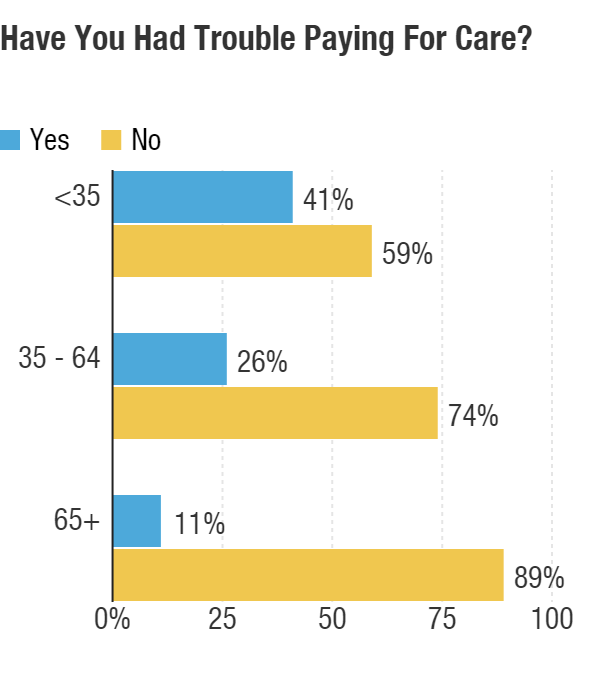
    We also asked people if they – or members of their household — had difficulty paying for some kind health care service in the preceding three months. A quarter said yes. And again the strain varied by age, with 41 percent of people under 35 saying they had experienced difficulty while only 11 percent of people 65 and older had.

    Almost all the respondents to the survey, about 97 percent, had some form of health coverage. The sample size of respondents reporting no insurance wasn’t large enough to support further analysis within the uninsured population.

    We also asked specifically about people’s experience receiving and filling prescriptions. In the three months before the survey, two-thirds of people said they’d received a prescription. A vast majority of older Americans – 84 percent – said they’d received a prescription, while 39 percent of people under 35 had.

    Almost everyone who said they’d gotten a prescription went ahead and filled it – 97 percent overall.

    The cost of prescriptions appeared to be a bigger concern for younger people, with 38 percent of those under 35 saying they had difficulty paying for their medicine. Only 9 percent of people 65 and older said they had the same problem.

    With an eye on costs, we asked people if they were familiar with discount coupons provided by drugmakers, one way to defray out-of-pocket expenses related to prescriptions. About two-thirds of people said they were aware of these coupons.

    In a follow-up question, we asked if people had used this kind of coupon. About a third of people said they had. Among older people, 65 and up, the proportion was quite a bit lower – only 19 percent said they’d used this kind of coupon.

    Drug costs weigh on people as deductibles and copayments add up.

    “Despite insurance, we feel that more people are experiencing a higher out-of-pocket burden due to medications,” says Thomas Goetz, head of research for GoodRx, a clearinghouse for drug pricing information, discounts and coupons. “Insurance is increasingly not covering that expense as much as it used to.”

    Manufacturers’ coupons are geared toward brand-name medicines, only one part of the financial challenge. “The burden for most Americans is largely with these generic drugs that are considered very routine to prescribe and are getting more expensive,” Goetz says. “A $20 drug becomes $100.”

    Think of all the sacrifices people are making to avoid skipping prescriptions, he says. “We take these medications because they’re supposed to makes us feel better, and the price doesn’t always have that effect.”

    The nationwide poll has an overall margin of error of plus or minus 1.8 percentage points. You can find the questions and full results here.

    Read the article here

    Share this Post

    Share Explaining Medicine Share Explaining Medicine

    Poll: Young People More Likely To Defer Health Care Because Of Cost was last modified: December 15th, 2018 by Scott Hensley

    Related

    copaymentshealth care costsNPR-IBM Watson Health Pollprescription drugs
    0 comment
    0
    Facebook Twitter Google + Pinterest
    Scott Hensley

    previous post
    Valsartan Blood Pressure Drug Recall Widens
    next post
    Too Much Salt Might Help Spur A-Fib

    Related Articles

    Some doctors are ditching the scale, saying focusing on weight drives misdiagnoses

    December 2, 2023

    Can Brain ‘Pacemaker’ Help Head Trauma Patients?

    September 29, 2016

    Unnecessary testing wastes money and can lead to further testing

    March 9, 2018

    A mom’s $97,000 question: How was an air-ambulance ride not medically necessary?

    March 25, 2024

    The fall of the digital rectal exam

    April 16, 2018

    New sex talk podcast for happier relationships

    December 5, 2018

    Why bioethicists fall short of connecting with clinicians

    February 9, 2019

    Could a Blood Test Spot Early Stage Colon Cancer?

    January 18, 2018

    Donate Blood: Save a Life

    November 18, 2018

    Hospitals Worry Repeal Of Obamacare Would Jeopardize Innovations In Care

    January 27, 2017

    Recent Posts

    • Flu shot recommendation for kids dropped just as the illness rages

      January 12, 2026
    • The CDC just sidelined these childhood vaccines. Here’s what they prevent

      January 9, 2026
    • Your next primary care doctor could be online only, accessed through an AI tool

      January 9, 2026
    • In Lodge Grass, Montana, a Crow community works to rebuild from meth’s destruction

      January 8, 2026
    • RFK Jr.’s new dietary guidelines go all in on meat and dairy

      January 7, 2026

    Keep in touch

    Facebook Twitter Google + RSS

    Recent Posts

    • Flu shot recommendation for kids dropped just as the illness rages

      January 12, 2026
    • The CDC just sidelined these childhood vaccines. Here’s what they prevent

      January 9, 2026
    • Your next primary care doctor could be online only, accessed through an AI tool

      January 9, 2026
    • In Lodge Grass, Montana, a Crow community works to rebuild from meth’s destruction

      January 8, 2026
    • RFK Jr.’s new dietary guidelines go all in on meat and dairy

      January 7, 2026
    • Terms of Service
    • Privacy Policy

    @2026 - Explaining Medicine. All Right Reserved.


    Back To Top
    Explaining Medicine
    Proudly powered by WordPress Theme: soledad child.