 Enlarge this image
A man walks past a building on the Google campus in Mountain View, Calif. Google search results about health can be influential, but sometimes they can be unreliable or wrong. Jeff Chiu/AP hide caption
toggle caption
Jeff Chiu/AP
A man walks past a building on the Google campus in Mountain View, Calif. Google search results about health can be influential, but sometimes they can be unreliable or wrong.
Jeff Chiu/AP
My wife is pregnant, and I’m terrified. I don’t even have a baby yet, but I have an untold number of questions and concerns that wake me up in the middle of the night. And as I lie awake, I inevitably dive down a Google rabbit hole searching for information.
And Google usually has an answer in a little box at the top of the search results. The information is displayed in a concise, easy-to-understand way, making it an attractive solution for filling in knowledge gaps. But look closer, and you’ll see that some answers contradict themselves, others come from questionable sources and sometimes they contain factual errors.
Google/Screenshot by NPR
Take, for example, the answer to the question, “Can pregnant women eat eggs?”
Citing a site called Mom Junction, Google says:
“During your pregnancy, you need to cook eggs properly until both the white and yolk turn solid. It, therefore, kills the bacteria and makes eggs a safe option to eat. Though salmonella poisoning will not harm your baby, it can be unpleasant for you as it could cause: Abdominal pain.”
According to Dr. Leena Nathan, an OB-GYN at UCLA Health, that answer is only partially correct. Yes, she says, pregnant women should cook their eggs completely; otherwise they risk being infected with salmonella. But, Mom Junction gets the second part of the answer wrong. A baby can be in grave danger if the mother is infected with the bacteria.
“In the first trimester it can actually cause miscarriage if you develop one of these bacterial gastroenteritides. You can definitely lose the pregnancy because of it,” Nathan says. She’s seen it happen.
After I reached out to Mom Junction for comment, they changed the answer from “will not” to “unlikely,” a correction that Nathan agrees with.
Shots – Health News
Should I Trust Wikipedia With My Health?
It’s not just anxious parents-to-be that are Googling health-related questions. People have been turning to the Internet for medical answers for years, and misinformation is nothing new.
“I would say on any given day, it’s probably at least 50 percent of patients who say something about the Internet,” says Dr. Lara Hart, an OB-GYN at Northside Hospital in Atlanta. “Probably less than 25 percent of the time does it end up being a reputable source.”
What is new are Google’s featured snippets, or the answer boxes at the top of the search page, which were introduced in 2014.
When someone submits a query, Google’s algorithms parse relevant search results for an answer. The text is pulled directly from sites that Google thinks best address what the user wants to know. And different users can get different results for the same question.
“Google actually doesn’t know what’s true and what’s not true,” says Danny Sullivan, who’s looked into the issue of false information in featured snippets for his website, Search Engine Land.
But it’s not just falsehoods that users have to contend with.
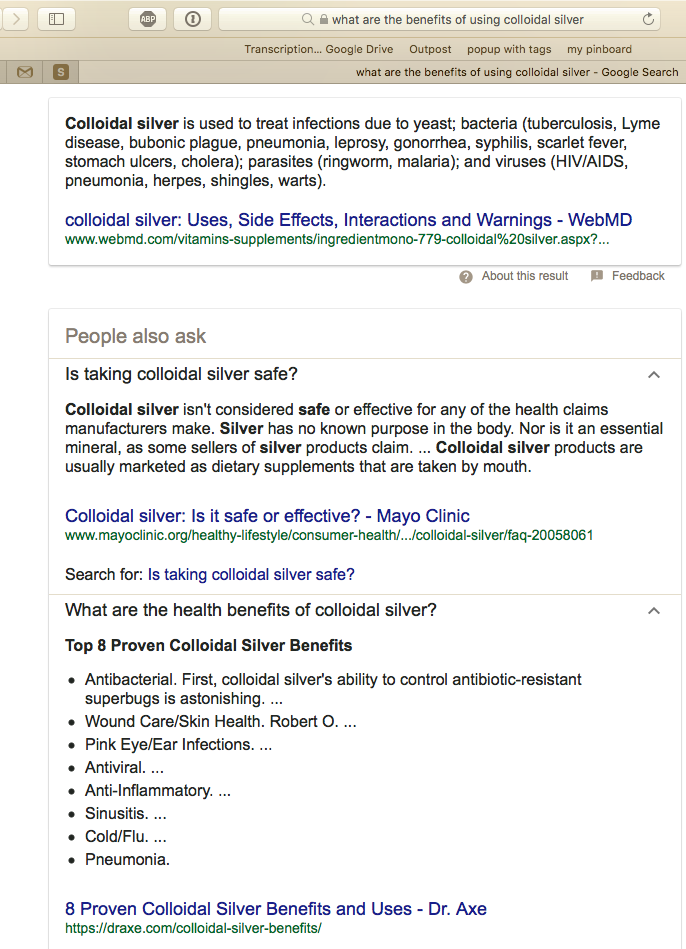
Ask one question and another will be suggested by the search engine, but sometimes the answers to those related questions contradict one another.
Take for instance the snippets about colloidal silver, a popular homeopathic supplement trumpeted by the likes of Gwyneth Paltrow and sold at stores like Whole Foods. It’s silver particles in water.
Check out the search results: The Mayo Clinic writes that colloidal silver is unsafe, while the WebMD result is unclear. DrAxe.com champions its health benefits.
Enlarge this image
Google/Screenshot by NPR
Google/Screenshot by NPRAccording to the National Center for Complementary and Integrative Health, part of the National Institutes of Health, colloidal silver can be dangerous and could potentially lead to a condition called argyria, where the user’s skin takes on a blue tone.
But ask Google if colloidal silver is safe and the NCCIH website doesn’t show up until near the bottom of the first page, below the result from DrAxe.com.
It matters what shows up in search results, because that information shapes people’s opinions, research shows.
Henry Brighton, an assistant professor of cognitive science and artificial intelligence at Tilburg University in the Netherlands, saw this first hand in a survey that he conducted in Germany. He asked 289 subjects about the measles, mumps and rubella vaccine and whether they thought that it was a good or bad thing. He asked them to search for information online to help form an opinion, but he manipulated what they could see. For some, he prioritized negative information about the vaccine, while others saw mostly positive results.
In the end, user opinions skewed toward whichever search results had been prioritized.
Shots – Health News
Why Your Doctor Won’t Friend You On Facebook
“The ordering is everything,” Brighton said. “So, the big finding is the degree to which we can manipulate people’s health care decisions, even when these issues are really, really important, and we can do that simply by changing the rankings of search results.”
When Google was asked what responsibility the company has to provide factually accurate snippets, the company responded, “Since the early days of Search, our goal has been to provide people with access to relevant information from the most reliable sources available. And while we may not always get it right, we’re making good progress in tackling the problem.”
There are trillions of queries submitted to Google each year, but it’s unclear how many of those include featured snippets according to a spokesperson for the company. When asked how many of them might be incorrect, they were unable to provide that information as well.
In recent months, the company has implemented a new feature that lets users flag bad results.
Nathan and Hart recommend that if you have a medical question, ask your physician. But if you’re going to look up information online, make sure that it is actually from a reputable source.
Jacob Margolis reports on science for member station KPCC. You can follow him @jacobmargolis.
Share this Post
