 Enlarge this image
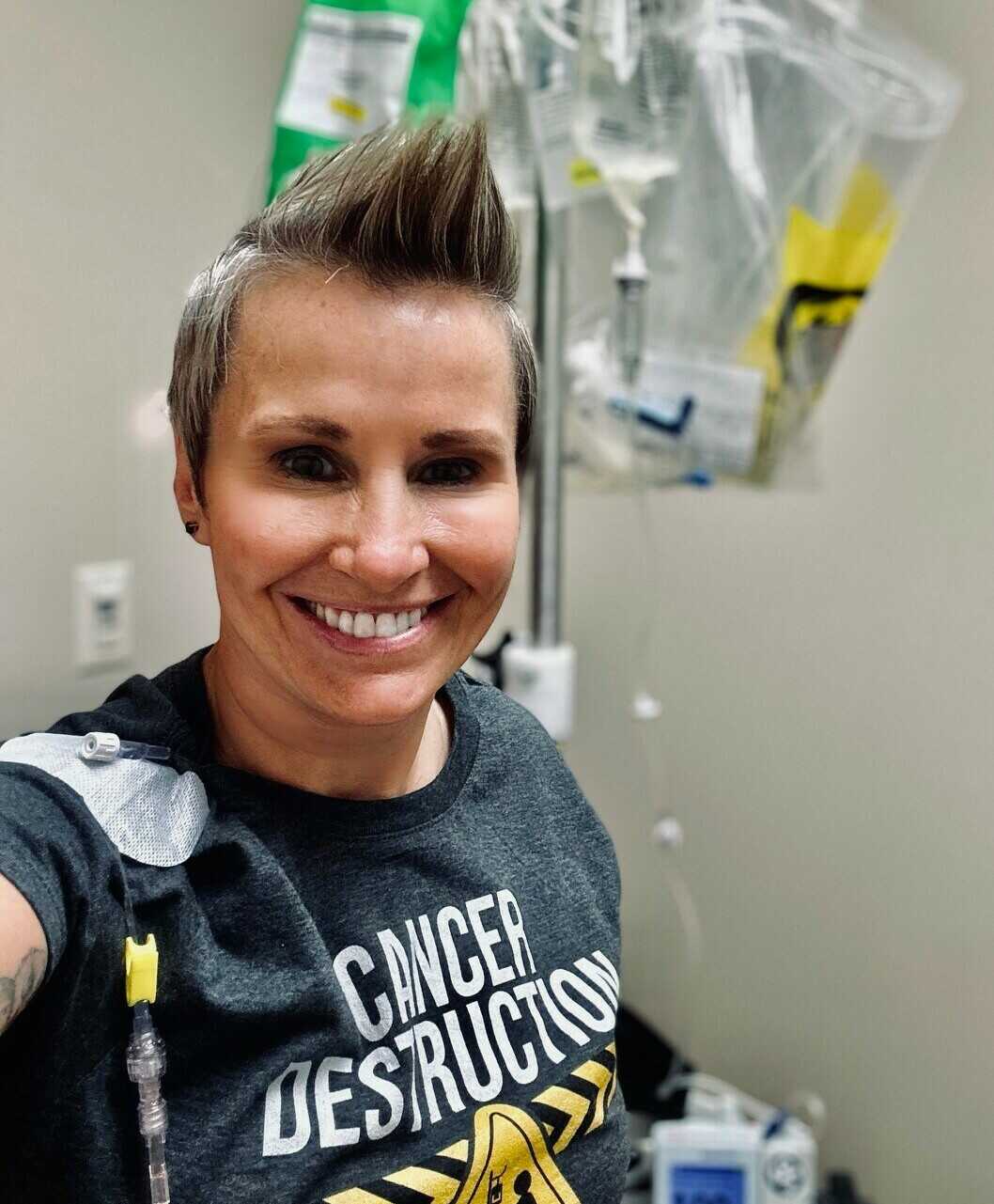
Toni Dezomits’ advanced ovarian cancer responded well to earlier rounds of chemo, but this spring, her doctors told her there was a shortage of a key chemo drug. Toni Dezomits hide caption
toggle caption
Toni Dezomits
Toni Dezomits’ advanced ovarian cancer responded well to earlier rounds of chemo, but this spring, her doctors told her there was a shortage of a key chemo drug.
Toni Dezomits
Toni Dezomits is used to facing death. She served in the Gulf War and later as a police officer, becoming a police chief in North Carolina before retiring. She says she doesn’t need any pity for her diagnosis of advanced ovarian cancer.
“I’m probably the toughest person you’re ever going to meet,” says Dezomits. At 55, she still feels mentally tough and physically prime despite her Stage 4 diagnosis.
“When we’re done talking, I’m going to go on a 10-mile bike ride,” she says, followed by gardening and walks with her three dogs. “I don’t ever sit around and go, ‘How long do people live with this cancer?'”
But even Dezomits felt scared in early April, when a medicine called carboplatin, which had almost eliminated tumors in her previous rounds of treatment, was unavailable. It and a similar drug called cisplatin — both core to treating many different cancers — fell into short supply earlier this year.
The shortage is so dire the Food and Drug Administration recently said it would allow import of unapproved cisplatin from China. Manufacturers are scrambling to try to make more. Still, experts say it will be year’s end before shortages of these two widely used generic drugs might begin to ease.
The story of how two critical medicines, plus more than a dozen other cancer drugs, ended up in shortage boils down to a faulty system for making and distributing generic drugs that has started leading to more and more shortages of various essential medications.
This latest shortage puts patients like Dezomits in a tough spot: “Here I am, faced with two suboptimal treatment plans.”
One choice: Substitute a drug with more severe side effects such as nausea and nerve pain. The other: Continue treatment without it. Dezomits opted to go without but won’t know the health implications of that choice for weeks, when she gets her next scan to see whether the cancers in her abdomen have grown.
Americans rely heavily on generic medications — they make up o ver 90% of prescriptions. But for the past 15 years, shortages of these non-brand drugs have become a more pervasive and acute problem, as everyone from consumers to retail drugstores and health systems put pressure on manufacturers to produce them at lower and lower prices.
“We have a market that’s totally just focused on price” at the expense of safety and ensuring availability, says Dr. Kevin Schulman, a professor of medicine and business at Stanford University.
National Security
Drug shortages and national security
Health
A drug shortage is making it harder for doctors to treat strep throat
Schulman says the way industry contracts work, it’s very hard for drugmakers to generate a profit on medicines once their patents run out. Additional costs of inflation and the COVID-19 pandemic have made those dynamics worse, leading to more factory shutdowns. The few companies that remain in the generics business are driven to cut dangerous corners.
That was the case at Intas, the India-based company that — until late last year — made about half of the key cancer drugs used in the U.S. Then, after FDA inspectors found evidence of major safety and quality violations there last fall, the company’s production of key cancer drugs was halted, which abruptly cut supply. It’s unclear whether other makers of these drugs have the capacity or the financial incentive to pick up the slack.
Schulman says this is a global problem; the pursuit of low-priced generics has come at the expense of safety and ensuring steady supply. Currently, about 130 generic drugs are in shortage, and that list keeps growing, according to the Association for Affordable Medicines, a generic drug industry group.
“I mean, we save hundreds of billions of dollars a year using generic drugs rather than brand-name drugs, but we only save that money if the drugs are available,” Schulman says.
Toni Dezomits Toni Dezomits hide caption
toggle caption
Toni Dezomits
And when crucial drugs are not available, the toll feels very heavy for Denver oncologist Jennifer Rubatt. Several weeks ago, her health system’s pharmacists told her both key cancer drugs her patients rely on ran out, so they recommended substitutes.
“When I was faced with this drug substitution for a young woman with young kids, I did cry, because if her cancer comes back, I will always question whether it was because I had to give her a substitute,” Rubatt says, her voice shaking.
Drug shipments have since trickled in, but Rubatt worries they’ll run out again, and she pores over research, looking for alternatives least likely to compromise patients’ care.
Last month, the Society for Gynecologic Oncology issued recommendations for doctors treating gynecological cancers, advising them on how to manage use of limited drugs if supply runs lower. Patients with early-stage, high-risk disease should be top priority. It also recommends using minimum doses, scraping drops from multiple vials, and stretching time between treatments to make it last.
“There’s hundreds of thousands of patients being impacted by the shortage and even missing one or two cycles of treatment could impact patients’ outcomes,” says Dr. Amanda Fader, president-elect of the society and vice chair of gynecologic surgical operations at Johns Hopkins Medicine.
In the longer run, she says the business model itself must change to ensure good quality supply: “Certainly a reimagined model of delivery to hospital systems, whether directly from manufacturers or through an improved intermediary model, is critical.”
Civica offers one such alternative. The nonprofit formed five years ago to address shortages of other drugs, starting with injectable ones, which are more complex to make. Civica purchases medicines directly from manufacturers to supply health systems that operate 1,500 hospitals. It conducts its own quality control and fixes drug prices high enough to ensure that factories can stay in business. It’s also building its own domestic manufacturing facility.
There are other benefits to making production more profitable and predictable, says Allan Coukell, Civica’s senior vice president of public policy.
“It also lets us build up an inventory of reserve. So we actually hold roughly six months of drug in a warehouse,” he says.
Coukell says Civica now supplies 80 essential drugs — things like antibiotics or anesthesia — and is currently evaluating whether and how to add cancer drugs to its list.
But even if it does, it will take many months — maybe longer — before it could benefit patients like Toni Dezomits, the retired police chief. Yet facing that prospect makes her worry more about others.
“My oncologist is beside herself. I mean, they’re struggling, too, because they signed up to help people and they’re powerless,” she says.
Dezomits joined support groups with hundreds of other cancer patients, many of whom lament how the drug shortage compounds their suffering. Some reach out to Dezomits for support from around the country.
As she has throughout her life, Dezomits welcomes those calls as an opportunity to serve others: “Right now, you’re living — and that’s, that’s what I say: ‘I’m living right now,'” she says. “Mentally, if you can keep yourself in a very positive mindset, it will carry you very far in a cancer journey.”
Shots – Health News
Facing cancer? Here’s when to consider experimental therapies, and when not to
Share this Post
