 Enlarge this image
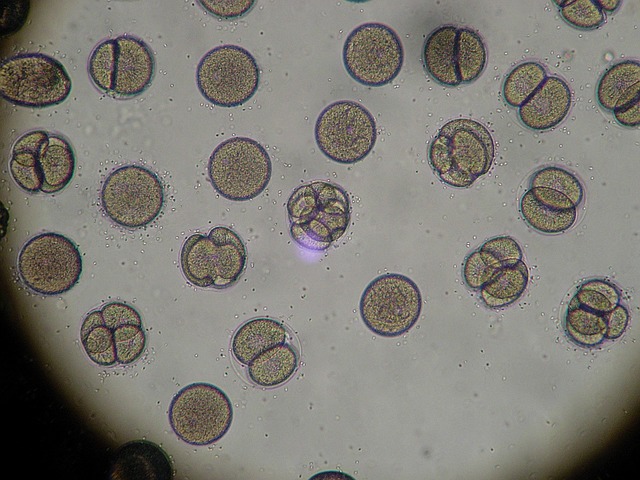
In these two two-cell mouse embryos, the surface of the embryos is outlined in orange, the DNA in the nucleus is indicated in blue and the activity of the LINE-1 gene is indicated via bright red spots. Ramalho-Santos lab/UCSF hide caption
toggle caption
Ramalho-Santos lab/UCSF
In these two two-cell mouse embryos, the surface of the embryos is outlined in orange, the DNA in the nucleus is indicated in blue and the activity of the LINE-1 gene is indicated via bright red spots.
Ramalho-Santos lab/UCSF
One of the enduring mysteries of biology is why so much of the DNA in our chromosomes appears to be simply junk. In fact, about half of the human genome consists of repetitive bits of DNA that cut and paste themselves randomly into our chromosomes, with no obvious purpose.
A study published Thursday finds that some of these snippets may actually play a vital role in the development of embryos.
The noted biologist Barbara McClintock, who died in 1992, discovered these odd bits of DNA decades ago in corn, and dubbed them ” jumping genes.” (She won a Nobel prize for that finding in 1983.) McClintock’s discovery stimulated generations of scientists to seek to understand this bizarre phenomenon.
Some biologists have considered these weird bits of DNA parasites, since they essentially hop around our chromosomes and infect them, sometimes disrupting genes and leaving illness in their wake. But Miguel Ramalho-Santos, a biologist at the University of California, San Francisco, doesn’t like that narrative.
Shots – Health News
Just A Bit Of DNA Helps Explain Humans’ Big Brains
“It seemed like a waste of this real estate in our genome — and in our cells — to have these elements and not have them there for any particular purpose,” Ramalho-Santos says. “So we just asked a very simple question: Could they be doing something that’s actually beneficial?”
He and his colleagues focused on a jumping gene called LINE-1; all told, copies of it make up a whopping 20 percent of our entire DNA. Ramalho-Santos’ lab studies embryos, so the team wondered whether LINE-1 played any role in prompting a single fertilized egg to develop into an embryo.
Normally, when biologists want to study one bit of a cell’s genetic material, they find a way to eliminate it to see how the cell behaves in its absence. That’s impossible to do in the case of the LINE-1 genes, since that would mean editing out 20 percent of the entire genome, notes postdoctoral researcher Michelle Percharde.
Instead, the scientists devised a way to silence this abundant DNA inside the cells of a mouse embryo to see what would happen.
“What we found was that, instead of it being good for the cells,” she says, “the cells did very poorly.”
In a series of experiments published in the journal Cell, the scientists conclude that LINE-1 seems to be essential in the earliest stages of an embryo’s development.
“That’s a very key role,” says Ramalho-Santos, “because, as you can imagine, if you can’t make a tiny little embryo — if you can’t make embryonic stem cells, which are the cells that give rise to the entire body — you don’t have any body.”
Research News
Scientists Find Chromosome Link to Heart Disease
Scientists Find Chromosome Link to Heart Disease
Listen Toggle more options Download Embed EmbedShare this Post
