 Enlarge this image
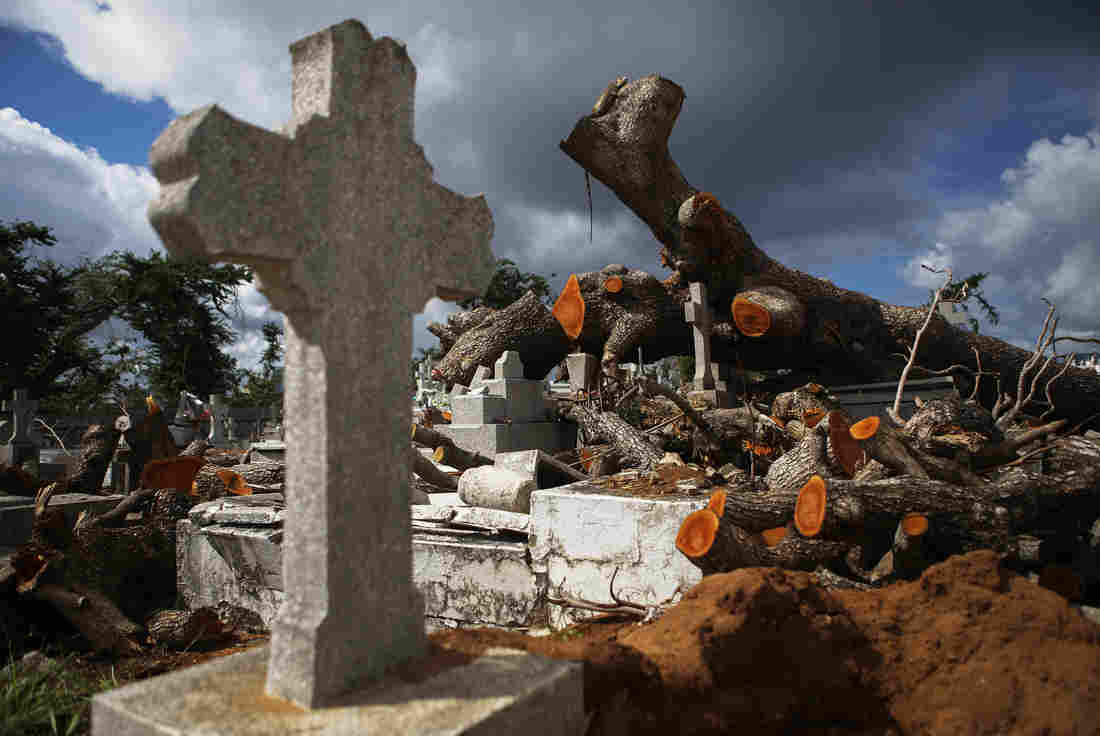
A tree toppled by Hurricane Maria rests over damaged graves in the Villa Palmeras cemetery in San Juan, Puerto Rico, in December 2017. Mario Tama/Getty Images hide caption
toggle caption
Mario Tama/Getty Images
A tree toppled by Hurricane Maria rests over damaged graves in the Villa Palmeras cemetery in San Juan, Puerto Rico, in December 2017.
Mario Tama/Getty Images
Updated 12:43 p.m. ET
Perhaps 5,000 people died in Puerto Rico in 2017 for reasons related to September’s Hurricane Maria, according to a study that dismisses the official death toll of 64 as “a substantial underestimate.”
A research team led by scientists at the Harvard T.H. Chan School of Public Health didn’t simply attempt to count dead bodies in the wake of the powerful storm. Instead, they surveyed randomly chosen households and asked the occupants about their experiences.
From that approach, they concluded that between Sept. 20 and Dec. 31, 2017, there were 4,645 “excess deaths” — that is, deaths that would not have occurred if the island hadn’t been plunged into a prolonged disaster following the devastating storm.
Shots – Health News
In A Puerto Rican Mountain Town, Hope Ebbs As The Hardship Continues
But the estimate isn’t as precise as the figure implies.The researchers calculate a statistical term called a 95 percent confidence interval, which encompasses a broad range – from 800 to 8,500 deaths. Their figure of 4,645 lies near the middle of that range, and they round up to something over 5,000 to account for some assumptions they made.
The findings were published Tuesday by The New England Journal of Medicine.
The research team randomly selected 3,299 households in Puerto Rico. Local scientists surveyed them over the course of three weeks in January. People in those homes reported a total of 38 deaths. The scientists then extrapolated that finding to the island’s total population of 3.4 million people to estimate the number of deaths. The researchers then subtracted deaths recorded during that same period in 2016 and concluded that the mortality rate in Puerto Rico had jumped 62 percent in the three months following the storm.
The death rate is a contentious subject, in part because federal and island governments haven’t responded as rapidly to the disaster as they have in other hurricane emergencies. The study notes that 83 percent of the households in Puerto Rico were without electrical power for the time period looked at, more than 100 days, from the date of the hurricane until the end of 2017.
Puerto Rico residents and outside observers have long argued that the official death toll is hopelessly inadequate. It captures the number of deaths the medical examiner attributed directly to the storm — the high water and howling winds in the worst natural disaster on record for the U.S. territory. Maria came ashore as a Category 4 hurricane, with winds gusting at over 110 mph and drenching rainfall.
CNN surveyed funeral homes after the storm and tallied 499 hurricane-related deaths. The New York Times compared official death records from September and October 2017 and identified more than 1,000 excess deaths, compared with the average for 2015 and 2016. Alexis Santos, a researcher at Penn State University, and a colleague, used death certificates to come up with a similar estimate.
The government of Puerto Rico commissioned researchers from George Washington University’s Milken Institute School of Public Health to estimate excess deaths. Results of that study have been delayed and are due out this summer. “We have always expected the number to be higher than what was previously reported,” said Carlos Mercader, executive director of the Puerto Rico Federal Affairs Administration. He says that’s why it commissioned the study from GW. “Both studies will help us better prepare for future natural disasters and prevent lives from being lost.”
Caroline Buckee, a lead author of the news and epidemiologist at the Harvard T.H. Chan School of Public Health, says, “Our approach is complementary to that and it provides a different kind of estimate and a different kind of insight into the impact of the hurricane.” The researchers suggested that the government in Puerto Rico could use its methods in an even larger survey to reduce the large uncertainties in their findings.
The Harvard study covers a greater time period than The New York Times’ calculation, a difference that could partly account for the much higher figure.
The household survey is a widely accepted technique for estimating casualties following a disaster. But it can be misleading if the sample isn’t truly random or if some households have been wiped out altogether and are therefore missing from the survey. In the latter, the result would underestimate the true toll. In fact, the Harvard team says its results are “likely to be an underestimate” because of this bias.
National
Communication Issues In Puerto Rico Make It Hard To Register Deaths
Communication Issues In Puerto Rico Make It Hard To Register Deaths
Listen · 4:04 4:04 Toggle more options Download Embed EmbedShare this Post
