 Enlarge this image
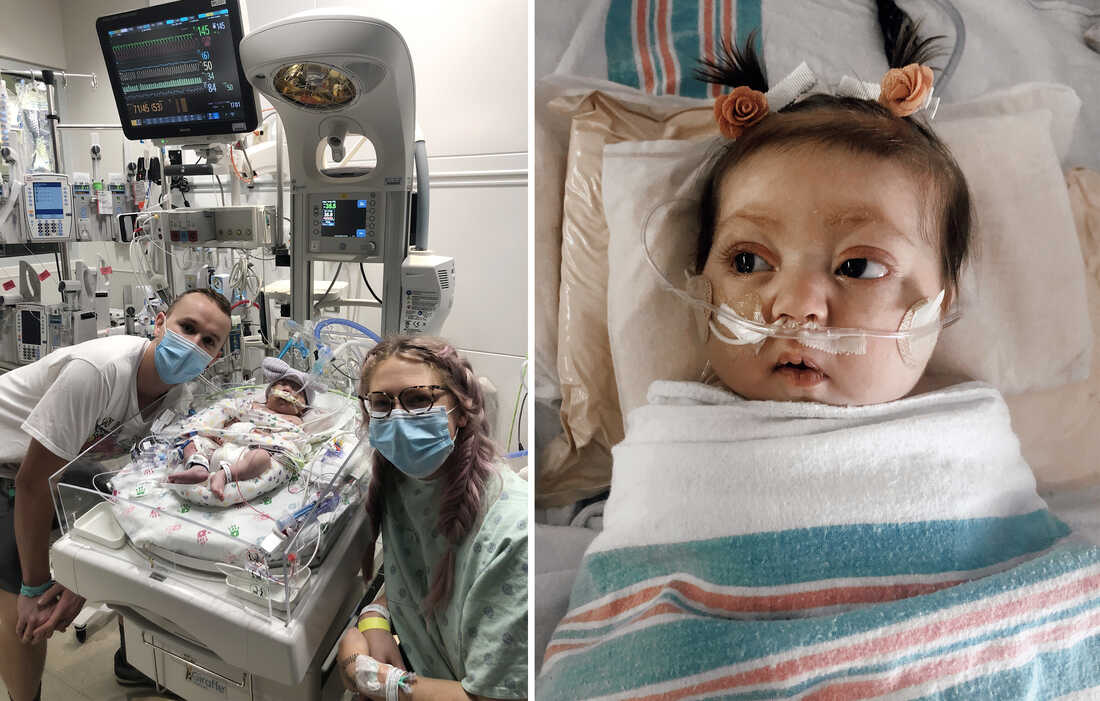
Bennett Markow looks to his big brother, Eli (right), during a family visit at UC Davis Children’s Hospital in Sacramento. Bennett was born four months early, in November 2020. Crissa Markow hide caption
toggle caption
Crissa Markow
Bennett Markow looks to his big brother, Eli (right), during a family visit at UC Davis Children’s Hospital in Sacramento. Bennett was born four months early, in November 2020.
Crissa Markow
The day after his 8-month-old baby died, Kingsley Raspe opened the mail and found he had been sent to collections for her care.
That notice from the collections agency involved a paltry sum, $26.50 — absurd really, given he’d previously been told he owed $2.5 million for treatment of his newborn’s congenital heart defect and other disorders.
Raspe and his wife, Maddie, had endured watching doctors crack open the chest of their pigtailed daughter, Sterling, whom they called “sweet Sterly gurl.” The health team performed so many procedures. But they couldn’t keep her — or her parents’ dreams for her — alive.
The bills lived on for the Raspes, as they do for many other families of premature and very sick infants who don’t survive.
“What a lasting tribute to the entire experience,” Kingsley said angrily. “The process was just so heartless.”
More than 300,000 U.S. families have infants who require advanced medical attention in the newborn intensive care units every year. Some babies stay for months, quickly generating astronomical fees for highly specialized surgeries and round-the-clock care. The services are delivered, and in U.S. health care, billing follows. But for the smaller fraction of families whose children die, the burden can be too much to bear.
A patchwork of convoluted Medicaid-qualification rules seek to defray these kinds of bills for very sick children. But policies differ in each state, and many parents — especially those, like the Raspes, who have commercial insurance — don’t know to apply or think they won’t qualify.
Also, because many crises that befall premature or very sick babies are in-the-moment emergencies, there may not be time for the preapprovals that insurers often require for expensive interventions. That leaves parents in crisis — or in mourning — tasked with fighting with insurers to have treatment covered.
Three families detailed for KHN how medical bills compounded their suffering during a time when they were just trying to process their loss.
Bennett Markow needed a $71,000 ‘out-of-network’ emergency flight
As the hospital in Reno, Nev., was converting a parking garage into a COVID-19 unit in November 2020, Bennett Markow came into the world four months early. He weighed less than a pound. His care team loved to sing “Bennie and the Jets” to him as a nod to the jet ventilator keeping his tiny lungs working.
On Jan. 20, 2021, when he was 2 months old, Bennett’s parents were told he needed to go to UC Davis Children’s Hospital in Sacramento, Calif., for specialized care that could keep him from going blind. The transfer team would be there in an hour. And the Nevada care team said that because it was an emergency, the family needn’t worry about their insurance or the method of transportation.
Bennett’s eye problem ended up being less severe than the doctors had feared. And Crissa Markow and her husband, A.J., were billed for the plane ride from REACH Air Medical Services, which turned out to be out-of-network. Jason Sorrick, vice president of government relations for REACH’s parent company, Global Medical Response, said the ride happened during a “lapse” in Bennett’s Medicaid coverage.
The Markows said there was no lapse. They hadn’t applied for Medicaid yet because they thought they wouldn’t qualify — the family is middle-class, and Bennett was on Crissa’s insurance. They did not know they should apply until a social worker at UC Davis gave them more information — after the flight.
Enlarge this image
Bennett Markow cuddles with his dad, A.J., hours before the baby died in July 2021 at UC Davis Children’s Hospital in Sacramento, Calif. Crissa Markow hide caption
toggle caption
Crissa Markow
Bennett Markow cuddles with his dad, A.J., hours before the baby died in July 2021 at UC Davis Children’s Hospital in Sacramento, Calif.
Crissa Markow
Crissa Markow said her heart dropped to her toes when she realized she was being billed more than $71,000 — that’s more than she makes in a year as a social worker. (The federal No Surprises Act, which aims to eliminate surprise billing, could have prevented some of the family’s headaches — but Bennett was born before the law went into effect this year.)
Although Crissa was used to working toward solutions, the billing quagmires she found herself in were overwhelming as she juggled her job, caring for Bennett and her other son and the travel logistics required to stay with Bennett, who was now getting care about 2½ hours away from her home. Crissa estimates she spent six to eight hours a week dealing with medical bills to keep them from being sent to collections — which still happened.
Bennett died that July after doctors said his lungs could not fight anymore. The Markows spent their bereavement leave battling with insurers and other billing agencies.
Finally, Crissa called REACH, the air transport company, and said: “Look, my son died. I just want to be able to grieve, I want to focus on that. Dealing with this bill is traumatic. It’s a reminder every day I shouldn’t have to be fighting this.”
“If every settlement amount was disclosed publicly, then those rates become the expectation of all patients and insurance providers,” Sorrick said. “Ultimately, that would lead to all patients wanting to pay below-cost, making our services unsustainable.”
Crissa Markow’s employer-provided insurance paid $6.5 million for Bennett’s care, not including what was covered by Medicaid. The Markows paid roughly $6,500 out-of-pocket to hospitals and doctors on top of their REACH settlement. But it was not those amounts — which the couple would have happily paid to save their son — but the endless harassment and the hours spent on the phone that haunt them.
“I just wanted to be with Bennett; that’s all I wanted to do,” Crissa Markow said. “And I just spent hours on these phone calls.”
Jack Shickel lived 35 days. His medical bill was $3.4 million
Jack Shickel was born with stunning silver hair and hypoplastic left heart syndrome. Even though he was surrounded by wires and tubes, the nurses at UVA Children’s Hospital would whisper to Jessica and her husband, Isaac, that they had a truly “cute” baby.
But his congenital disorder meant the left side of his heart never fully developed. Each year in the U.S., over a thousand babies are born with the syndrome.
After two surgeries, Jack’s heart could not pump enough blood on its own. He made it 35 days.
Weeks after his death, when the Shickels were trying to muddle through life without him in Harrisonburg, Va., they called the hospital billing department about two confusing bills. They were then told the full cost of his care was $3.4 million.
“I laughed and then cried,” Jessica said. “He was worth every penny to us, but that’s basically $100,000 a day.”
Enlarge this image
The Shickels with baby Jack at UVA Children’s Hospital in Charlottesville, Va. Jack was born with hypoplastic left heart syndrome — which means the left side of his heart never fully developed. Jessica Shickel hide caption
toggle caption
Jessica Shickel
The Shickels with baby Jack at UVA Children’s Hospital in Charlottesville, Va. Jack was born with hypoplastic left heart syndrome — which means the left side of his heart never fully developed.
Jessica Shickel
Bills from out-of-network labs and other prior approval notifications continued to overwhelm their mailbox. Eventually, they figured out how to get Medicaid. The Shickels ended up paying only $470.26.
Jessica got the final bills in March, seven months after Jack’s death.
She noted that all of this was happening as the University of Virginia Health System said it was rolling back its aggressive billing practices — after a KHN investigation found the prestigious university hospital was putting liens on people’s homes to recoup medical debt.
When KHN reached out to UVA Health for comment on the Shickel case, a spokesperson, Eric Swensen, expressed condolences to the Shickel family, and added that the health system works to help patients navigate the “complex process” of evaluating financial assistance, including Medicaid coverage.
The Shickels also got a call from UVA after that, saying that the hospital was refunding their payment.
The hospital care team had given the family a pamphlet about what to do when grieving, but a more useful one, Jessica said, would have been titled “How Do You Deal With Medical Bills After Your Child Has Died?”
How to navigate your own NICU bills
Parents who’ve been there advise contacting your health plan immediately to talk through the costs of your child’s NICU stay, including what is covered and what is not. If your baby’s not already on your health plan, make sure to add them. Speak to a social worker immediately about applying for Medicaid or the Supplemental Security Income program, known as SSI. If your baby qualifies, it can dramatically reduce your personal cost for a child who has extensive medical bills. The March of Dimes offers a My NICU Baby app designed to help families wade through the overwhelming experience. The nonprofit says the app can help you learn about caring for your baby in the NICU and at home, as well as monitor your baby’s progress, manage your own health, and keep track of your to-do list and questions.
Sterling Raspe’s parents considered bankruptcy to pay their bills
Kingsley Raspe likes to say his daughter Sterling was “one special little lady” — not only did she have the same congenital heart defect as Jack Shickel, but she was also diagnosed with Kabuki syndrome, a rare disorder that can severely affect development. Sterling also had hearing loss, spinal cord issues and a compromised immune system.
An explanation of benefits from the Raspes’ commercial insurance indicated the couple would need to pay $2.5 million for Sterling’s care — an amount so large the numbers didn’t all fit in the column. Even Kingsley’s suspicion that the $2.5 million charge was likely erroneous — in large part or in whole — didn’t erase the sheer panic he felt when he saw the number.
Enlarge this image
(Left) To fend off medical debt, the Raspes were once advised to get divorced. (They declined.) Their daughter Sterling (right) was 8 months old when she died, and had spent most of her life in the hospital. Kingsley Raspe hide caption
toggle caption
Kingsley Raspe
(Left) To fend off medical debt, the Raspes were once advised to get divorced. (They declined.) Their daughter Sterling (right) was 8 months old when she died, and had spent most of her life in the hospital.
Kingsley Raspe
As a computer programmer making $90,000 a year, Kingsley had decent insurance. He frantically Googled “medical bankruptcy.”
Sterling had been denied Medicaid, which is available to children with complex medical problems in some states. In rejecting the application, Indiana cited an income threshold and other technical reasons.
Everyone kept telling Kingsley and Maddie to get divorced — just so Sterling would qualify for Medicaid. But that wasn’t an option for Kingsley, a British citizen who is in the U.S. on a green card tied to his marriage.
Ultimately, Kingsley’s health insurer revised the faulty notice that he owed $2.5 million. The family was told the mistake had occurred because Sterling’s initial hospital stay and surgeries had not been preapproved, although Kingsley said the heart defect was discovered halfway through the pregnancy, making surgery inevitable.
Throughout Sterling’s eight months of life, Kingsley did his programming job remotely — usually from his daughter’s bedside in her hospital room. Using his web-developer skills, he created visualizations that break down Sterling’s expensive care — it helped him make sense of it all. Then, and in the months afterward, he and his wife compiled advice for other families navigating long NICU stays with their babies.
Kingsley cries when he remembers those days.
YouTubeHe hates that Sterling’s life has been reduced to a 2-inch stack of printed-out medical bills and the still-frequent phone calls he endures from errant billers.
Despite receiving a plethora of other bills in the tens of thousands of dollars, he and his wife eventually only had to pay their $4,000 deductible, and a smattering of smaller charges and fees for equipment rentals that weren’t covered. In April, Maddie gave birth to a son, Wren. Kingsley said he knows Sterling served as her brother’s guardian angel.
“My daughter passed away. I’m not unscathed, but I’m not in financial ruin. The same can’t be said for every family,” he said. “How lucky am I? I went through the worst thing imaginable, and I consider myself lucky — what kind of weird, messed-up logic is that?”
KHN (Kaiser Health News) is a nonprofit, editorially independent program of the Kaiser Family Foundation that produces in-depth journalism about health issues.
Share this Post
