 Enlarge this image
Kennise Nevers holds her son, AJ, in her arms at home. Nevers’ mother, Nancy Josey, looks on. Jesse Costa/WBUR hide caption
toggle caption
Jesse Costa/WBUR
Kennise Nevers holds her son, AJ, in her arms at home. Nevers’ mother, Nancy Josey, looks on.
Jesse Costa/WBUR
With both feet flat on the floor, Kennise Nevers settles into the sofa in her living room. She peels open a blood pressure cuff, and straps it around her left arm, exhaling as it squeezes her bicep.
After a minute, she gets the reading. “It’s perfect,” says the mom of two from Brockton, Massachusetts.
Nevers, 37, tracked her blood pressure at home each day for months as part of a program for patients at Boston Medical Center who are pregnant or recently had babies and are at risk for hypertension. That perfect reading Nevers got was transmitted to her medical record and reviewed by a nurse.
Blood pressure is just one way to measure a person’s health, but during pregnancy and soon after, it’s a critical metric. Unchecked, high blood pressure can contribute to serious complications for the pregnant woman and baby, and increase the risk of death.
So for Nevers, it was a relief to know that health care providers were tracking her numbers so closely.
“Of course, you’re always going to worry: It’s pregnancy. Things change all the time,” she says. “But it eased some of my worry. I feel like I had doctors always on my side, looking after me. I wasn’t forgot about.”
Pregnancy-related death
Studies show that Black people are more than twice as likely as white people to experience severe pregnancy-related complications, and nearly three times as likely to have a pregnancy-related death.
The U.S. has the worst maternal mortality rate of high-income countries in the world — and the numbers are climbing. New federal data shows maternal deaths spiked 40% in 2021.
Many serious problems stem from high blood pressure, says Dr. Tina Yarrington, director of maternal-fetal medicine at BMC.
“It’s the root cause for many, many maternal health inequities,” she says. “People who are marginalized by structural racism, people who are Black, African American, Latina, Hispanic, suffer higher levels of hypertension and higher levels of complications when that hypertension strikes.”
Blood pressure measures the force of blood pushing against the artery walls. When that force is too high during pregnancy — a condition called pre-eclampsia — it can lead to stroke, organ damage, pregnancy loss or low birth weight for the baby. It also raises the risk of death for the pregnant person and baby.
Pre-eclampsia affects about 14% of BMC’s white patients, but 18% of its Black patients — a small but significant difference.
“That’s the fuel for this fire,” Yarrington says. “That’s why we’re putting so much energy and work into pre-eclampsia, in the interest of not just better outcomes, but better outcomes specifically for the populations that have suffered from inequities.”
Close watch, quick action
High blood pressure is sometimes called the “silent killer” because it can suddenly rise to dangerous levels without causing pain or other symptoms. That’s why BMC has assigned a nurse, Megan O’Brien, to watch patients’ numbers daily.
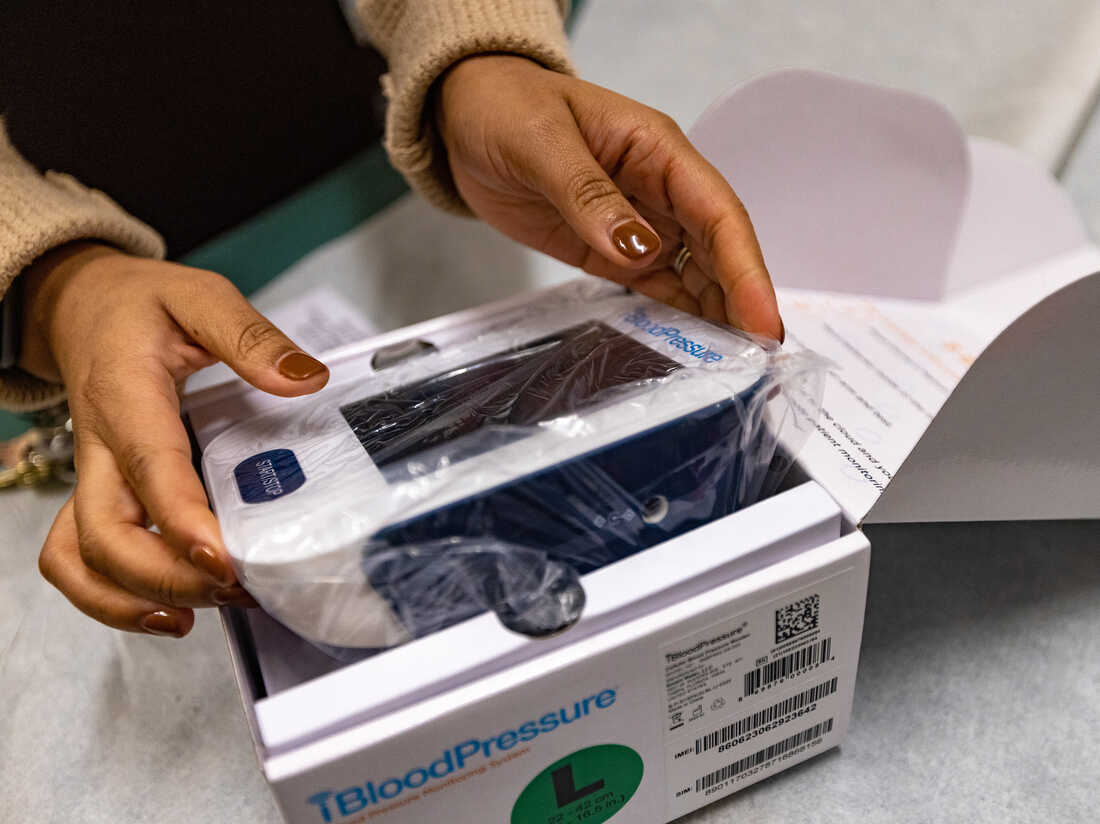
Each time a patient takes a reading at home, their blood pressure cuff sends the numbers straight to their electronic health record. The cuffs don’t need an internet connection; they use the signal of nearby cell towers.
“The first thing I do every morning is look at all of the high readings that have come in since the night before,” O’Brien says.
If she sees a concerning number, she follows up right away — often with the help of interpreters for patients who don’t speak English.
The patient might need a new medication. Or they might need to come to the hospital to be monitored. Sometimes, blood pressure spikes so rapidly that patients have to deliver their babies early to avoid serious complications.
After delivery, some patients are still at risk of developing seizures, stroke, heart attacks or other problems. O’Brien monitors their numbers, too.
The daily at-home blood pressure checks allow nurses and doctors to spot issues early and act sooner. “We’re intervening so much quicker in these potential problems that could be happening at home,” O’Brien says. “It’s really about catching those as fast as possible.”
Enlarge this image
A cellular blood pressure monitoring system in its packaging. The monitor sends the data from each reading directly to Boston Medical Center for health workers to review. Jesse Costa/WBUR hide caption
toggle caption
Jesse Costa/WBUR
A cellular blood pressure monitoring system in its packaging. The monitor sends the data from each reading directly to Boston Medical Center for health workers to review.
Jesse Costa/WBUR
BMC’s home-monitoring program began during the COVID pandemic. The hospital started providing blood pressure cuffs to postpartum patients in 2020, when in-person medical visits were disrupted, and last spring, expanded to include pregnant patients.
‘Interrogate’ disparities
This effort is part of a sweeping hospital-wide initiative to take better care of people of color and eliminate racial and ethnic disparities in health care.
Hospital leaders dove into data about their patients and uncovered stark disparities in pregnancy, as well as COVID, diabetes, cancer and behavioral health. They found, for example, that their Black patients were twice as likely to develop pregnancy-related complications as white patients.
“There’s no way you can find those things and not interrogate them and have an intentionality to change them,” says Dr. Thea James, vice president of mission and co-executive director of the Health Equity Accelerator. “It is unethical to see those things and leave them there.”
Some of the work is in eliminating the potential for bias and subjectivity during decision-making — for example, deciding when pregnant patients with pre-eclampsia should deliver their babies.
“We saw that it was taking twice as long to make that decision in Black women,” James says. “So the first thing we did was to standardize the decision-making process.”
BMC has enrolled hundreds of patients in the initiative to monitor blood pressure at home during and after pregnancy; about 80% of them are Black or Hispanic, reflecting the makeup of the hospital’s overall patient population.
Simple, but not easy
It may seem like a simple intervention. But not all health care providers have funding to pay for a home-monitoring program and dedicated staff to run it. Health insurance plans typically don’t cover these costs.
And while some patients don’t mind checking their blood pressure at home, others may find it too stressful or time-consuming.
“Creating a habit is tough for anything,” says Dr. Lara Kovell, director of the pregnancy and heart disease clinic at UMass Memorial Medical Center in Worcester, Mass.
Kovell is part of a team of researchers at UMass Memorial, Yale University and the University at Buffalo who are studying the use of at-home support, including blood pressure monitoring, for postpartum patients.
“Maternal mortality being three- to four-fold higher in our Black women is just something that really needs to change,” Kovell says. “And I think hypertension is one of the things that will get to that.”
Dr. Rose Molina, an OB-GYN at Beth Israel Deaconess Medical Center in Boston, said research on home monitoring so far remains inconclusive — though there appears to be little downside to giving patients blood pressure cuffs at home.
“I don’t think that there is necessarily harm,” she says, “but there’s still questions around how do we build the system around self-monitoring that really is high-value in terms of having a clinical impact, and also saving costs, ideally, in some way.”
Doctors at BMC are still studying the impacts of home monitoring, but they have seen some promising early results.
Baby AJ’s arrival
Kennise Nevers was eight months pregnant and cooking chicken for a big family dinner one evening in October when her blood pressure suddenly spiked.
“We were actually getting ready to play cards,” Nevers recalls. “And I was like, ‘Oh, let me just check my blood pressure before I play.’ And the night ended pretty quick.”
She went to the hospital right away. The next day, doctors induced labor, and her baby, AJ, was born.
He arrived three weeks early, but strong and healthy.
“It was a relief,” Nevers said. “I was so worried throughout the pregnancy because of my blood pressure.”
Nevers made it past the high-risk postpartum days without developing a complication.
But she has chronic hypertension, so she still keeps a blood pressure cuff nearby.
Share this Post
