 Enlarge this image
Protesters gather outside the U.S. Supreme Court on June 25, 2022 in the wake of the decision overturning Roe v. Wade. Tasos Katopodis/Getty Images hide caption
toggle caption
Tasos Katopodis/Getty Images
Protesters gather outside the U.S. Supreme Court on June 25, 2022 in the wake of the decision overturning Roe v. Wade.
Tasos Katopodis/Getty Images
In June 2022, the U.S. Supreme Court’s ruling in Dobbs v. Jackson Women’s Health Organization struck down Roe v. Wade, the 1973 landmark ruling that guaranteed the right to an abortion.
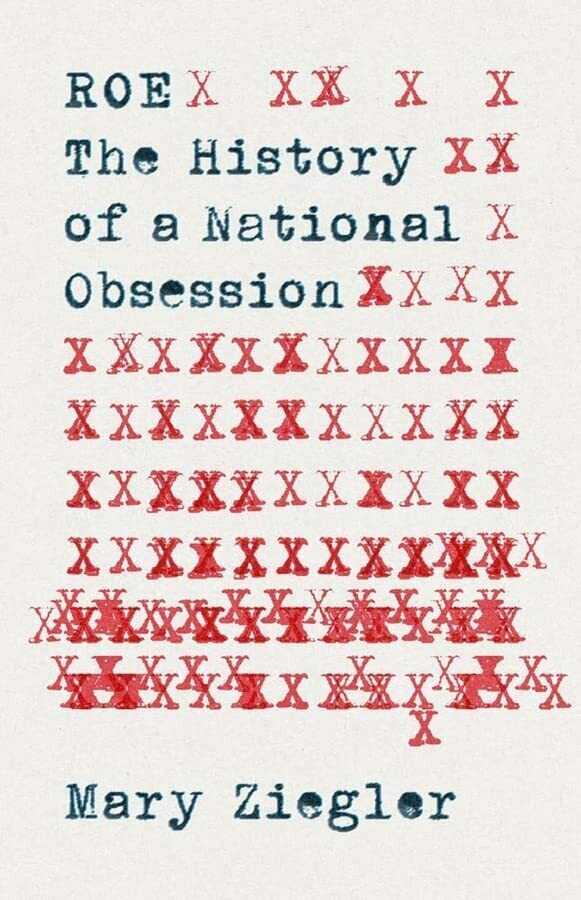
Without Roe, the Court’s decision left it up to the states to decide on the legality of abortion and the restrictions surrounding it. Legal scholar Mary Ziegler chronicles the legal, political and cultural debate around abortion in the new book, Roe: The History of a National Obsession. She says the battle over abortion rights is far from over.
“We’re at a moment of really almost unprecedented uncertainty in the United States when it comes to abortion,” Ziegler says. “Lots of people are waking up to the reality that what was a constitutional right not very long ago is now a crime in large swaths of the country.”
Some states, including California, Michigan, Kansas and South Carolina, have responded to the Dobbs decision by protecting legal access to abortion. Meanwhile, more than a dozen other states, including Idaho, Tennessee, Arkansas and Texas, have moved to enact sweeping abortion bans.
In Texas, for instance, abortion is a felony punishable by up to life in prison. The state’s law explicitly prohibits criminally prosecuting people seeking abortions. Instead, it focuses on abortion providers, as well as people who aid or abet them — including those who help fund abortions.
Reproductive rights in America
Court rules doctors who provide abortions can’t be prosecuted under Arizona law
Then there are states where abortion is legal, but hasn’t been explicitly protected as a right in a state’s constitution or by court decisions. Ziegler points to Florida, which, because it has more liberal abortion laws that its neighboring states, is considered a “receiving state,” for people seeking abortion. “Florida, at the moment, has a 15-week ban, but nothing more than that,” she says. “We expect to see some of those states [like Florida] become battlegrounds in the years ahead.”
While Ziegler acknowledges that no one knows what the future of abortion rights in the U.S. will look like, one thing is certain: This is a story that’s larger than one court decision.
“The story of our abortion politics has always been one about more than the Supreme Court telling us what to do,” she says. “It’s been grassroots movements. It’s been ordinary voters, it’s been legislatures, it’s been state courts. And that’s going to continue to be true. So I think we’re at the very beginning of something very confusing, but also something that is far, far from over.”
Interview highlights
Enlarge this image
Roe: The History of a National Obsession, by Mary Ziegler Yale University Press hide caption
toggle caption
Yale University Press
Roe: The History of a National Obsession, by Mary Ziegler
Yale University Press
On how confusion about abortion law can stop people from exercising their right to an abortion
A lot of people, if they’re not sure what is and is not OK, may make the decision to not come close to crossing the line. They may be scared away from exercising a right they do, in fact, have. But I think we’re at a moment of really almost unprecedented uncertainty in the United States when it comes to abortion. That’s true of the laws. It’s true of the way abortion care is delivered. It’s true, frankly, of the strategies that are being pursued by both movements. I think the kind of old hierarchies in the movements on both sides were shaken up by the Dobbs decision and the political developments of the past couple of years.
On Texas prosecutors targeting abortion funds
Shots – Health News
Doctors who want to defy abortion laws say it’s too risky
Abortion funds kind of emerged because it was very difficult for low-income people to pay for abortions because of the Hyde Amendment, which bans federal Medicaid monies being used for reimbursement for abortions. So these abortion funds have been an important part of the funding reality for decades. And these demand letters that were sent to the abortion funds in Texas essentially suggested that they had been aiding and abetting a criminal act and demanded, among other things, details about their patients’ information.
And I think this has been frightening for people who support abortion rights, not only because of what it would mean for abortion funds, which, as I mentioned, are kind of the only way that low-income people have been able to reliably access money for abortion, but also because they suggest at least the possibility that people who have abortions will be somehow swept into the criminal system too.
On how federal health privacy law doesn’t protect a lot of digital privacy
Technology
Data privacy concerns make the post-Roe era uncharted territory
If you’re on Facebook talking to your friends about whether you’re going to have an abortion, that’s not protected by HIPAA.
There’s lots of information related to reproductive health services that doesn’t come from HIPAA-protected sources. Abortion funds are not medical providers. If you’re on Facebook talking to your friends about whether you’re going to have an abortion, that’s not protected by HIPAA. If you’re using your phone and you’re using Google Maps to get to a clinic and Google sells that data to various advertisers, there’s nothing theoretically stopping law enforcement from purchasing the same data. So in a world where abortion is a crime, it’s a reminder of how little digital privacy many of us already have.
On how are anti-abortion activists using the Comstock Act (an 1873 law that prohibits mailing “obscene” materials) to target pills by mail
The anti-abortion movement read the Comstock Act to say that it’s illegal to mail abortion pills anywhere — full stop — for any purpose. And so that would be tantamount to saying abortion pills themselves are entirely illegal because all abortion pills that any patient in the United States takes have been in the mail in some way or another. Abortion clinics are not manufacturing their own pills; they’re purchasing them from drug companies, pharmacies or getting them in the mail. People having telehealth procedures are getting them in the mail for the moment.
This argument isn’t going to go anywhere, likely because the Justice Department just put out a memorandum saying that, for the time being, the federal government interprets the Comstock Act to only apply to people who are mailing abortion [pills] with criminal intention. That is to say, deliberately trying to violate laws against those abortion pills, which would make it much harder to prosecute anyone under the Comstock Act.
Health
How An Anti-Vice Crusader Sabotaged The Early Birth Control Movement
But anti-abortion activists who are invoking the Comstock Act are really playing the long game. They’re hoping either, 1) through lawsuits to get arguments about the Comstock Act before the Supreme Court, which is very conservative on abortion and may agree with anti-abortion activists’ interpretation of the Comstock Act, or, 2) just bide time until a Republican is in the White House and a Republican [Department of Justice] takes a different interpretation of the Comstock Act. So we’re seeing this argument crop up in lawsuits. We’re seeing it crop up in local ordinances passed by small towns in blue, red and purple states that mention the Comstock Act. So it’s become a kind of central part of strategy in some quarters in the anti-abortion movement.
On questions around the legality of traveling out of state for an abortion
There are pre-file bills in places like Texas and Missouri that try to put a stop to out-of-state travel for abortion. For the most part, based on the pre-file bills we’re seeing, states are not directly saying, “We’re going to criminalize travel or allow people to be sued for traveling.” They’re going more kind of indirect routes where they’re either allowing kind of SB8 [ Texas Senate Bill 8.]-style “bounties” against people who help others travel for abortion, people who maybe perform abortions for people from states where it’s criminal, kind of focusing on doctors and aiders or abettors. What’s unusual about that, obviously, is that one state usually can’t tell another state what to do.
Imagine a woman from Mississippi travels to South Carolina where there’s now going to have to be legal abortion and has an abortion. And then Mississippi says, “Well, we’re going to prosecute the doctor in Mississippi for this abortion.” Usually we don’t do things like that. We haven’t done things like that really since before the Civil War, when there were fugitive slave laws in place.
Imagine a woman from Mississippi travels to South Carolina where there’s now going to have to be legal abortion and has an abortion. And then Mississippi says, “Well, we’re going to prosecute the doctor in Mississippi for this abortion.” Usually we don’t do things like that. We haven’t done things like that really since before the Civil War, when there were fugitive slave laws in place. So it creates all kinds of uncertainty about whose law would apply. Would it be Mississippi’s or South Carolina’s in that hypothetical? Would it be constitutional for Mississippi to tell South Carolina doctors what to do? Or would that raise all kinds of red flags constitutionally? We don’t know any of the answers to that. And again, the one thing we do know is that they would most likely land before the same U.S. Supreme Court that reversed Roe v. Wade, which is why state legislators are willing to try things out that are unprecedented in recent history and potentially constitutionally questionable as well.
On the anti-abortion movement’s crack down on free speech and information
If people don’t know what their options are, in other words, they don’t know where the clinic out of state is, they don’t know how to get abortion pills in the mail, or they don’t know how to use them safely, or how late in pregnancy it’s safe to do so, some people quite simply aren’t going to have those abortions. And so I think the effort to crack down on speech has not just been about advocacy, it’s been about access to information – online as well as offline. … There’s been a kind of concerted effort to … prevent people from accessing kind of basic information about what medication abortion involves or what kinds of services might be available in nearby states.
Sam Briger and Susan Nyakundi produced and edited this interview for broadcast. Bridget Bentz, Molly Seavy-Nesper and Carmel Wroth adapted it for the web.
Share this Post
