 Enlarge this image
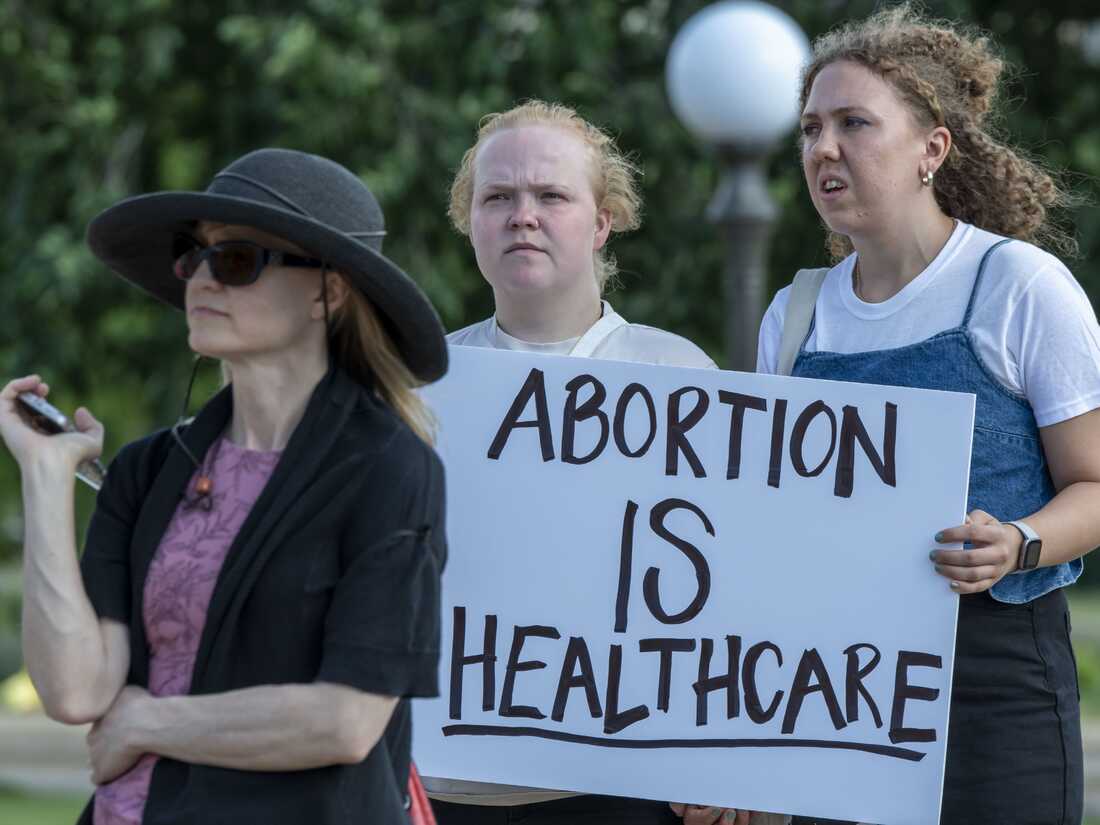
Supporters of abortion rights rally at the Minnesota State Capitol Building in downtown St. Paul following the U.S. Supreme Court ruling to overturn Roe v. Wade. Michael Siluk/Universal Images Group via Getty Images hide caption
toggle caption
Michael Siluk/Universal Images Group via Getty Images
Supporters of abortion rights rally at the Minnesota State Capitol Building in downtown St. Paul following the U.S. Supreme Court ruling to overturn Roe v. Wade.
Michael Siluk/Universal Images Group via Getty Images
Will your health plan pay for an abortion now that the U.S. Supreme Court has overturned Roe v. Wade?
Even before the June 24 ruling, insurance coverage for abortion varied widely. Now the issue is even more complex as states set varying rules — about half are expected to limit or ban abortion in almost all circumstances.
To be clear, though, the question of whether an insurance plan covers abortion is not the same as whether abortion is allowed in a state. Coverage issues are more complicated and governed by a wide variety of factors, including the level of abortion access a state allows.
How dense a thicket is it? Abortion may be covered in a health plan, but if no providers are available, patients don’t have access. However, people with insurance that does not cover abortion can still get one — but only if it’s available in their states or they can afford to travel and pay out-of-pocket. There are also a host of unanswered questions about whether states that restrict abortion will have the legal authority to target the coverage in employer plans.
The issues will likely be before the courts for years to come.
“States will pass laws, there will be some conflict, and then it goes to the courts,” said Erin Fuse Brown, director of the Center for Law, Health & Society at the Georgia State University College of Law. “It could be a while.”
In the meantime, here are answers to three common questions.
Are health plans — or employers — required to offer coverage for elective abortions?
The simple answer is “no.”
“There’s no law that requires any health plan, employer-based or anything else, to cover an elective abortion,” Fuse Brown said.
Whether they do is more complicated.
Some job-based health plans cover elective abortions. Patients can search their plan documents or call their insurers directly to check.
Coverage is more likely in plans offered by self-insured employers because those plans are generally exempt from state laws. Self-funded employers, which tend to be the larger ones, pay their employees’ medical bills out-of-pocket, although they generally hire third parties, sometimes health insurers, to handle claims and administrative work.
This story was produced in partnership with Kaiser Health News.
Still, millions of Americans work for smaller employers, which tend to buy plans directly from health insurers, which then pay the medical bills. Those plans, known as “fully insured,” are subject to state laws, which have long varied regarding abortion coverage.
Eleven states bar those private plans from covering abortion in most circumstances, according to the Kaiser Family Foundation, although some of the states allow people to buy an insurance rider that would cover the costs.
If you’re not sure what type of health plan you have, ask the administrators.
“There is no way to tell from the face of your insurance card if you are fully insured or self-funded,” Fuse Brown said.
For the more than 14 million Americans who buy their coverage through the Affordable Care Act marketplaces, their state of residence is key.
Twenty-six states restrict abortion coverage in ACA plans, while seven states require it, according to KFF. Those states are California, Illinois, Maine, Maryland, New York, Oregon and Washington.
The rules for Medicaid, the federal-state health program for people with low incomes, also vary. Thirty-four states and the District of Columbia follow the Hyde Amendment, which bars federal funds from paying for abortions, except in cases of rape or incest or to save the life of the mother, although some states allow coverage for other medically necessary abortions.
For all those reasons, it’s not surprising that research published in the journal Health Affairs in April noted that patients paid out-of-pocket for the majority of abortions (69% in one study.) The researchers found that the median cost of a medication abortion was $560 and that abortion procedures ranged from a median of $575 in the first trimester to $895 in the second.
What about coverage for pregnancy-related complications that require treatment similar to abortion?
Insurance policies must cover care for essential health services, including medically necessary pregnancy care and abortion when carrying a pregnancy to term would endanger a patient’s life.
Under the Pregnancy Discrimination Act of 1978 and other rules, Fuse Brown said, “pregnancy and prenatal care, including high-risk pregnancies, and obstetric care in general is required to be covered.”
In an ectopic pregnancy — when a fertilized egg implants outside the uterus — the embryo is not viable, and the condition is generally life-threatening to the mother without medical treatment. Many other scenarios could come into play, such as if a woman has a miscarriage but not all the tissue is expelled, potentially leading to a dangerous infection.
Shots – Health News
Advocates struggle with how much they can help with self-managed abortions
Although all state laws that currently restrict abortion include an exception to save the life of the mother, what constitutes a life-threatening scenario is not always clear. That means physicians in abortion-ban states may have to weigh the medical risk to the mother against possible legal ramifications.
“This is less of a coverage question and more of a question of whether providers in the states that ban abortion are going to provide the care,” said Katie Keith, a research faculty member at the Center on Health Insurance Reforms at Georgetown University. “All of these laws are designed to chill behavior, to make it so unattractive or scary to providers to keep them from doing it at all.”
Can residents of states where abortion is illegal get coverage in other states or help with travel costs?
In recent weeks, many large employers — including Microsoft, Bank of America, Disney and Netflix — have said they will set up programs to help pay travel costs so workers or other beneficiaries can legally access abortion services in states where it remains legal.
But it isn’t as straightforward as it sounds. Employers will have to figure out whether workers will be reimbursed through the health plan or some other way. Protecting privacy, too, may be an issue. Some consultants also said employers will also need to consider other conflicts. If an employer, for example, covers travel for abortion procedures but not for an eating disorder clinic, does that violate the Mental Health Parity and Addiction Equity Act? If a plan has no providers willing or able to do abortions, does it violate any state or federal rules that require reasonable in-network access to physicians and health services?
Lawmakers need to think about these conflicts, said Jessica Waltman, vice president for compliance at employee benefits company MZQ Consulting. “They could be putting all the employer group plans in their state in a very precarious position if that state law would prohibit them from complying with federal law,” she said, particularly if they restrict access to benefits called for in the Pregnancy Discrimination Act.
Shots – Health News
How much health insurers pay for almost everything is about to go public
There are other potential conflicts if an employer is in a state that allows abortion but a worker is in a state that restricts it. “If I’m an Oregon-based company, my insurance plan must provide for abortion coverage, but what do I do about an Oklahoma employee? I don’t know the answer,” said René Thorne, a principal at Jackson Lewis law firm, where she oversees litigation that involves self-insured companies.
Also uncertain is whether state laws will take aim at insurers, employers or others that cover abortion services, including travel or televisits.
Laws that restrict abortion, Thorne wrote in a paper on her firm’s website, generally apply to the medical provider and sometimes those who “aid or abet” the abortion. Some states, including Texas, allow private citizens to sue for $10,000 anyone who provides an illegal abortion or helps a person access one.
Whether those laws will be applied to employers or insurers will undoubtedly end up in the courts.
“We are in uncharted territory here, as we’ve never before been in a situation where plans, as well as their employer sponsors and those administering the plans, might face criminal liability in connection with a plan benefit,” said Seth Perretta, a principal at the Groom Law Group, which advises employers.
Answers won’t come soon, but “there will be so much litigation around this,” said Thorne.
KHN (Kaiser Health News) is a national newsroom that produces in-depth journalism about health issues. It is an editorially independent operating program of KFF (Kaiser Family Foundation).
Share this Post
