It took more than 10 minutes for paramedics to arrive after a housekeeper found a man collapsed on the floor of a bathroom in a Boston Veteran Affairs building.
The paramedics immediately administered naloxone, often known by its brand name Narcan, to reverse the man’s opioid overdose. But brain damage can begin after just a few minutes without oxygen.
Pam Bellino, patient safety manager for the Boston VA, read that incident report back in December 2015 with alarm. “That was the tipping point for us to say, ‘We need to get this naloxone immediately available, without locking it up,’ ” she says.
The easiest way to do it quickly, Bellino reasoned, would be to add the drug to automated external defibrillator cabinets already in place. Those metal boxes on the walls of VA cafeterias, gyms, warehouses, clinic waiting rooms and some rehab housing were installed to hold equipment for a fast response to heart attacks.
Now the Veterans Administration, building on a project started in Boston, is moving to add naloxone kits to the AED cabinets in its buildings across the country, an initiative that could become a model for other health care organizations.
 Enlarge this image
Pamela Bellino opens the AED box located in the cafeteria at West Roxbury campus of the VA Boston Healthcare System. The blue pouch, tucked next to the defibrillator, contains the naloxone. Jesse Costa/WBUR hide caption
toggle caption
Jesse Costa/WBUR
Pamela Bellino opens the AED box located in the cafeteria at West Roxbury campus of the VA Boston Healthcare System. The blue pouch, tucked next to the defibrillator, contains the naloxone.
Jesse Costa/WBUR
Equipping police with nasal spray naloxone is becoming more common across the country, but there has been some resistance to making the drug available in public.
Bellino has heard from critics who say easy access to naloxone gives drug users a false sense of safety. She disagrees.
“Think of this as you would a seat belt or an airbag,” she says. “It by no means fixes the problem, but what it does is save a life.”
Giving naloxone to someone who hasn’t overdosed isn’t harmful, but it is a prescription drug. So Bellino says the VA had to persuade the accrediting agency The Joint Commission to approve guidelines for the AED naloxone project.
The cabinets must be sealed and alarmed so staff can tell if they’ve been opened. They must be checked daily and refilled when the naloxone kits expire.
The commission didn’t agree to let the VA put the words “naloxone” or “Narcan” on the cabinets doors to alert the public that the drug is inside, but did allow the VA to affix the letter “N.”
In December, the project will expand nationwide, as VA hospitals across the country will add naloxone to their AED cabinets.
“The overwhelming evidence is that it just saves lives,” says Dr. Ryan Vega with the VA’s Center for Innovation. “We’re hopeful that other health systems take notice and think about doing the same.”
Shots – Health News
Poll: Most Americans Know About Opioid Antidote And Are Willing To Use It
Vets have nearly twice the risk of overdose, compared with civilians, says Amy Bohnert, an investigator with the VA Ann Arbor Healthcare System, citing 2005 death data. She says it isn’t clear why veterans are more likely to OD, but many do have complex medical conditions.
“Some of that’s related to combat exposure,” Bohnert says. “They’ve got mental health treatment needs. They may have injuries that result in them being more likely to be prescribed opioids than your average person. And all of these things can impact their risk of overdose.”
A smattering of schools, airports, churches and employers around the country have added naloxone to their AED cabinets.
Some are stocking other lifesaving tools as well: tourniquets to stop bleeding after a shooting; EpiPens to keep airways open; and even injectors to treat diabetic shock.
Dr. Jeremy Cushman leads a project at the University of Rochester that has placed both tourniquets and naloxone in 80 AED cabinets across that campus as of July.
“This system is already in place,” Cushman says. “The question is, how can we leverage it to save more lives?”
Enlarge this image
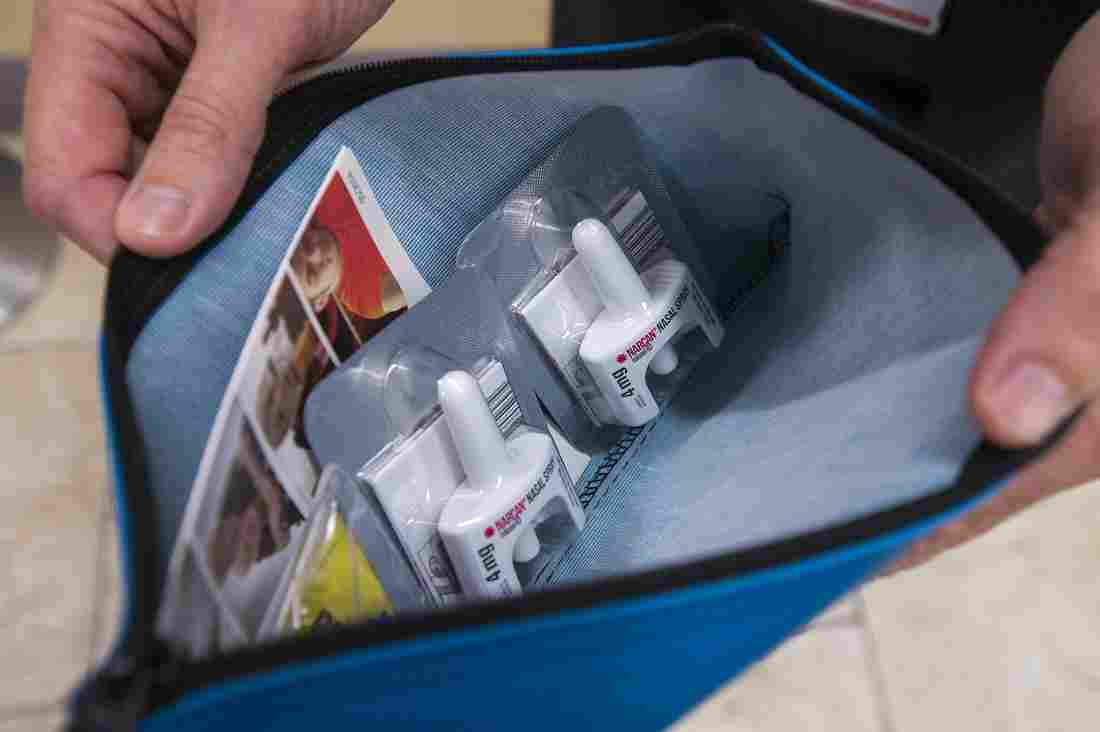
The contents of the naloxone kit inside an AED box located in the VA West Roxbury cafeteria. Jesse Costa/WBUR hide caption
toggle caption
Jesse Costa/WBUR
The contents of the naloxone kit inside an AED box located in the VA West Roxbury cafeteria.
Jesse Costa/WBUR
Cushman says there are challenges to turning AED cabinets into miniature emergency medical stations. Medicines can’t be left outside during extreme temperatures. They are expensive and expire.
Those are all challenges, says Dr. Scott Weiner, president of the Massachusetts College of Emergency Physicians. He has encountered them all while developing street-level dispensing stations for naloxone.
And then there’s the belief among some that naloxone enables drug use by offering an assurance of life after an overdose. Weiner says that attitude is waning and as it does, the public may be more open to other controversial, lifesaving measures.
“Naloxone is kind of the lowest barrier for people to understand, where someone has already overdosed and we’re going to give them the antidote,” Weiner says. “The leap to giving them needles [through a needle exchange] or allowing them to inject in a safe space, that’s just another level of acceptance that people will have to get to.”
The Boston VA’s Bellino hopes that AED manufacturers will start selling cabinets that meet the new hospital accreditation standards. So far, the Boston VA counts 132 lives saved through all three parts of its naloxone project: training high risk veterans, equipping police and the AED cabinets.
This story is part of a reporting partnership that includes WBUR, NPR and Kaiser Health News.
Share this Post
