 Enlarge this image
When Kristie Fields was undergoing treatment for breast cancer nine years ago, a nurse suggested she go on the local news and ask for help with her medical bills. Fields says she and her husband quickly dismissed the idea. Sonja Foster/KFF Health News hide caption
toggle caption
Sonja Foster/KFF Health News
When Kristie Fields was undergoing treatment for breast cancer nine years ago, a nurse suggested she go on the local news and ask for help with her medical bills. Fields says she and her husband quickly dismissed the idea.
Sonja Foster/KFF Health News
When Kristie Fields was undergoing treatment for breast cancer nine years ago, she got some unsolicited advice at the hospital: Share your story on the local news, a nurse told her. Viewers would surely send money.
Fields, a Navy veteran and former shipyard worker, was 37 and had four kids at home. The food processing plant where her husband worked had just closed. And Fields’ medical care had left the family thousands of dollars in debt.
It was a challenging time, says Fields, who has become an outspoken advocate for cancer patients in her community. But Fields and her husband, Jermaine, knew they wouldn’t go public with their struggles. “We just looked at each other like, ‘Wait. What?'” Fields recalls. “No. We’re not doing that.”
It was partly pride, she says. But there was another reason, too. “A lot of people have misperceptions and stereotypes that most African American people will beg,” explains Fields, who is Black. “You just don’t want to be looked at as needy.”
Health care debt now burdens an estimated 100 million people in the U.S., according to a KFF Health News-NPR investigation. And Black Americans are 50% more likely than white Americans to go into debt for medical or dental care.
Diagnosis: Debt
But while people flock to crowdfunding sites like GoFundMe seeking help with their medical debts, asking strangers for money has proven a less appealing option for many patients.
Black Americans use GoFundMe far less than white Americans, studies show. And those who do typically bring in less money.
The result threatens to deepen long-standing racial inequalities.
“Our social media is inundated with stories of campaigns that do super well and that are being shared all over the place,” says Nora Kenworthy, a health care researcher at the University of Washington in Bothell who studies medical crowdfunding. “Those are wonderful stories, and they’re not representative of the typical experience.”
In one recent study, Kenworthy and researchers Shauna Elbers Carlisle and Aaron Davis looked at 827 medical campaigns on GoFundMe that in 2020 had raised more than $100,000. They found only five were for Black women. Of those, two had white organizers.
GoFundMe officials acknowledge that the platform is an imperfect way to finance medical bills and that it reaches only a fraction of people in need. But for years, health care has been the largest category of campaigns on the site. This year alone, GoFundMe has recorded a 20% increase in cancer-related fundraisers, says spokesperson Heidi Hagberg. As Fields learned, some medical providers even encourage their patients to turn to crowdfunding.
The divergent experience of Black patients with this approach to medical debt may reflect the persistent wealth gap separating Black and white Americans, Kenworthy says. “Your friends tend to be the same race as you,” she says. “And so, when you turn to those friends through crowdfunding for assistance, you are essentially tapping into their wealth and their income.”
Bill Of The Month
Nationally, the median white family now has about $184,000 in assets such as homes, savings, and retirement accounts, according to an analysis by the Federal Reserve Bank of St. Louis. The assets of the median Black family total just $23,000.
But there is another reason Black Americans use crowdfunding less, Fields and others say: a sensitivity about being judged for seeking help.
Fields is the daughter of a single mom who worked fast-food jobs while going to school. The family never had much. But Fields says her mother gave her and her brother a strict lesson: getting a hand from family and friends is one thing. Asking strangers is something else.
“In the Black community, a lot of the older generation do not take handouts because you are feeding into the stereotype,” Fields says.
Her mother, whom Fields says never missed paying a bill, refused to seek assistance even after she was diagnosed with late-stage cancer that drove her into debt. She died in 2019.
Confronting the stereotypes can be painful, Fields says. But her mother left her with another lesson. “You can’t control people’s thoughts,” Fields said at a conference in Washington, D.C., organized by the National Coalition for Cancer Survivorship. “But you can control what you do.”
Fields says she was fortunate that she and her husband could rely on a tight network of relatives and friends during her cancer treatment.
“I have a strong family support system. So, one month my mom would take the car payment, and his aunt would do the groceries or whatever we needed. It was always someone in the family that said, ‘OK, we got you.'”
That meant she didn’t have to turn to the local news or to a crowdfunding site like GoFundMe.
UCLA political scientist Martin Gilens says Fields’ sensitivity is understandable.
“There’s a sort of a centuries-long suspicion of the poor, a cynicism about the degree of true need,” says Gilens, who is the author of Why Americans Hate Welfare.
Starting in the 1960s, that cynicism was reinforced by the growing view that poverty was a Black problem, even though there are far more white Americans living in poverty, according to census data. “The discourse on poverty shifted in a much more negative direction,” Gilens explains, citing a rise in critical media coverage of Black Americans and poor urban neighborhoods that helped drive a backlash against government assistance programs in the 1980s and ’90s.
Fields, whose cancer is in remission, resolved that she would help others sidestep this stigma.
Enlarge this image
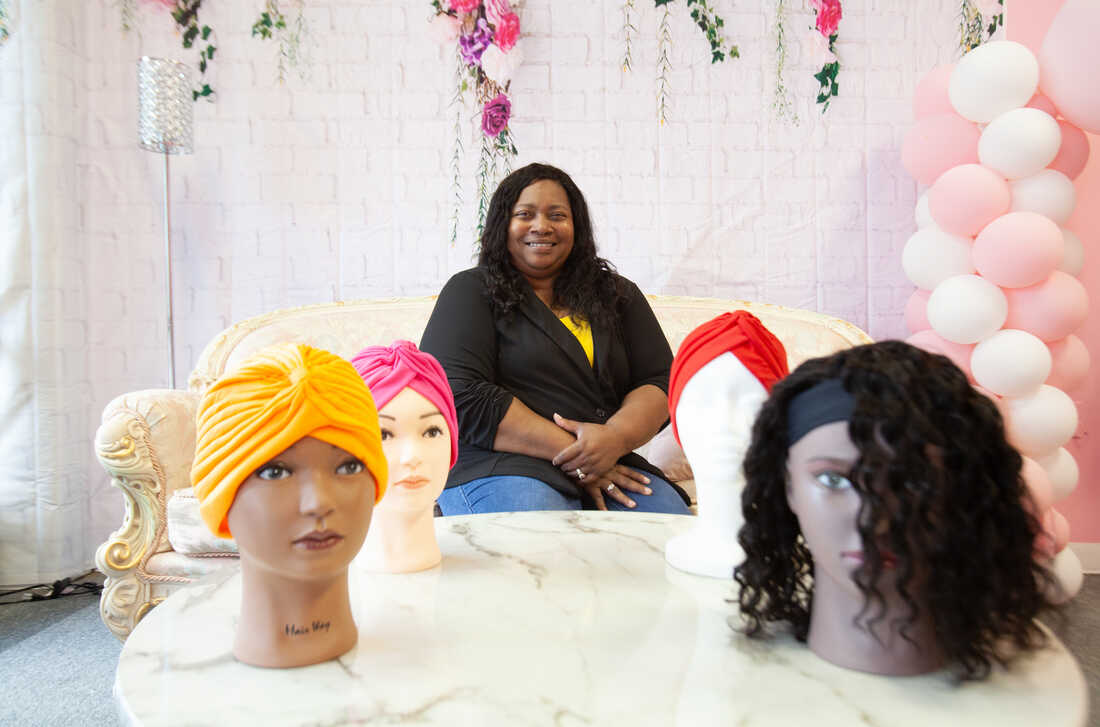
Kristie Fields recently opened a nonprofit store to provide low-cost supplies, including wigs, to cancer patients around Suffolk, Virginia. Sonja Foster/KFF Health News hide caption
toggle caption
Sonja Foster/KFF Health News
Kristie Fields recently opened a nonprofit store to provide low-cost supplies, including wigs, to cancer patients around Suffolk, Virginia.
Sonja Foster/KFF Health News
After finishing treatment, she and her family began delivering groceries, gas cards, and even medical supplies to others undergoing cancer treatment.
Fields is still working to pay off her medical debt. But this spring, she opened what she calls “a cancer care boutique” in a strip mall outside downtown Suffolk. PinkSlayer, as it’s called, is a nonprofit store that offers wigs, prosthetics, and skin lotions, at discounted prices.
“The one thing my mom always said was, ‘You fight whatever spirit that you don’t want near you,'” Fields said as she cut the ribbon on the store at a ceremony attended by friends and relatives. “We are fighting this cancer thing.”
In one corner of her small boutique, Fields installed a comfortable couch under a mural of pink and red roses. “When someone is in need, they don’t want to be plastered all over your TV, all over Facebook, Instagram,” Fields explained recently after opening the store. “They want to feel loved.”
KFF Health News, formerly known as Kaiser Health News (KHN), is a national newsroom that produces in-depth journalism about health issues.
Share this Post
