 Enlarge this image
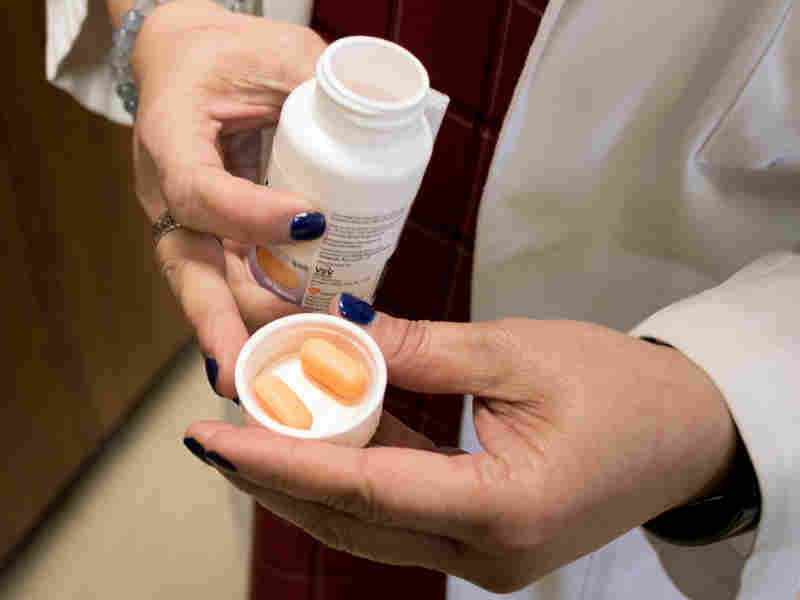
Dr. Michelle Salvaggio, medical director of the Infectious Diseases Institute at the University of Oklahoma Health Sciences Center in Oklahoma City, points to drugs used to treat HIV/AIDS. Medical advancements since the epidemic surfaced in the 1980s have helped many of her HIV-positive patients lead healthy lives. Jackie Fortier/StateImpact Oklahoma hide caption
toggle caption
Jackie Fortier/StateImpact Oklahoma
Dr. Michelle Salvaggio, medical director of the Infectious Diseases Institute at the University of Oklahoma Health Sciences Center in Oklahoma City, points to drugs used to treat HIV/AIDS. Medical advancements since the epidemic surfaced in the 1980s have helped many of her HIV-positive patients lead healthy lives.
Jackie Fortier/StateImpact Oklahoma
One of the goals President Trump announced in his State of the Union address was to stop the spread of HIV in the U.S. within 10 years.
In addition to sending extra money to 48 mainly urban counties, Washington, D.C., and San Juan, Puerto Rico, Trump’s plan targets seven states where rural transmission of HIV is especially high.
Health officials and doctors treating patients with HIV in those states say any extra funding would be welcome. But they say that strategies that work in progressive cities like Seattle won’t necessarily work in rural areas of Alabama, Arkansas, Kentucky, Mississippi, Missouri, Oklahoma and South Carolina.
Stigma around HIV and AIDS and around being gay runs deep in parts of Oklahoma, says Dr. Michelle Salvaggio, medical director of the Infectious Diseases Institute at the University of Oklahoma Health Sciences Center in Oklahoma City. The institute is one of two federally funded HIV clinics in Oklahoma; the other is in Tulsa, the second-largest city in the state.
A long drive for anonymity
Salvaggio’s clinic has six exam rooms where she sees patients, many of whom drive hours for treatment. The clinic used to employ a case manager in rural Woodward County, a little more than two hours’ drive northwest of Oklahoma City.
But Salvaggio says that having a case manager there ended up being a waste of money. “We had to let that position go, because nobody would go see her,” Salvaggio says. “Because they didn’t want to be seen walking into the HIV case manager’s office in that tiny town — that can only mean one thing.”
In Oklahoma, as in much of the U.S., black gay and bisexual men have the highest risk of HIV infection. Other groups with elevated risk in Oklahoma include Latinos, heterosexual women and Native Americans.
Salvaggio applauds the goal of ending HIV transmissions within 10 years, but says she doesn’t think it’s feasible in Oklahoma. The plan fails to recognize the particular ways different populations experience the epidemic, she says.
Native Americans in Oklahoma, for example, can’t count on the anonymity of a large health clinic.
“When they go into an Indian Health Service clinic, it is possible that they will see their cousin behind the desk, and their cousin’s brother-in-law working in medical records, and their niece’s boyfriend working in the pharmacy,” Salvaggio says.
Even if Native Americans have access to HIV care at the clinic, she says, “they are literally in fear of being outed.”
Enlarge this image
Ky Humble, who now lives in Oklahoma City, says there needs to be more support for people who are HIV-positive. Jackie Fortier/StateImpact Oklahoma hide caption
toggle caption
Jackie Fortier/StateImpact Oklahoma
Ky Humble, who now lives in Oklahoma City, says there needs to be more support for people who are HIV-positive.
Jackie Fortier/StateImpact Oklahoma
Social support services needed
Ky Humble’s hometown is Afton, Okla., which had a population of about 800 people when he was growing up. He belongs to the Cherokee Nation, and was raised a Southern Baptist. He doesn’t remember learning about HIV at all when he was in school.
“Even if I did, it clearly wasn’t enough,” Humble says. “I knew I was gay in middle school; I think I would have paid attention.”
When he was diagnosed with HIV six years ago, at age 21, Humble felt like his life was ending.
“I knew that that was a thing, [but] I was very ignorant,” he recalls. “I was two weeks away from graduating from college — you’re supposed to be on top of the world. I thought it was a death sentence.”
He called his mom right away. She immediately drove across the state to be with him.
“We just sat there and cried for six hours straight,” Humble says. “And then we actually went [out] and bought several books on HIV, and just started reading them — to try to figure out what was going on.”
Today, Humble is healthy. His HIV levels are undetectable and he gets regular medical treatment to keep it that way. He now lives in Oklahoma City, but his family still lives in his hometown. He says some people back in Afton know he has HIV, and some don’t.
“It’s like coming out as diabetic,” Humble says. “I don’t necessarily tell people that I’m HIV-positive. It’s just part of who I am; it doesn’t define me.”
He says he is cautiously optimistic that the Trump administration’s plan could mean more funding for HIV prevention in Oklahoma. But rural Oklahomans, Humble says, also need access to “wraparound services” — such as food pantries, mental health therapy and transportation assistance — to help them deal with the disease.
“I have friends who have HIV and live in rural areas, and just getting to appointments is challenging,” he says.
Oklahoma’s uninsured rate is the second-highest in U.S.
Exactly how much money the president’s HIV plan will get is up to Congress. But even inexpensive, proven methods for fighting HIV — like distributing condoms — can be a tough sell in a state that doesn’t mandate comprehensive sex education.
Informational HIV talks with teenagers often turn into a basic health class for dispelling myths, says Andy Moore, clinic administrator of the Infectious Diseases Institute at the University of Oklahoma.
Enlarge this image
Dr. Michelle Salvaggio holds one of the medicines she prescribes to her patients with HIV. Jackie Fortier/StateImpact Oklahoma hide caption
toggle caption
Jackie Fortier/StateImpact Oklahoma
Dr. Michelle Salvaggio holds one of the medicines she prescribes to her patients with HIV.
Jackie Fortier/StateImpact Oklahoma
“We’ve had teenagers write questions like, ‘I’ve heard that if you douche with Mountain Dew after sex that it kills sperm,’ ” Moore says. They earnestly want to know if that’s true. “We have to back way up, and explain what sex is, how babies are made, different types of sex — before we can teach them about HIV prevention,” he says.
Salvaggio says thousands of people across Oklahoma would need to be tested for HIV to reach the administration’s goal. And Oklahoma has the second-highest uninsured rate in the nation after Texas — meaning many people don’t have a primary care doctor, let alone prescription drug coverage for drugs like Truvada, which can be used to prevent HIV infection.
It’s also one of 14 states that hasn’t expanded Medicaid under the Affordable Care Act. So, even if more people were HIV-tested, getting those that need it into treatment wouldn’t be easy, Salvaggio says.
Health care in Oklahoma is underfunded, she says, and couldn’t cope with a sudden influx of new patients. “I don’t know what we’d do with all those new patients,” she says. “We don’t have a facility to see them in, and we don’t have [the] providers.”
This story is part of NPR’s reporting partnership with StateImpact Oklahoma and Kaiser Health News. You can follow Jackie Fortier on Twitter: @JackieFortier.
Share this Post
