 Enlarge this image
An experimental vaccine against the AIDS virus is being tested in South Africa. Scientists hope it will succeed where others have failed. Mujahid Safodien/AFP/Getty Images hide caption
toggle caption
Mujahid Safodien/AFP/Getty Images
An experimental vaccine against the AIDS virus is being tested in South Africa. Scientists hope it will succeed where others have failed.
Mujahid Safodien/AFP/Getty Images
When Health and Human Services Secretary Margaret Heckler announced that scientists had discovered the virus that caused AIDS at a press conference in 1984, the disease was still mysterious and invariably fatal.
Perhaps with a vaccine, AIDS could be ended like smallpox or contained like polio, two scourges that yielded to intense public health interventions. Heckler suggested that experimental vaccine trials were just two years away.
We now know that HIV is rarely curable, though it can be managed with antiviral medicines. And more than 30 years later, HIV vaccine research has produced mainly a string of failures.
Only one major HIV vaccine trial has shown any progress to date. In that study, done in Thailand, a two-stage vaccination approach called RV 144 resulted a roughly 30 percent reduction in HIV infections after several years. These results were hailed as proving the concept that an HIV vaccine could be protective, but the results weren’t strong enough to pursue regulatory approval.
Public health officials still say that a vaccine is essential to vanquishing HIV and AIDS.
“Development of an effective HIV vaccine will likely be necessary to achieve a durable end to the HIV pandemic,” Dr. Anthony Fauci, director of the National Institute of Allergy and Infectious Diseases, wrote in JAMA, the journal of the American Medical Association, in October.
And Fauci is optimistic that it can happen because the vaccines don’t need to be perfect to be helpful. An incremental improvement over the one tested in the Thai trial could have a major effect on spread of HIV, he says.
The best case scenario is a vaccine that is at least 60 percent effective, Fauci says in an interview, “but I’d settle for from 50 to 55.” With a HIV vaccine that stops a little more than half of all transmissions, “you could really nail down the end of the epidemic,” he says.
Enlarge this image
A vaccine will be necessary to end the HIV pandemic, says Dr. Anthony Fauci, director of the National Institute of Allergy and Infectious Diseases. Molly Riley/AP hide caption
toggle caption
Molly Riley/AP
A vaccine will be necessary to end the HIV pandemic, says Dr. Anthony Fauci, director of the National Institute of Allergy and Infectious Diseases.
Molly Riley/AP
There are two HIV vaccine trials underway today that Fauci says are the most promising efforts since 2009.
The first trial, called HVTN 702, began its third and final phase in 2016 with 5,400 South African volunteers. Results are expected in 2021.
“We were able to tease out what were the immune responses that we think were responsible at least partly for protection of [the Thai vaccine],” says Susan Buchbinder, director of Bridge HIV at the San Francisco Department of Public Health. The HVTN 702 study is “tailored for the sub-Saharan African epidemic, and we’re currently testing that combined vaccine regimen,” she says.
Buchbinder, a leader in the HIV Vaccine Trials Network, notes that the Thai vaccine was 60 percent effective for the first year before weakening to 30 percent. She says the HVTN 702 trial uses a new regimen that scientists hope will draw out the higher response over a longer period of time.
In November 2017, a separate trial called “Imbokodo” launched in five southern African nations. It attempts to address the challenge of vaccinating against the strains of HIV that are prevalent in different regions of the world.
HIV is “kind of what I call a sloppy virus — it makes mistakes and it doesn’t correct them,” Buchbinder says. “That makes it difficult for the antibodies to keep up.”
Imbokodo uses what Buchbinder calls “a mosaic insert,” or lab-created fragments of HIV, to train the body to make the antibodies that are likely to be most effective against the common strains of HIV, rather than the approach used in HVTN 704 and RV 144, both of which specifically targeted regional HIV strains.
But even as U.S. public health officials hope for a safe and effective HIV vaccine, there has been progress on other fronts. Robust HIV testing, treatment, and prevention programs — in the District of Columbia, San Francisco, and New York City, for instance — have led to significant reductions in the rate of new HIV cases over the past decade.
Enlarge this image
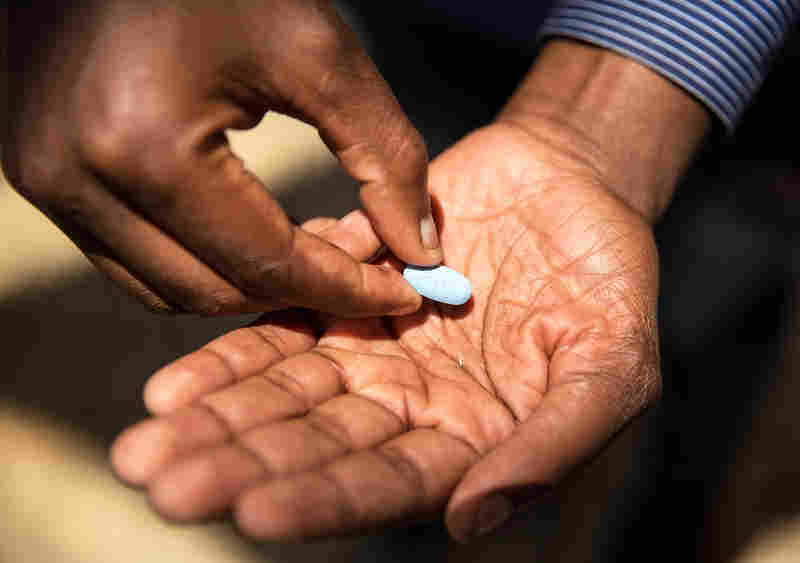
Thembelani Sibanda, of Soweto, South Africa, shows an HIV-preventing drug he takes to reduce the risk of becoming infected with HIV, an approach called pre-exposure prophylaxis, or PrEP. Daniel Born/The Times/Getty Images hide caption
toggle caption
Daniel Born/The Times/Getty Images
Thembelani Sibanda, of Soweto, South Africa, shows an HIV-preventing drug he takes to reduce the risk of becoming infected with HIV, an approach called pre-exposure prophylaxis, or PrEP.
Daniel Born/The Times/Getty Images
Two of the most effective HIV prevention tools today were discovered in the past decade: PrEP, short for pre-exposure prophylaxis, and TasP, short for treatment as prevention. Both involve taking HIV medication daily and both dramatically reduce the risk of transmitting or contracting the virus. PrEP and TasP are statistically more effective at preventing HIV than condoms, and they have revolutionized HIV prevention and treatment — at least in areas with robust access.
For example, the District of Columbia had one of the fastest growing HIV rates in the country a decade ago. But aggressive public health action — including free condoms, needle exchanges, widespread testing, rapid treatment for newly diagnosed people and easily accessible PrEP — helped cut the number of newly diagnosed HIV infections in the city from 1,333 cases in 2007 to 347 cases in 2016, down 73 percent.
But when health officials in Washington released a racy sexual health ad campaign last December, its imagery raised eyebrows: a woman licking an ice cream cone, a churro being dipped in creamy sauce, a plate of hot dogs and an explosion of mustard.
“Thinking about sex?” asks a sultry voice. “Then think about PrEP.”
The sexual innuendo is plain, and that’s just how Michael Kharfen wants it. He heads the HIV/AIDS office in Washington’s health department.
“For the broadcast networks, we are airing it after 10 at night, which is fairly reasonable,” Kharfen says with a smile.
But if you’re in the target demographic online, he explains, you’ll come across this ad on Pandora, YouTube or even Facebook.
“One of our goals — particularly with scaling up PrEP — is around how to not lose momentum,” says Kharfen.
Washington is at the point where so few people are becoming HIV positive that Kharfen’s office can analyze each case and ask hard questions. “Where did the system fail that person?” Kharfen says. “Where did we not make sure that somebody had the opportunity to have PrEP, or to have some prevention strategy that fit them that would have averted this diagnosis?”
“You could actually turn off the AIDS pandemic right now,” says NIAID’s Fauci, reflecting on the success of jurisdictions like Washington. If existing approaches were universally implemented, HIV transmission would grind to a halt, and that would be a “somewhat awesome feeling,” he says.
But it’s “theoretical,” Fauci says, because PrEP and TasP haven’t been implemented widely enough to end the pandemic.
That’s why a vaccine is so important, he says, even if it only provides imperfect protection against HIV. Results from the two vaccine trials that provide the best shot at that goal are expected in late 2020 and 2021.
Tim Fitzsimons is a New York-based reporter. He tweets at @tfitzsimons.
Share this Post
