 Enlarge this image
Canadian astronaut David Saint-Jacques has his blood sampled on board the International Space Station for an experiment that examines the space-related changes that occur in blood and bone marrow. NASA hide caption
toggle caption
NASA
Canadian astronaut David Saint-Jacques has his blood sampled on board the International Space Station for an experiment that examines the space-related changes that occur in blood and bone marrow.
NASA
Astronauts are supposed to be in excellent health. It’s part of the job description. They quarantine before blasting off to avoid getting sick and derailing a mission. Once aloft, they live and work in a sterile environment.
And yet, when they get to outer space, some have viral flareups or break out in rashes. It’s a puzzle that got Odette Laneuville, a molecular biologist at the University of Ottawa, asking herself, “Why is it that they get infections up there?”
In a new study in Frontiers in Immunology, Laneuville and her colleagues suggest it could be due to the reduced activity of one hundred immune-related genes, which help give opportunistic infections a toehold.
History
40 years ago, Sally Ride became the first American woman in space
Knowing what causes astronauts to be more vulnerable to infections could help make future missions to space safer, experts say — and may improve treatments for those who are immunocompromised back here on Earth.
Normally, Laneuville says our bodies host a multitude of viruses and bacteria at any given moment — even when we feel just fine.
“And because we’re healthy, we manage to keep those at check and dormant,” she says. “But if we’re stressed or if there’s a dysregulation of the immune system,” then those viruses and bacteria can cause infections. Laneuville thought maybe something in space was triggering a change in the gene activity of of the immune cells in astronaut blood that was allowing these opportunistic infections to surface.
So she and her colleagues enlisted 14 American and Canadian astronauts — all headed to the International Space Station for several months at different times. Laneuville had their blood sampled before and after their missions here on Earth, but also during their time in outer space. The 10-minute procedure on land took 90 minutes in orbit.
“They have to be very careful to pull out all their equipment, the needles, the tubes. And they have to secure everything,” Laneuville says. “We don’t want any leak. Not a drop of blood. Otherwise, it will float in the air and contaminate everybody.”
The astronauts spun the blood down and stored it in a super-cold freezer until they returned to Earth, samples in tow. “I was supposed to hire someone to process those,” she says. “But then I said, ‘No, they’re too precious. This blood comes from space.’ It was my baby and I had to take care of it.”
Enlarge this image
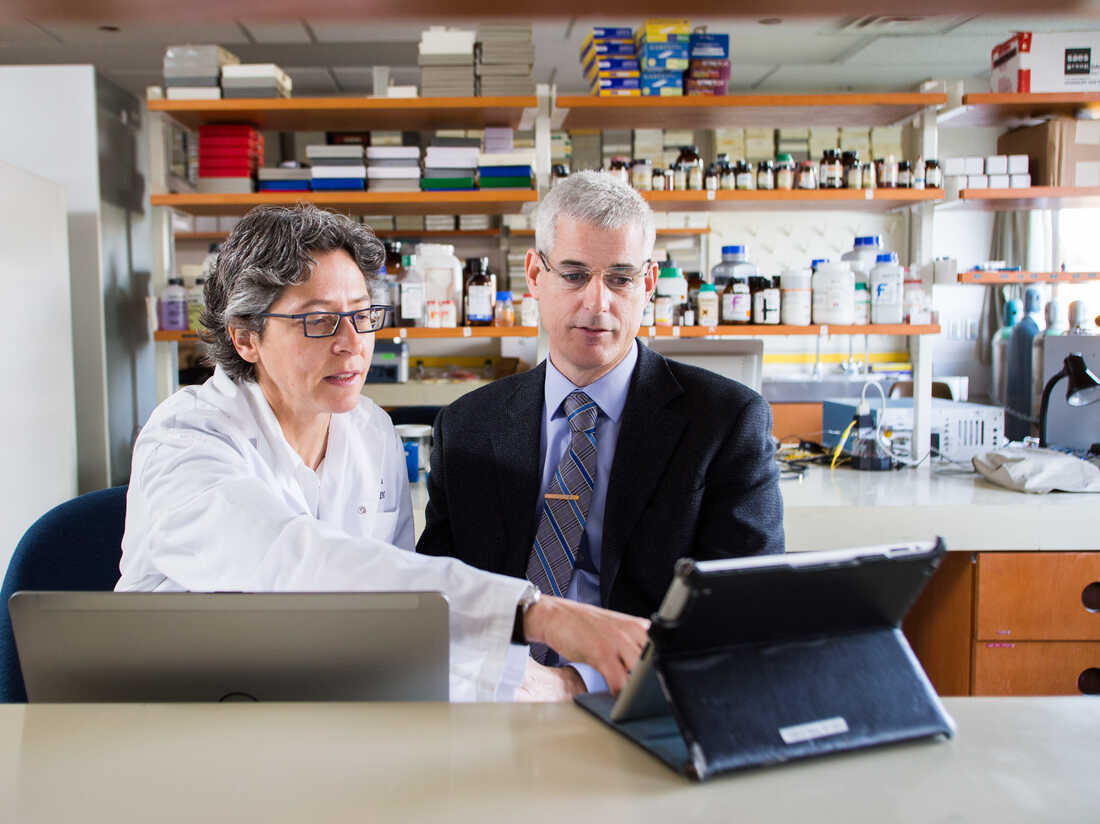
Ottawa-based researchers Dr. Odette Laneuville (left) and Dr. Guy Trudel (right) were part of a team that studied how the space environment affects astronauts’ blood. University of Ottawa hide caption
toggle caption
University of Ottawa
Ottawa-based researchers Dr. Odette Laneuville (left) and Dr. Guy Trudel (right) were part of a team that studied how the space environment affects astronauts’ blood.
University of Ottawa
All told, across multiple missions to the International Space Station, it took five years to collect all the samples. “One has to be very patient,” says Laneuville. “But it’s worth waiting. I was gonna wait more if I had to.”
Here’s what that special blood revealed. Exactly one hundred immune-related genes get dialed down in outer space. It could be due to stress. But Laneuville thinks there’s another possibility: “Those genes respond to a decrease in gravitational force.”
She says that when an astronaut enters microgravity, their blood shifts from their legs to their torsos and heads. It’s uncomfortable and throws things out of whack. Their body resolves the problem by reducing the fluid by up to 15%. But that now means that there are too many immune cells crammed into this smaller amount of blood.
Laneuville thinks the drop in gene activity helps eliminate those extra cells. And this in turn affects the way the immune system responds to pathogens.
“It’s as if the body is telling them, ‘Don’t defend, put your guards down,'” she says.
And this would allow viral and bacterial infections — normally held at bay — to rise up, infecting the astronauts.
But once they step foot on land again, the whole thing reverses as the genes are dialed back up and fluid levels return to normal. This reversal takes no longer than a year, but for many genes it’s only a matter of a few weeks.
Space
NASA assigns astronauts to enter lunar orbit for the first time in decades
Down the road, the study may have something to say about those with compromised immune systems right here on Earth, says Brian Crucian, a research immunologist at NASA who wasn’t involved in the work.
“Think about a transplant patient,” or someone who’s elderly or under a large amount of stress. “There are a lot of ties between astronauts and terrestrial medicine.”
People who spend long periods of time in Antarctica may also benefit from this research. With these individuals, “you run them through difficult travel to a profoundly extreme environment,” says Crucian. “You put them in a base for a year, they experience 24-hour darkness, 24-hour daylight. And so you’ve got almost everything but microgravity and radiation in the Antarctic.”
This study is a good start, says Jeremy Teo, a biomedical engineer at NYU Abu Dhabi who wasn’t part of the research.
As we send astronauts farther and father out — to the Moon and even Mars — experts say it will be harder to get them back to Earth for recovery or expedient treatment.
“The feasibility of extraditing compromised astronauts back to Earth is just not there anymore,” says Teo. “And hence, we need to develop these new countermeasures to cater to these space travel stresses on the immune system.”
Share this Post
