 Enlarge this image
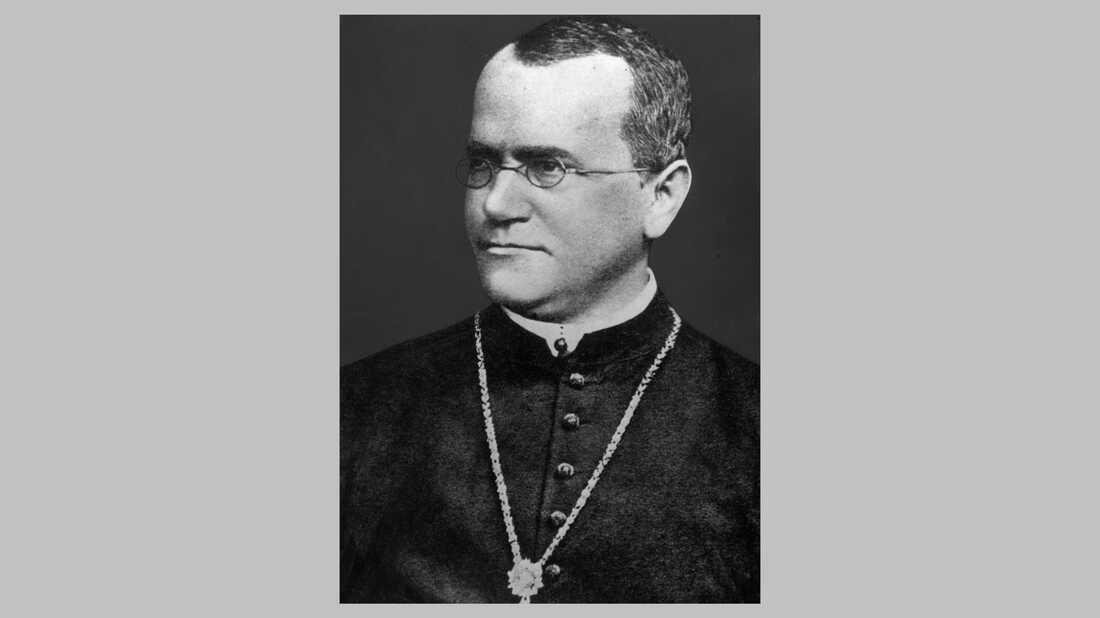
Gregor Johann Mendel (1822 – 1884) the priest and botanist whose work laid the foundation of the study of genetics. Hulton Archive/Getty Images/ Max Posner/NPR hide caption
toggle caption
Hulton Archive/Getty Images/ Max Posner/NPR
Gregor Johann Mendel (1822 – 1884) the priest and botanist whose work laid the foundation of the study of genetics.
Hulton Archive/Getty Images/ Max Posner/NPR
When the man known as “father of genetics” turns 200, how do you celebrate?
That’s what a team of scientists in the Czech Republic did this year to celebrate Gregor Mendel, a scientist and friar whose experiments in the mid-1800s laid the groundwork for modern genetics.
Mendel lived and worked in Brno, the second-largest city in the Czech Republic. With 2022 marking the bicentennial of Mendel’s birth, local researchers there – where Mendel remains something of a hometown hero – searched for ways to remember the man and honor the moment. Possibilities included a festival, a scientific conference, and a statue.
Astronomer Jiří Dušek, director of the Brno Observatory and Planetarium, wondered whether the founder of genetics had ever been subjected to any genetic testing.
“So that was the beginning,” says Šárka Pospíšilová, a geneticist who is also the vice rector for research at Masaryk University in Brno.
A ‘crazy’ idea becomes reality
At first, she says the idea of analyzing Mendel’s genes seemed “crazy.”
Still, Pospíšilová went around to different specialists at the university to ask what might be possible.
“I asked the anthropologists who had experiences with analysis of remains of various historical persons,” she recalls. She consulted with archaeologists as well.
Exhuming Mendel from his grave in Brno and running genetic tests on his remains turned out to be a doable project – so long as they could get permission from the Augustinians. That’s the religious order that Mendel belonged to, and with which he remains: The Augustinian tomb in the city’s central cemetery was thought to contain Mendel’s body.
Local religious leaders consulted with Augustinians in Prague, their bishop, and finally Augustinians in Rome. Eventually, permission was granted.
He had an extraordinarily large brain and was 168 cm tall. ♂️We are talking about the founder of genetics, Gregor Johann Mendel. His remains are currently being studied by scientists from Masaryk University. pic.twitter.com/2TZEUNbrPQ
— BrnoNewsCTV (@BrnoNewsCTV) November 4, 2021
A giant in genetics
Filip Pardy, a molecular biologist on the research team, felt that a heavy sense of responsibility came with being part of this effort.
“Gregor Mendel is a person that is taught at the first course of genetics at the university,” says Pardy. “Everybody feels that he’s very important, especially here in Brno. He’s kind of a role model … who stood at the beginning of everything we do.”
Mendel was ahead of his time in the way he used math to study patterns of inheritance in pea plants when looking at things like flower color and plant height, says Pardy.
“He analyzed a set of about 25,000 plants to actually get his numbers right and to create the formulas,” says Pardy. “And so in this regard he was also kind of a visionary and one step ahead.”
Mendel’s plant experiments were known and respected during his lifetime, but his fame really took off after 1900, when geneticists rediscovered his work and realized its implications.
“No one at the time, including Mendel, I think, suspected that his work would be so groundbreaking in terms of being a major scientific theory,” says Daniel Fairbanks, a plant geneticist and author of a book called Gregor Mendel: His Life and Legacy.
Mendel’s genes offer clues about his life
The excavation of Mendel’s tomb revealed five coffins, stacked one on top of the other. That was a bit of a surprise, given that the tomb’s marker had the names of only four Augustinian brothers.
Mendel’s coffin seemed to be the metal one at the bottom. It was lined with some newspapers that were dated shortly before he died, which seemed pretty conclusive. Still, Pardy says they wanted even better evidence that this coffin held Mendel’s remains.
“We actually came up with this idea of going through his personal possessions because we knew we needed some reference material to actually confirm his identity,” says Pardy.
Curators at local museums let them swab items like Mendel’s microscopes, his eyeglasses, written records of his meteorological measurements, and a cigarette case. The team also carefully searched inside Mendel’s favorite books and, in a book about astronomy, found a hair.
YouTubeSequencing his DNA revealed genetic variants linked to diabetes, heart problems, and kidney disease. The variant that most intrigued Fairbanks was in a gene that has been associated with epilepsy and neurological issues.
“He suffered throughout his life from some sort of a psychological or neurological disorder that caused him to have very severe nervous breakdowns,” says Fairbanks. “That may well have been an inherited condition – and that was a fascinating discovery that these scientists made.”
What would Mendel do?
Fairbanks has thought about how Mendel would feel about being disturbed in his grave to satisfy the curiosity of today’s scientists.
“I tend to think, from what I know about him, that he very well may have been happy about this,” says Fairbanks. “But of course we can’t directly ask him.”
Pospíšilová leans toward that theory, too.
“We believe that he would be happy. We know he was very enthusiastic for all kinds of research,” she says – noting that just before he died, Mendel requested that an extensive autopsy be done.
“He wasn’t against research on his own body,” she says.
Even though Mendel knew nothing about DNA or the role that it played in the inheritance patterns he so closely observed, she says, in all likelihood “he wouldn’t mind being part of research, even after his death.”
Share this Post
