 Enlarge this image
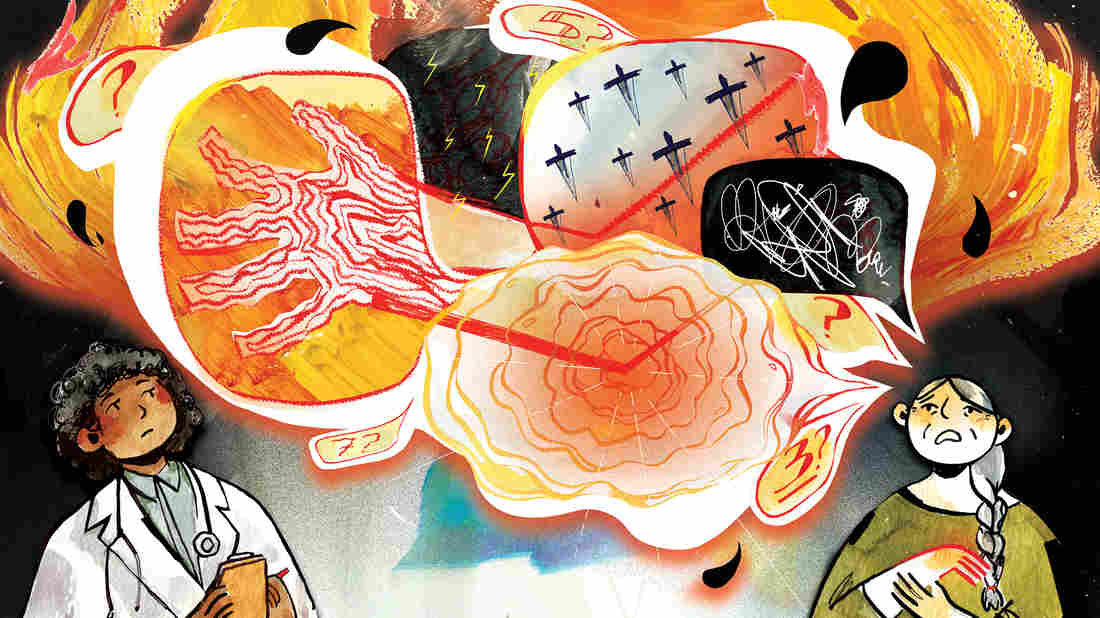
Describing how pain affects your daily activities may be more effective than the standard pain scale. Lynn Scurfield for NPR hide caption
toggle caption
Lynn Scurfield for NPR
Describing how pain affects your daily activities may be more effective than the standard pain scale.
Lynn Scurfield for NPR
If you’re in the hospital or a doctor’s office with a painful problem, you’ll likely be asked to rate your pain on a scale of 0 to 10 – with 0 meaning no pain at all and 10 indicating the worst pain you can imagine. But many doctors and nurses say this rating system isn’t working and they’re trying a new approach.
The numeric pain scale may just be too simplistic, says Dr. John Markman, director of the Translational Pain Research Program at the University of Rochester School of Medicine and Dentistry. It can lead doctors to “treat by numbers,” he says and as a result, patients may not be getting the most effective treatment for their pain.
Take the case of 33-year-old Adam Rosette, who was recently hospitalized for fibrous dysplasia, a bone disorder that made it nearly impossible for him to chew or even speak. After brain surgery to remove benign tumors related to the disorder, he was definitely in pain. But he was reluctant to label the pain too high.
“I don’t think I ever answered higher than a ‘7’ because an ‘8’ would be, in my mind, like I’m missing half of my body or a limb,” he recalls.
On the pain scale a rating of 4 to 7 is considered moderate. Mild pain is rated 1 to 3. Over 7 is considered severe.
Today, Rosette has recovered and is pain-free, but he wonders if “low balling” his pain level while in the hospital, meant he wasn’t given adequate pain medication.
“You realize you got less medicine and it’s been eight hours and they’re not allowed to give you more for a while,” Rosette says.
Shots – Health News
Patients With Chronic Pain Feel Caught In An Opioid Prescribing Debate
If your doctor gets the wrong idea about your pain, it’s not just going to affect your comfort — it can affect your treatment. Markman says that especially after an injury, there’s therapeutic value to keeping the pain tamped down, so that you can keep up with physical therapy.
For chronic pain, being clear can help clinicians choose the right mix of therapies or medications to allow you to stay as active as possible. And staying active can help manage chronic pain, says Dr. William Maixner, with Duke University School of Medicine and current president of the American Pain Society.
Exercise, he says, “causes the release of a number of anti-inflammatory substances from the muscle that can help diminish pain and pain processing and make the individual more resilient.”
Shots – Health News
For Chronic Pain, A Change In Habits Can Beat Opioids For Relief
To find out more about how the numerical pain scale was affecting treatment, Markman and colleagues at the University of Rochester did a study, which they will present at the World Congress on Pain in Boston in September. The research analyzed data from other studies, which asked chronic pain patients to rate their pain using both numbers and words.
Patients were asked to rate their pain on a scale of 0 to 10, and they were also asked the question, “Is your pain tolerable?”
Surprisingly, three-quarters of the patients who rated their pain between 4 and 7 on the numerical scale, a range that typically calls for higher doses of medications, also described their pain as “tolerable” — a description that normally means no more pain treatment is needed.
This showed the danger of relying only on a number, Markman says. “If you were just treating by the numbers you might say, ‘Well, someone has a pain that is 6 [out of]10. I feel obligated to do something about that … to fix that number just like you might fix their blood pressure or their blood glucose,’ ” he says.
If clinicians just look at a number, Markman says, they may be more likely to over-treat or prescribe more medication, which can be worrisome during an era of concern about opioid abuse and addiction.
So if today’s pain scale isn’t working well for patients and doctors, what’s the alternative?
Many health care providers are trying to come up with a system that involves words, not numbers.
“I never look at just the pain scale,” says Dr. Chrystina Jeter, an anesthesiologist and pain management specialist with UCLA Health, who was Rosette’s doctor.
Using words to describe pain brings greater specificity to the measurement of pain, says Maixner.
If patients can describe their pain precisely, he says, their appointment with a health care provider will be much more focused, allowing the physician to “come to a decision about treatment in a much more rapid and logical way.”
Here’s advice for the next time you need to talk to your doctor about your pain.
Get descriptive: use metaphor and memoir
You can help doctors understand just how debilitating your pain is by being more descriptive.
“It’s perfectly OK to be a little more flowery in the description of pain,” says Jeter. “My pain is aching, burning. What does it feel like to you? Where is it? Does it move?”
Jeter typically asks patients to compare their current pain to the worst pain they ever had, such as childbirth or kidney stones. This helps put their pain in context, she says, and may help them realize their pain may not be that bad after all.
Describe your day
It can be helpful to talk about how your pain waxes and wanes throughout the day, says Jeter. For example, is it mostly when you eat, walk, or do certain activities?
“I look for trends over time and I look at their function,” she says.
Talk about function, not feeling
Be clear about how your pain interferes with daily activities, such as getting out of bed early, getting dressed, feeling fatigued, or no longer enjoying getting out with friends, suggests Maixner.
Thinking about function is key, agrees Markman. He says the most accurate measurement of pain may be what it prevents patients from doing. For example, if a patient cannot chew or talk, walk, or exercise that might be more disturbing to them than the pain. Sometimes it’s more useful to seek ways to “work around the pain” rather than “making it go away,” Markman says.
Share your treatment history
Describe the history of the pain, the location, how long it’s been hurting and what factors seem to aggravate it, or help it get better, suggests Maixner.
Share other treatments you’ve sought, such as acupuncture, massage and certain medications, he says. “Let the doctor know what you’ve done and whether it was effective.”
Family history is also important, he says, especially when you consider much of an individual’s pain sensitivity is inherited. If your parents were highly sensitive to pain, chances are you will be, too, he says.
Share this Post
