 Enlarge this image
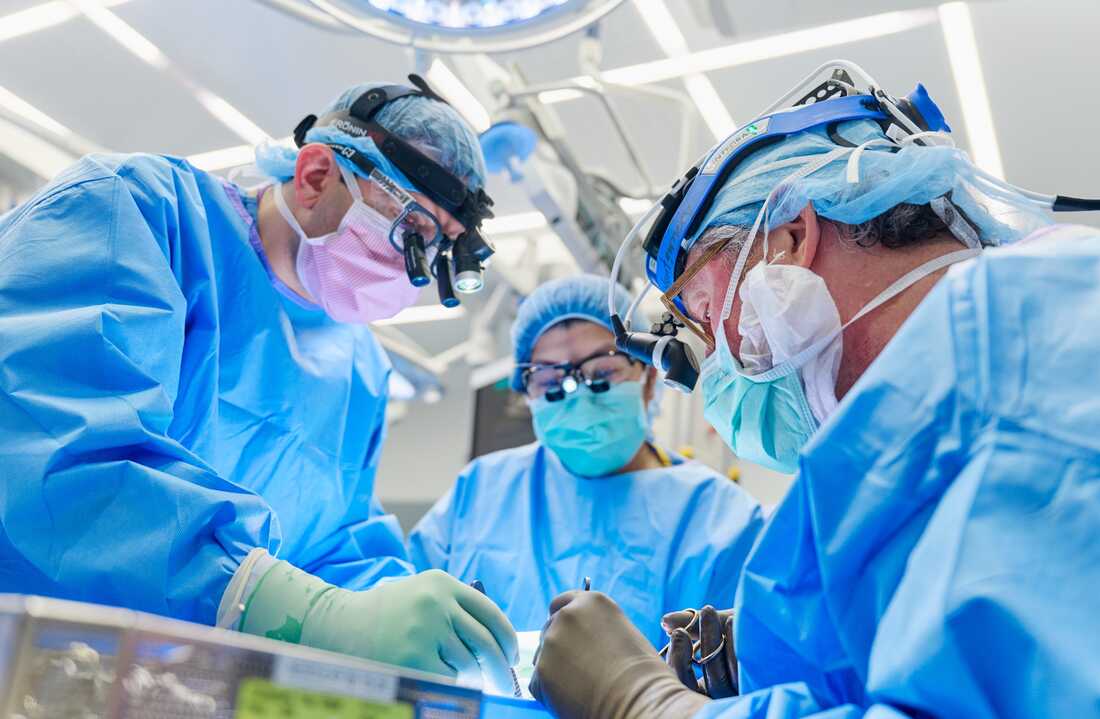
Dr. Jeffrey Stern, assistant professor in the Department of Surgery at NYU Grossman School of Medicine, and Dr. Robert Montgomery, director of the NYU Langone Transplant Institute, prepare the gene-edited pig kidney with thymus for transplantation. Joe Carrotta for NYU Langone Health hide caption
toggle caption
Joe Carrotta for NYU Langone Health
Dr. Jeffrey Stern, assistant professor in the Department of Surgery at NYU Grossman School of Medicine, and Dr. Robert Montgomery, director of the NYU Langone Transplant Institute, prepare the gene-edited pig kidney with thymus for transplantation.
Joe Carrotta for NYU Langone Health
NEW YORK — Lisa Pisano was lying in a hospital bed at NYU Langone Health, hooked up to beeping monitors and an array of tubes. Her surgical wounds were still healing, and she looked tired. But the 54-year-old New Jersey woman said she hasn’t felt this good in years.
“I’m feeling better and better and better every day,” said Pisano, 54, of Cookstown, N.J. “I got somewhat of me back. Not there yet. But I’m getting there.”
Ten days earlier, Pisano became the second living person in the world to get a kidney from a genetically modified pig transplanted into her body to replace her own failing organs, her doctors announced Wednesday. A Massachusetts man was the first to get a pig kidney last month.
Pisano also got a thymus gland from the same genetically engineered pig to help prevent her body from rejecting the kidney, as well as a pump to shore up her failing heart.
“I’m amazed,” said Pisano during a bedside interview two days before her kidney transplant was announced publicly. “I’m absolutely amazed that it’s an option for me. Because I didn’t think I even had that option.”
Progress in human transplant of animal organs
Pisano’s transplant is the latest development in the fast-moving effort to use genetically modified pigs to solve the persistent shortage of organs for transplants. More than 103,000 people are currently on the waiting list for organs. About 17 die every day because they can’t get one.
“We’re in a new universe in transplantation,” said Dr. Robert Montgomery, who runs the NYU Langone Transplant Institute where the operation was performed. “This would be a sustainable, unlimited source of organs. This would be transformative.”
Shots – Health News
How genetically modified pigs could end the shortage of organs for transplants
Many transplant specialists are excited by the research. But the effort is also raising some concerns. Some doctors worry pig organs could spread viruses to people. Some critics are uncomfortable with the prospect of breeding thousands of genetically modified animals to be slaughtered for their organs. Some also are concerned about using vulnerable patients for experimentation.
“This is a real landmark procedure,” said Karen Maschke, a bioethicist at The Hastings Center, a bioethics think tank in Garrison, N.Y. “But there are lot of issues that need to be discussed.”
When Pisano arrived at the hospital, she was within weeks — maybe even days — of dying, Montgomery said. Years of diabetes had taken a terrible toll. She had suffered multiple heart attacks and was on dialysis to compensate for her failing kidneys.
“I didn’t really have a life,” she said. “I didn’t do anything. I just sat around. I couldn’t get up and do anything. I couldn’t even cook dinner. I couldn’t vacuum. I couldn’t play with my grandkids because I couldn’t bend down to get them. I just couldn’t do anything with them. And that is the most horrible feeling in the world. That was really, really tearing me apart. I was almost at the point of giving up. It was terrible.”
Pisano wasn’t eligible to get a human organ transplant because she had too many other health problems, especially serious heart problems. So she jumped at the chance to get a pig kidney.
“My first thought was: ‘Wow, I can’t even believe that was even possible.’ So when it was brought to my attention I was like, ‘You know what? I’m going to try it.’ I said, ‘You know what? I’m going to do it. I have to do it — for myself and for the rest of my family.’ “
A transplant for research — and to buy time
The hope is the pig kidney will give Pisano at least a little more time, and provide researchers with important information they could use to improve the outcome in future transplants. Pisano also needs to take anti-rejection medication.
“When we brought her into the hospital, she was in really bad shape,” said Montgomery. “None of us could have imagined that it would have gone this smoothly.”
“Her kidney is working better than yours or mine. So we’re optimistic that she’ll be able to go home and spend time with her children and grandchildren and live a comfortable life,” Montgomery told NPR in an interview before the announcement.
He stressed, however, that she will probably need several months to recover in the hospital before she can go home. He also said he couldn’t predict how much more time Pisano may gain from the procedure.
Beyond Pisano’s case, much more research is needed before organs from genetically modified pigs could become commonly used. “It’s still early,” Montgomery said. “These are early days. There’s still a lot we need to learn and perfect.”
Shots – Health News
First human transplant of a genetically modified pig kidney performed
Surgeons had previously transplanted kidneys and livers from genetically modified cloned pigs into baboons and a handful of people whose brains had stopped functioning. Surgeons at the University of Maryland even tested hearts in two men who had run out of other options. They lived for several weeks after the procedures. The Massachusetts man who got the pig kidney left the hospital within weeks and is still doing well, according to Massachusetts General Hospital.
Pig organs are genetically modified for human compatibility
The organs come from pigs that have been genetically modified to minimize the risk they will be rejected by the human body, spread pig viruses to people or cause other complications.
NPR recently got exclusive access to one research farm breeding pigs for Revivicor Inc. of Blacksburg, Va., the biotech company that produced the kidney and thymus Pisano received. The kidney transplanted in Boston came from a pig created by eGenesis of Cambridge, Mass.
The companies hope that someday an ample supply of genetically modified pigs will save thousands of lives.
The modified organs haven’t been reviewed or approved for widespread use.
The transplant of the pig hearts and kidneys were made possible by the Food and Drug Administration as part of a ” compassionate use” program aimed at helping desperate patients.
“I think there are worries about conducting these experiments in this way, where we are finding the most desperate patients who have no other options,” said L. Syd Johnson, a bioethicist at SUNY Upstate Medical University in Syracuse, N.Y.
“Maybe those patients will benefit. Maybe they believe they will benefit and that the risks are worthwhile for them. But I do worry about whether or not we are taking advantage of particularly vulnerable and desperate patients in conducting these experiments,” Johnson said.
The doctors performing the transplants, and some independent observers, say the volunteers are fully informed of the risks and potential benefits.
But some would prefer the FDA approve a formal study to fully evaluate the approach instead of granting individual patient’s approval.
“It’s a remarkable development. It is incredible how quickly this is progressing,” said Michael Gusmano, a bioethicist at Lehigh University. “But I remain concerned about the use of the expanded access protocol in lieu of moving forward with a trial.”
The companies hope the FDA will authorize a formal study soon.
Pisano just hopes for some more time with her grandchildren.
“Any time on this Earth is better than none,” she said. “So if I get two years, that’s two years that I didn’t have before.”
Share this Post
