 Enlarge this image
Students and administrators at the Icahn School of Medicine are working to fight racial disparities at their school, including: (from left) Masrai Williams, Michelle Sainté, Giselle Lynch, Dr. David Muller, Eziwoma Alibo, Michael Espino and Shashi Anand. Gabriela Bhaskar for NPR hide caption
toggle caption
Gabriela Bhaskar for NPR
Students and administrators at the Icahn School of Medicine are working to fight racial disparities at their school, including: (from left) Masrai Williams, Michelle Sainté, Giselle Lynch, Dr. David Muller, Eziwoma Alibo, Michael Espino and Shashi Anand.
Gabriela Bhaskar for NPR
Senior medical student Giselle Lynch has plenty of accomplishments to list when she applies for a coveted spot in an ophthalmology residency program this fall.
But one box she won’t be able to check when she submits her application is one of the highest academic awards medical students can receive, election to the honor society Alpha Omega Alpha.
It’s not because she didn’t excel. It’s because her medical school, the Icahn School of Medicine at Mount Sinai in New York City, put a moratorium on student nominations because it determined the selection process discriminates against students of color.
The award is open to the top 25 percent of a medical school’s graduating class and can be a valuable career boost, making students more competitive for desirable residencies and jobs.
Icahn administrators say the disparities in the selection process reflect deeper issues of racial inequality in medical education.
“AOA perpetuates systems that are deeply flawed,” says Dr. David Muller, the dean for medical education at Icahn. “We can’t justify putting people who are historically at a disadvantage at an even greater disadvantage. It just doesn’t seem fair to dangle in front of our students an honorific that we know people are not equally eligible for.”
Enlarge this image
“AOA is an award of student excellence,” says Lynch, who led student efforts at Icahn to fight racial inequality at the school. “What was the argument that was being perpetuated about us if we’re not being included?” Gabriela Bhaskar for NPR hide caption
toggle caption
Gabriela Bhaskar for NPR
“AOA is an award of student excellence,” says Lynch, who led student efforts at Icahn to fight racial inequality at the school. “What was the argument that was being perpetuated about us if we’re not being included?”
Gabriela Bhaskar for NPR
Over the past five years, around 3 percent of students chosen for the distinction at Icahn were from a racial background that is underrepresented in medicine, which includes blacks and Latinos. In that same period, about 18 percent to 20 percent of each graduating class at Icahn came from those groups.
The school made the change after Lynch led a group of fellow students in an effort to fight inequality at Icahn. The students collected data on how many students from underrepresented minorities were nominated to the honor society at Icahn and presented it in a series of meetings with school leadership last year.
Lynch, who is black, recalls one particularly moving meeting when they showed photographs of Icahn’s past AOA students — and black and Latino faces were conspicuously sparse.
“Where are we? We’re nowhere here,” says Lynch, remembering her reaction. “AOA is an award of student excellence. What was the argument that was being perpetuated about us if we’re not being included?”
Announced in May of this year, the decision at Icahn was a controversial one, because many students and faculty fear that not participating in the award puts Icahn students at a disadvantage when competing for slots in residency programs.
Shots – Health News
After Charlottesville, A Doctor Reflects On Hateful Patients And His Own Biases
The honor society has existed since 1902 and is a sought-after line on the résumés of medical students across the country. Membership can help students secure training in competitive specialties and is a predictor of success in academic medicine.
Membership is generally open to the top 25 percent of medical students in a graduating class, as determined by their grades and scores on standardized tests, but only about 16 percent makes it in. Each medical school has its own criteria for making final selections including qualities like leadership or professionalism.
Enlarge this image
“AOA perpetuates systems that are deeply flawed,” says Dr. David Muller, the dean for medical education at Icahn. Gabriela Bhaskar for NPR hide caption
toggle caption
Gabriela Bhaskar for NPR
“AOA perpetuates systems that are deeply flawed,” says Dr. David Muller, the dean for medical education at Icahn.
Gabriela Bhaskar for NPR
Icahn is not alone in selecting a disproportionately low number of minority students for the honor society. A 2017 study in JAMA Internal Medicine showed that nationwide, black and Asian students were less likely than their white counterparts to be selected for the honor.
Dr. Dowin Boatright, the study’s lead author and an assistant professor of emergency medicine at Yale, hypothesizes that the disparities may be related to racial inequalities in grading and standardized tests, a phenomenon well-documented in medical education literature. Grading based on clinical performance is subjective, he notes, since it often reflects a global assessment of a student rather than technical skills or performance on a test.
“You’re graded on things that are completely vulnerable to bias, like, ‘How good is this medical student?’ ” Boatright says.
Other medical schools are also considering how their AOA chapters can accurately reflect the racial makeup of their student bodies, according to Dr. Eve Higginbotham, the president of AOA board. And at the University of California, San Francisco, faculty and students are debating whether the honor society has a future there.
“Systems we use [for student evaluation] fail to take into account the extra work minorities are doing,” says Dr. Catherine Lucey, vice dean for education at UCSF. “[Minority] students have more stressors they have to deal with, low levels of racism that exist in our patients and our clinical environments.”
Enlarge this image
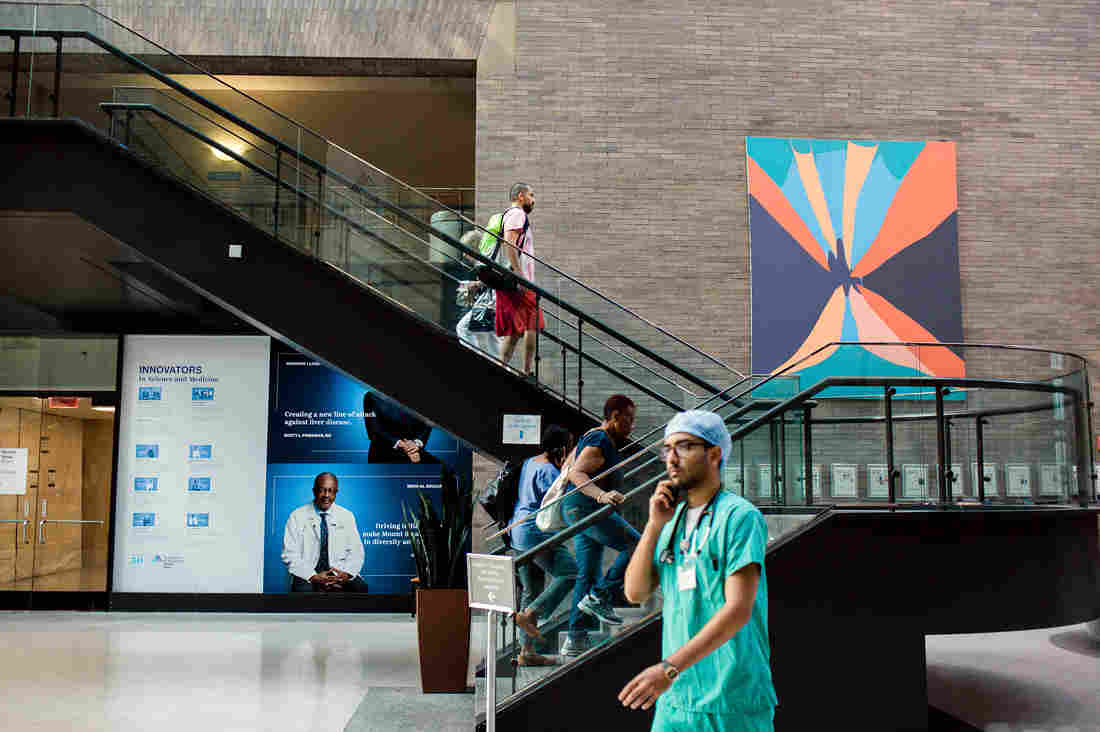
Icahn School of Medicine at Mount Sinai in New York City is reconsidering its participation in Alpha Omega Alpha. Gabriela Bhaskar for NPR hide caption
toggle caption
Gabriela Bhaskar for NPR
Icahn School of Medicine at Mount Sinai in New York City is reconsidering its participation in Alpha Omega Alpha.
Gabriela Bhaskar for NPR
Lucey says that UCSF changed its selection criteria for AOA in 2016 to focus less on grades. The number of minority students selected for the honor society that year increased to match the percentage of minorities in each graduating class.
Dr. Jonathan Giftos, an internist in New York who was president of the Icahn chapter when he graduated in 2012, says disparities in the honor society are important to address because when medical education favors white students that can mean fewer minorities in leadership roles.
“It feels like a layering on of accolades that makes people who are doing well do better, have more access and power and opportunity,” Giftos says.
National AOA leadership says that diversity is a priority for the organization, but since every medical school is different, they leave the specifics of how students are chosen up to the school.
“We know that improving diversity will hopefully result in inclusion of talented individuals from different backgrounds, and that will help benefit our patient care,” says Dr. Richard Byyny, executive director of AOA. “But the schools themselves need to tackle this.”
Muller notes that Icahn has not officially closed its AOA chapter and will still nominate faculty and residents.
And student activists at Icahn aren’t celebrating yet. Lynch says she now wants to focus on discrimination in grading and medical school admissions. This, she says, can help address the dearth of minority physicians in different specialities — a problem with negative consequences for the health of minority patients.
“Many of us are still wary,” Lynch says. “It is a symbolic gesture, actually. We are interested in the deeper work.”
Mara Gordon is a family physician in Washington, D.C., and a health and media fellow at NPR and Georgetown University School of Medicine.
Share this Post
