Explaining Medicine
  • News
  • Health & Lifestyle
    • Diet & Weight Management
    • Exercise & Fitness
    • Nutrition, Food & Recipes
    • Prevention & Wellness
  • Conditions
    • Custom1
      • Conditions A-Z
      • Procedures A-Z
      • Allergies
      • Alzheimer’s
      • Arthritis
      • Asthma
      • Blood Pressure
      • Cholesterol
      • Cancer
    • Custom2
      • Chronic Pain
      • Cold Flu
      • Depression
      • Diabetes
      • Digestion
      • Eyesight
      • Health Living
      • Healthy Kids
      • Hearing Ear
    • Custom3
      • Heart
      • HIV/AIDS
      • Infectious Disease
      • Lung Conditions
      • Menopause
      • Men’s Health
      • Mental Health
      • Migraine
      • Neurology
    • Custom4
      • Oral Health
      • Pregnancy
      • Senior Health
      • Sexual Health
      • Skin Problems
      • Sleep
      • Thyroid
      • Travel Health
      • Women’s Health
  • Medications
    • Medications
    • Supplements and Vitamins
  • Medical Dictionary
  • Health Alerts
Is It Dry Skin or Atopic Dermatitis?
Atopic Dermatitis: How to Get Enough Sleep
Atopic Dermatitis: Help for Broken Skin
Atopic Dermatitis and Food Triggers
What’s at stake as the Supreme Court hears...
Oncologists’ meetings with drug reps don’t help cancer...
Chronic Spontaneous Urticaria: What to Know
CSU: What to Wear and What to Avoid
Treatment Plan for Chronic Spontaneous Urticaria
When the Hives of CSU Don’t Go Away...
Top Posts

Explaining Medicine

  • News
  • Health & Lifestyle
    • Diet & Weight Management
    • Exercise & Fitness
    • Nutrition, Food & Recipes
    • Prevention & Wellness
  • Conditions
    • Custom1
      • Conditions A-Z
      • Procedures A-Z
      • Allergies
      • Alzheimer’s
      • Arthritis
      • Asthma
      • Blood Pressure
      • Cholesterol
      • Cancer
    • Custom2
      • Chronic Pain
      • Cold Flu
      • Depression
      • Diabetes
      • Digestion
      • Eyesight
      • Health Living
      • Healthy Kids
      • Hearing Ear
    • Custom3
      • Heart
      • HIV/AIDS
      • Infectious Disease
      • Lung Conditions
      • Menopause
      • Men’s Health
      • Mental Health
      • Migraine
      • Neurology
    • Custom4
      • Oral Health
      • Pregnancy
      • Senior Health
      • Sexual Health
      • Skin Problems
      • Sleep
      • Thyroid
      • Travel Health
      • Women’s Health
  • Medications
    • Medications
    • Supplements and Vitamins
  • Medical Dictionary
  • Health Alerts
  • News

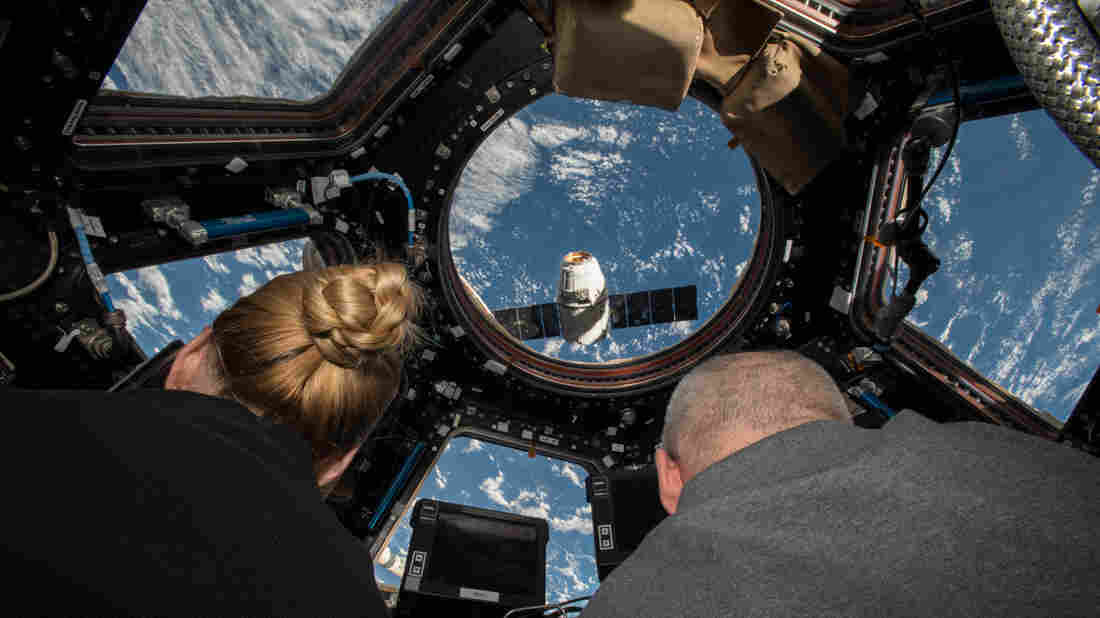
    A Microbe Hunter Plies Her Trade In Space

    by NPR March 14, 2017

    Enlarge this image

    NASA astronaut Kate Rubins floats in the International Space Station in September 2016, wearing a spacesuit decorated by patients recovering at the MD Anderson Cancer Center. NASA Johnson/Flickr hide caption

    toggle caption

    NASA Johnson/Flickr

    NASA astronaut Kate Rubins floats in the International Space Station in September 2016, wearing a spacesuit decorated by patients recovering at the MD Anderson Cancer Center.

    NASA Johnson/Flickr

    A few months ago, at her office in Houston, Kate Rubins was feeling weird.

    She was dizzy, she says — “staggering around like a 2-year-old who had just learned to walk.” She was constantly looking at her desk to make sure the objects on top weren’t floating away.

    Rubins wasn’t going nuts. She was just readjusting to Earth after living without gravity for four months, hundreds of miles above the planet’s surface.

    Floating around up there, with blood rushing to her head like she was hanging upside-down on monkey bars, had been disorienting at first, though she eventually learned to move around using all four limbs.

    Enlarge this image

    Rubins donned a spacesuit to install equipment on the outside of the International Space Station. NASA Johnson/Flickr hide caption

    toggle caption

    NASA Johnson/Flickr

    Rubins donned a spacesuit to install equipment on the outside of the International Space Station.

    NASA Johnson/Flickr

    Coming back to Earth’s gravity at the end of October was even more disorienting.

    But Rubins is used to drastic transitions. Oddly enough, her journey to space had started years before, in central Africa.

    “If you put your finger on a map in the middle of Africa, that’s about where our field site was located,” says Rubins, a microbiologist as well as an astronaut.

    It was 2007, and an airplane touching down on a grass runway in the Democratic Republic of the Congo had brought Rubins and her colleagues to study a nasty outbreak of monkey pox in a remote village. She’d already spent time studying HIV, Ebola and smallpox in the lab.

    This time the airplane wouldn’t be back for six weeks.

    Rubins didn’t know it at the time, but that remote expedition gave her experience she’d eventually draw on during a much bigger journey — to outer space.

    After the work in Africa, Rubins returned to Cambridge, Mass., and a fellowship at the Whitehead Institute for Biomedical Research, where she spent a lot of time writing grants.

    All that paperwork was “mind-numbing,” Rubins says. Just to get a break, a colleague suggested they try filling out a different sort of application — to become NASA astronauts.

    “So, I found the application online,” Rubins says, and filled it out on a lark. “I’ll take this chance,” she figured, “and maybe it’ll be a good story someday of how I applied to be an astronaut.”

    A few months later, she got a call from Houston asking her to come down for an interview.

    Rubins doesn’t fit the normal astronaut profile. Many start out as military pilots, engineers or doctors — not microbiologists studying viruses. But she got the job.

    “There’s been a lot of growth in people’s interest in doing biological research on the space station,” explains Julie Robinson, NASA’s chief scientist for the International Space Station program.

    Enlarge this image

    Rubins works on an experiment inside the station’s glovebox. Prior research has suggested that the microgravity of space can change gene expression in certain bacteria and make them more virulent. NASA Johnson/Flickr hide caption

    toggle caption

    NASA Johnson/Flickr

    Rubins works on an experiment inside the station’s glovebox. Prior research has suggested that the microgravity of space can change gene expression in certain bacteria and make them more virulent.

    NASA Johnson/Flickr

    Before the shuttle program ended in 2011, Robinson says, “our commanders and our pilots had to be ready to land the shuttle, so that implied a really strong piloting [and] aerospace background, and that isn’t as important now.”

    But once NASA’s shuttle program ended and U.S. astronauts started hitching rides to space on Russian rockets, the focus for the American personnel shifted away from piloting skills — they no longer have to be counted on to land the shuttle.

    “What’s more important now is the time they spend in orbit, when they’re carrying out a variety of experiments,” says Robinson. “We can take what we learn in space to help us understand aging, disease processes, and even the basic biology of cells.”

    There’s another reason it’s useful to have molecular biologists and microbiologists in space: While there aren’t viruses like Ebola or monkeypox on the space station (astronauts get quarantined before liftoff to make sure of that), space travel has never been sterile.

    Take this moment from the Apollo 10 mission in 1969, for example, when three astronauts on board notice a loose turd floating through their spacecraft.

    Audio from the Apollo 10 mission, 1969

    0:28

    Toggle more options

    Embed Embed
    Read the article here

    Share this Post

    Share Explaining Medicine Share Explaining Medicine

    A Microbe Hunter Plies Her Trade In Space was last modified: March 17th, 2017 by NPR

    Related

    astronautbacteriafungiInternational Space Stationmicrobiologymicrobiome
    0 comment
    0
    Facebook Twitter Google + Pinterest
    NPR

    previous post
    Orangutan’s Vocal Feats Hint At Deeper Roots of Human Speech
    next post
    How Many Would Lose Health Coverage? It Depends On How You Define ‘Insurance’

    Related Articles

    To Prevent Pregnancy-Related Depression, At-Risk Women Advised To Get Counseling

    February 12, 2019

    Unauthorized ACA plan switches drive call for action against rogue agents

    April 8, 2024

    Alcohol Helps Kill 2.8 Million People Globally Each Year

    August 24, 2018

    Psoriatic Arthritis: How Remission Is Giving Me Hope

    November 6, 2023

    Too Much Salt Might Help Spur A-Fib

    December 7, 2018

    Another Mass Shooting? ‘Compassion Fatigue’ Is A Natural Reaction

    November 9, 2018

    Get Off The Couch Baby Boomers, Or You May Not Be Able To Later

    September 4, 2017

    Stop letting delayed gratification steal your joy

    February 6, 2018

    Naturopath

    October 23, 2018

    Legal Dispute Continues Over Medicare Coverage Of Physical Therapy

    January 30, 2017

    Recent Posts

    • Is It Dry Skin or Atopic Dermatitis?

      April 24, 2024
    • Atopic Dermatitis: How to Get Enough Sleep

      April 24, 2024
    • Atopic Dermatitis: Help for Broken Skin

      April 24, 2024
    • Atopic Dermatitis and Food Triggers

      April 24, 2024
    • What’s at stake as the Supreme Court hears Idaho case about abortion in emergencies

      April 23, 2024

    Keep in touch

    Facebook Twitter Google + RSS

    Recent Posts

    • Is It Dry Skin or Atopic Dermatitis?

      April 24, 2024
    • Atopic Dermatitis: How to Get Enough Sleep

      April 24, 2024
    • Atopic Dermatitis: Help for Broken Skin

      April 24, 2024
    • Atopic Dermatitis and Food Triggers

      April 24, 2024
    • What’s at stake as the Supreme Court hears Idaho case about abortion in emergencies

      April 23, 2024
    • Terms of Service
    • Privacy Policy

    @2026 - Explaining Medicine. All Right Reserved.


    Back To Top
    Explaining Medicine
    Proudly powered by WordPress Theme: soledad child.