 Enlarge this image
Rocky spent his first few years raised by people, and is particularly attuned to human speech and behavior, researchers say. But his remarkable ability to learn and match human pitch and common sounds of speech surprised them. Mark Kaser/Courtesy of Indianapolis Zoo hide caption
toggle caption
Mark Kaser/Courtesy of Indianapolis Zoo
Rocky spent his first few years raised by people, and is particularly attuned to human speech and behavior, researchers say. But his remarkable ability to learn and match human pitch and common sounds of speech surprised them.
Mark Kaser/Courtesy of Indianapolis Zoo
An orangutan named Rocky is helping scientists figure out when early humans might have uttered the first word.
Rocky, who is 12 and lives at the Indianapolis Zoo, has shown that he can control his vocal cords much the way people do. He can learn new vocal sounds and even match the pitch of sounds made by a person.
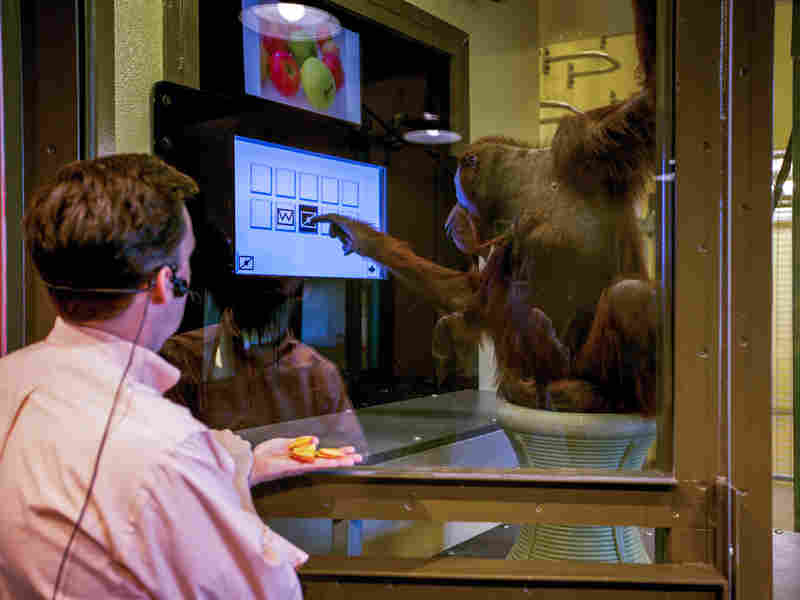
Enlarge this image
Rob Shumaker, who directs the Indianapolis Zoo, works with Rocky in a project testing the orangutan’s ability to recognize and respond to symbols that appear on a touch screen. Ian Nichols/Courtesy of Indianapolis Zoo hide caption
toggle caption
Ian Nichols/Courtesy of Indianapolis Zoo
Rob Shumaker, who directs the Indianapolis Zoo, works with Rocky in a project testing the orangutan’s ability to recognize and respond to symbols that appear on a touch screen.
Ian Nichols/Courtesy of Indianapolis Zoo
“Rocky, and probably other great apes, can do things with their vocal apparatus that, for decades, people have asserted was impossible,” says Rob Shumaker, the zoo’s director, who has studied orangutans for more than 30 years.
Rocky’s abilities suggest that our human ancestors could have begun speaking 10 million years ago, about the time humans and great apes diverged, Shumaker says. Until now, many scientists thought that speech required changes in the brain and vocal apparatus that evolved more recently, during the past 2 million years.
A very special ape
The vocal abilities of orangutans might have gone undetected had it not been for Rocky, an ape with an unusual past and a rare relationship with people.
Typical Vocalizations Of Wild Orangutans
Wild orangutans
0:04 Toggle more options Embed Embed <iframe src="https://www.npr.org/player/embed/518170608/518411351" width="100%" height="290" frameborder="0" scrolling="no" title="NPR embedded audio player">Rocky was separated from his mother soon after he was born, and spent his early years raised largely by people, and working in show business. “He was certainly the most visible orangutan in entertainment at the time,” says Shumaker. “TV commercials, things like that.”
Even a photo shoot with the singer Fergie.
When Rocky was about 3 1/2, Shumaker was able to move him to an animal sanctuary in Iowa, and later to the Indianapolis Zoo, where Rocky learned to interact with other orangutans.
Shumaker and other scientists named these vocalizations “wookies” because they sound like the Star Wars Wookiee character, Chewbacca.
“Wookies” and jelly beans
On the day of my visit with Rocky, it’s very clear he uses wookies a lot.
He’s one of a half-dozen orangutans relaxing in a sun-filled atrium at the Indianapolis Zoo. When they catch sight of Shumaker and me, they swing and lumber toward an area where metal mesh allows orangutans and people to interact.
“When we have special visitors like today, we do really big treats,” Shumaker begins to explain before he’s interrupted by a very loud wookie sound. “That’s Rocky trying to get my attention,” Shumaker says.
Rocky makes ‘wookie’ sounds
0:04 Toggle more options Embed Embed <iframe src="https://www.npr.org/player/embed/518170608/518411783" width="100%" height="290" frameborder="0" scrolling="no" title="NPR embedded audio player">All the apes are eager to get the sugar-free jellybeans and a juice box that Shumaker has brought. But Rocky is by far the most vocal, and the only one making the wookie sound.
Rocky’s ability to produce a sound not made by any other orangutan raised a really interesting possibility to researchers at the zoo.
“We assumed that it had to be learned,” Shumaker says. And “if it was learned it had to involve voluntary control of his vocal folds, or what people call a voice box.”
People are masters at controlling the voice box and imitating sounds. But an ape wasn’t thought to have that ability. To find out for sure what Rocky could do, the team did an experiment. They asked him to match the pitch of vowel sounds made by a scientist.
“Slightly to our surprise, he was matching things perfectly,” Shumaker says.
Rocky matches the pitch of a scientist
0:04 Toggle more options Embed Embed <iframe src="https://www.npr.org/player/embed/518170608/518394592" width="100%" height="290" frameborder="0" scrolling="no" title="NPR embedded audio player">The team published their findings online last year in Scientific Reports. And those findings suggested something really important about the origins of human speech, says Adriano Lameira, a research anthropologist at Durham University in the U.K. and an author of the study.
“The type of control that we need to produce vowels and learn vowels is already present in great apes,” Lameira says.
In an earlier study, Lameira found that an orangutan named Tilda could make consonant-like sounds, and even produce the rhythms of human speech.
Tilda replicates speech rhythms
0:04 Toggle more options Embed Embed <iframe src="https://www.npr.org/player/embed/518170608/518388241" width="100%" height="290" frameborder="0" scrolling="no" title="NPR embedded audio player">But Rocky went further by showing he could learn new sounds, pair consonants with vowels, and match the pitch of a human’s voice. Together, Rocky and Tilda make the case that orangutans can manipulate the building blocks of speech, Lameira says.
That may not sound like a big deal. After all, parrots can speak entire sentences. But we evolved from ape-like ancestors, not birds.
And for decades, there’s been a debate about whether humans’ ability to speak appeared suddenly, or evolved slowly from abilities found in other primates.
It’s a question that can’t be answered by looking at fossils of early humans, because neither the brain nor the vocal apparatus are made of bone.
“So you have to make inferences,” Shumaker says. “And the best ways to make inferences about human language are by studying great apes. They are not early versions of humans, of course, but they are the best we have.”
Before scientists began studying Rocky and Tilda, great apes’ vocal abilities were thought to be limited to calls that were reflexive, not learned. So scientists who suspected speech evolved from abilities found in apes were unable to answer a simple question, Lameira says. “If the control of the voice is so fundamental — if this is so crucial — why are we not seeing it in our closest relatives?”
Now that it looks like apes do have at least rudimentary vocal control, he says, it’s time to focus on a new question: “Why did our ancestors about 10 million years ago paste together the first consonant with the first vowel to make up the first syllable or the first word?” What was their motivation?
That’s still a mystery. But Lameira thinks it’s pretty clear what motivates Rocky, and it’s not just food treats — he wants to connect with, and please, his human friends.
This is especially obvious when Rocky is taking part in an experiment. “He’s so into it,” Lameira says. “He wants to perform so well so badly that we really need to sort of calm him down, and give him hints that he’s not being judged according to his performance.”
Share this Post
