 Enlarge this image
Susie Talevski has gone through years of legal back-and-forth with the state agency in Indiana that operates the nursing home where her father, Gorgi, resided before his death. Farah Yousry/Side Effects Public Media hide caption
toggle caption
Farah Yousry/Side Effects Public Media
Susie Talevski has gone through years of legal back-and-forth with the state agency in Indiana that operates the nursing home where her father, Gorgi, resided before his death.
Farah Yousry/Side Effects Public Media
When Susie Talevski sued the agency that managed her elderly father’s care before he died, she hoped to get justice for her family. She did not expect the case would grow into a national bellwether. A ruling against her could strip millions of vulnerable Americans of their power to hold states accountable when they do not receive benefits allowed by law.
“This case has taken on, really, a life of its own way beyond what I could have foreseen,” said Talevski, a resident of Valparaiso, Ind.
Talevski filed a lawsuit in 2019 alleging that her father’s rights were violated at a nursing home where he resided to get 24/7 care for his dementia.
“He went from being able to walk and talk … to not being able to move,” Talevski said. “[The nursing facility] treated my dad like trash, like a dog. In fact, dogs are treated better than that.”
In court filings, the Talevski family claims that her father was overmedicated to keep him asleep, his dementia wasn’t properly managed, and he was involuntarily transferred to different facilities hours away from the family’s home, which accelerated his decline. Gorgi Talevski died a year ago, in October.
Talevski sued the Health and Hospital Corp. of Marion County, the public health agency in Indiana that owns the nursing facility. The agency declined to comment on the case. In court documents, it argued that Gorgi Talevski was violent and sexually aggressive and that affected his care.
HHC tried to get the case dismissed, saying Talevski didn’t have the right to sue. But federal courts said the lawsuit could move forward.
So, the public health agency made an unexpected move. It took the case to the nation’s highest court and posed a sweeping question: Should people who depend on initiatives that are funded in part by the federal government — such as Medicaid and programs that provide services for nutrition, housing and disabilities — be allowed to sue states when their rights are violated?
A ruling in favor of the Marion county Health and Hospital Corp. could mean millions of Americans who rely on federal assistance programs would lose that right. The U.S. Supreme Court is scheduled to hear oral arguments on Tuesday — Nov. 8.
“The reach of an adverse decision would be catastrophic,” said Jane Perkins, an attorney at the National Health Law Program. “It would leave these programs really standing out there without a true enforcement mechanism.”
How a case regarding one man’s rights grew to have national implications
HHC of Marion County owns and operates 78 skilled nursing facilities across the state of Indiana in a public-private partnership with American Senior Communities.
The answer to the question of whether people who depend on federal assistance programs can sue if their rights are violated has been settled precedent for decades, said Perkins, who has litigated numerous civil rights cases for Medicaid beneficiaries over the years.
For that reason, she was shocked when she learned the Supreme Court had chosen to hear this case. The Supreme Court is asked to review nearly 7,000 cases each year and they often agree to look at only 1 to 2 % of them.
Perkins said she sees parallels between this case and the recent Supreme Court decision that overturned the constitutional right to an abortion.
“The idea that the court would accept this case and accept that question of whether you can ever enforce these laws is of concern,” Perkins said. “The recent court decisions — Dobbs in the abortion context coming to mind — shows the court is willing to set aside precedent.”
Since the Supreme Court agreed to look at the case, 25 entities filed amicus briefs, which provide courts information from people not directly involved in a case. Most of them sided with the Talevskis — including current members of Congress like House Speaker Nancy Pelosi and Majority Whip James Clyburn, AARP, American Cancer Network, American Public Health Association, and Children’s Health Care Providers and Advocates. Marion County will be represented by Lawrence S. Robbins, who has argued 19 cases before the Supreme Court and represented Christine Blasey Ford during the confirmation hearing of Justice Brett Kavanagh. Talevski will be represented by Andrew Timothy Tutt of Arnold & Porter Kaye Scholer. Recently, Tutt has argued and won a case before the Supreme Court that safeguarded the reemployment rights of thousands of veterans and servicemembers.
What exactly is at stake?
Programs like Medicaid that rely on federal money flowing from Congress to states typically come with a set of provisions or requirements that states are supposed to follow in order to receive and use this money. Civil rights lawsuits are one of the primary enforcement mechanisms beneficiaries of those programs have to hold state agencies accountable if the agencies violate their rights or fail to provide entitled services.
There are other means of oversight, which supporters of the Indiana state agency’s petition tout as viable alternatives to lawsuits. One of those alternative enforcement mechanisms, for example, is federal oversight by the U.S. Department of Health and Human Services. The agency can investigate and threaten to withhold funding from state programs that fail to comply with federal provisions. But this usually involves lengthy legal processes that can be counterproductive, stalling benefits to individual patients, instead of helping them.
“If [HHS] tries to turn off the money, the state could take them to court immediately and get an injunction,” arguing that the ceasing of federal funds would cause irreparable harm, said Sara Rosenbaum, professor of health law and policy at George Washington University. “People [would be] left totally without their benefits, or the providers are left totally without their payments.”
Former senior HHS officials say that federal oversight is far from sufficient and that civil rights lawsuits remain a crucial enforcement mechanism. Private enforcement through lawsuits is indispensable for nursing home residents, they say, especially in places like Indiana where the state owns the vast majority of nursing homes.
The former officials said in a court brief that a decision in favor of Marion County would potentially raise the risk of waste, fraud and abuse of Medicaid funds, leading to widespread underenforcement and leaving “millions of individuals, providers, and other beneficiaries more vulnerable to violations of their statutory rights.”
Nearly 83 million Americans, a quarter of the U.S. population, are enrolled in Medicaid. This means HHS oversees more than half a trillion dollars in spending across 56 states and territories — and the federal agency, the former officials argue, lacks the logistical and practical capacity to “meaningfully remedy individual violations in many cases.”
Why some argue beneficiaries of federal entitlements should not be able to sue
Indiana’s Attorney General Todd Rokita is among allies publicly supporting the state’s perspective. Rokita, in a court brief filed along with 21 other Republican attorneys general, said civil rights lawsuits burden states and cripple them with legal expenses, just to line the pockets of attorneys rather than benefit Medicaid enrollees.
“The state has litigated 1,200 civil rights cases just in the last three years,” Rokita said in a written statement.
Legal experts told Side Effects that the number Rokita cites is highly misleading because it lumps together all civil rights lawsuits, not just those that have to do with federal entitlement programs, which are at the heart of this case.
For example, civil rights lawsuits can be filed by people who are wrongly denied a permit to protest, alleging the state violated their right to freedom of expression, or by people who are subjected to excessive use of force by police, or denied medical treatment while in prison. The right to file those kinds of lawsuits will not be affected by the outcome of this case.
Chris Schandevel, an attorney at the legal nonprofit Alliance Defending Freedom, which sides with the state of Indiana in this case, said cases like Susie Talevski’s infringe on states’ autonomy, and give the power to dictate what’s best for states and their beneficiaries to unelected federal judges.
This case is not about taking away people’s rights, Schandevel and some nursing home associations and other state officials argue. It’s about a contract between two parties, the federal government and the states, that a third party — beneficiaries of public programs — want to meddle with.
Schandevel gives a hypothetical example of a contract between himself, as an investor, and a construction company to build a shopping mall in one neighborhood. A lawsuit like the Talevski case would be akin to a neighbor suing the construction company because the shopping mall “is not being built fast enough.”
“Should that third party be able to file a lawsuit in federal court against me and say that I’m not holding up my end of the deal in the contract? We would say that basic fairness says no,” Schandevel said. “And the same should apply for contracts between the federal government and states, too.”
But advocates and public policy experts say Schandevel’s analogy is not sound. What he describes as a contract between the state and the federal government is more of a “treaty” to serve that third party — the beneficiaries of entitlement programs.
Plus, they point out, what’s at stake is not a shopping mall. It’s the health and well-being of the nation’s most vulnerable residents.
How civil rights lawsuits have helped vulnerable people in the past
A few years ago, Sarah Jackson, a mother of six in Fort Wayne, Ind., who had hepatitis C, couldn’t get access to the medication that doctors said she needed. Jackson was on Medicaid, and recovering from a substance use disorder. Indiana was among several states that severely restricted which Medicaid patients qualified for this drug, because of its high cost — despite medical opinions saying this treatment should be standard of care for most hepatitis C patients.
Jackson was desperate for the hepatitis C medication. She sought help from the ACLU of Indiana, and attorney Gavin Rose took her case.
Rose filed a class-action lawsuit on behalf of Jackson and other Medicaid recipients in her situation.
“There was a significant outbreak in Southern Indiana at the time and we ultimately ended up with a settlement that said Indiana is going to start providing [coverage] consistent with what every doctor says they should be doing,” said Rose, senior staff attorney for the ACLU of Indiana. The lawsuit resulted in Jackson and thousands of others gaining access to the life-altering treatment.
If the Supreme Court rules in favor of the Health and Hospital Corporation, these lawsuits may not be possible in the future, said Emily Munson, an attorney with the advocacy group Indiana Disability Rights.
Enlarge this image
Emily Munson, an attorney with Indiana Disability Rights, says the premise of the Supreme Court case Health and Hospital Corp. v. Talevski scares her. She filed an amicus brief in support of the Talevskis, outlining the importance of lawsuits in enforcing rights for vulnerable populations. Farah Yousry/Side Effects Public Media hide caption
toggle caption
Farah Yousry/Side Effects Public Media
Emily Munson, an attorney with Indiana Disability Rights, says the premise of the Supreme Court case Health and Hospital Corp. v. Talevski scares her. She filed an amicus brief in support of the Talevskis, outlining the importance of lawsuits in enforcing rights for vulnerable populations.
Farah Yousry/Side Effects Public Media
When states tried to cap the benefits of people with disabilities in Indiana and across the nation, civil rights lawsuits have helped these patients gain access to things like in-home support with day-to-day tasks, known as attendant care.
Munson has litigated similar cases. She has a disability herself, and the prospect of a Supreme Court decision in favor of Marion County terrifies her.
“I rely on Medicaid for attendant care, for wheelchair repairs,” Munson said, “and losing the ability to go to federal court if need be is very scary, because the administrative procedures that folks like Attorney General Rokita say we can rely on are not effective.”
What’s next for the case
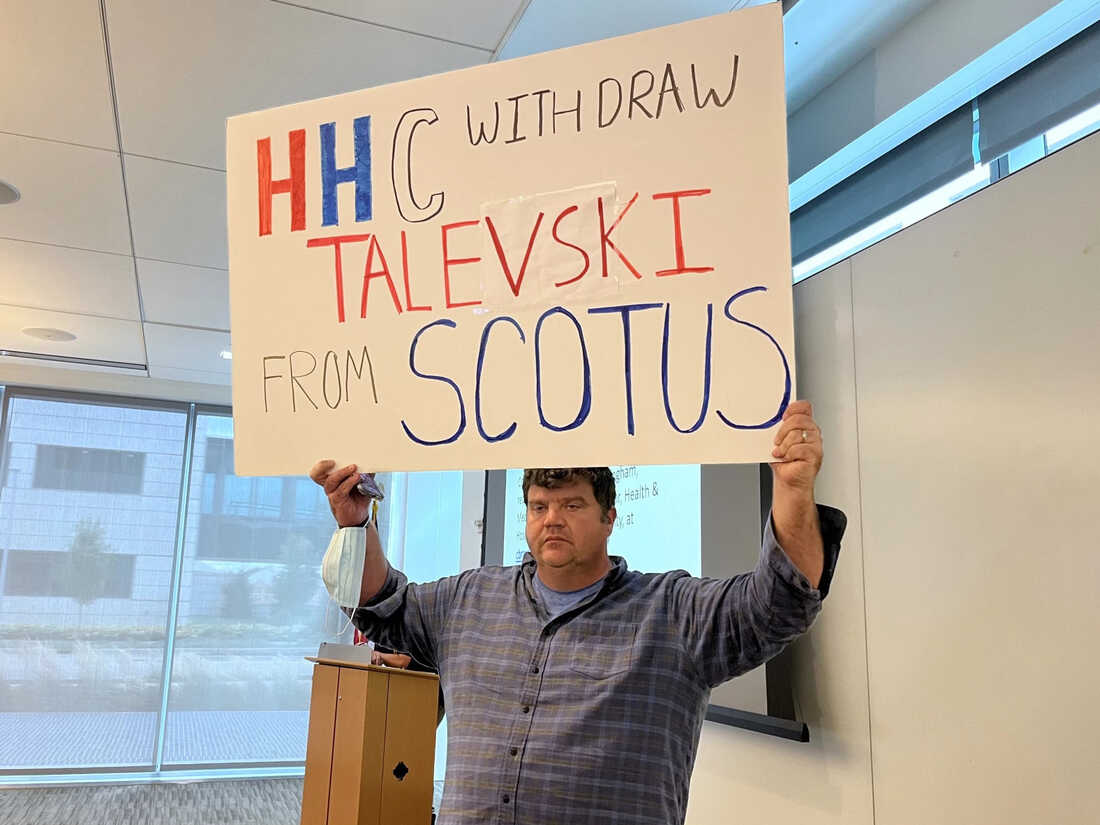
During the latest monthly Health and Hospital Corp. board of trustees meeting in mid-October, the monumental case was absent from the agenda. But when the meeting opened for public comment, state representatives, patients and advocates seized the opportunity to voice their concerns.
They had one demand for the agency: withdraw its Supreme Court petition.
Enlarge this image
Michael Oles, national field director of the advocacy organization Our Revolution, made it clear at last month’s board meeting of the Health and Hospital Corp. of Marion County, Ind., that he supports the Talevskis, and their right to sue the nursing home that they say mistreated their late father. Farah Yousry/Side Effects Public Media hide caption
toggle caption
Farah Yousry/Side Effects Public Media
Michael Oles, national field director of the advocacy organization Our Revolution, made it clear at last month’s board meeting of the Health and Hospital Corp. of Marion County, Ind., that he supports the Talevskis, and their right to sue the nursing home that they say mistreated their late father.
Farah Yousry/Side Effects Public Media
State Representatives like Robin Shackleford, a Democrat from Indianapolis, have been vocal about their concerns. Shackleford said many of her constituents are on Medicaid and SNAP, the USDA’s supplemental nutrition program.
“They would be horrified … if they knew the board was the driver behind removing their rights,” Shackleford said.
But even if the agency complies with the demands and withdraws its petition, legal experts say it might be too late. Now that the Supreme Court has shown interest in looking at such a sweeping question, there’s a good chance it could pick up the next case that raises it.
This story comes from a reporting collaboration that includes NPR, KHN (Kaiser Health News) and Side Effects Public Media — a public health news initiative based at WFYI.
Share this Post
