 Enlarge this image
Northern California’s River Fire tore through a canyon near the town of Lakeport early last week, filling orange-tinged skies with smoke for miles around. Noah Berger/AP hide caption
toggle caption
Noah Berger/AP
Northern California’s River Fire tore through a canyon near the town of Lakeport early last week, filling orange-tinged skies with smoke for miles around.
Noah Berger/AP
There are 18 wildfires now blazing across California, which means many of the state’s residents are waking up to the smell of smoke and hazy skies. The Carr fire near Redding has scorched at least 145,015 acres and killed seven people, and three fires in Mendocino County are all less than an hour away from Santa Rosa — where some neighborhoods burned to the ground last year.
Confronting constant reminders of what fire can do has become a terrifying reality for people who survived last year’s flames and are still piecing their lives back together. As psychologists, therapists and other counselors offer comfort and tips for quenching the terror, they also assure survivors that surges of panic, grief, and agitation are healthy and normal.
National
California’s Carr Fire 30 Percent Contained As New Blazes Erupt Elsewhere
Even so, the view from Danielle Bryant’s bedroom window, in her temporary apartment in Santa Rosa, is pretty unsettling these days.
“The orange-tinged sky is just enough to set off my anxiety and feelings of fear,” Bryant says.
Running for your life
Last year, on Oct. 8, an explosion jolted Bryant awake in the middle of the night. Howling winds shook her Santa Rosa house. The air was hot. Bryant and her husband jumped in their car and fled with only the clothes on their backs.
“I feared for our life,” she says. “We were running for our life.”
When they returned the next day the street was desolate. The air wreaked of burnt chemicals. Homes were charred rubble. The October flames eventually destroyed thousands of houses and killed 44 people.
Enlarge this image
Not long after last year’s fire tore through Danielle Bryant’s neighborhood in Santa Rosa, Calif., she returned to find her home destroyed and her car a ruined shell. courtesy of Danielle Bryant hide caption
toggle caption
courtesy of Danielle Bryant
Not long after last year’s fire tore through Danielle Bryant’s neighborhood in Santa Rosa, Calif., she returned to find her home destroyed and her car a ruined shell.
courtesy of Danielle Bryant
“We were victims to one of the most terrible events in history,” says Bryant.
Still haunted 10 months later
For the past year, Bryant has struggled with many symptoms of trauma: sleeplessness, nightmares, irritability, and loss of appetite.
“Agitation — so quick to agitation,” says Bryant. “Hence the fight that I got in the other night with my husband.”
It was a fight about nothing. She says she blew up after watching the news about all the fires on television. She hasn’t turned on the TV since. She’s hearing similar stories from friends and neighbors.
“You can just feel it,” says Bryant. “There’s a sense of tension here in Santa Rosa,”
Bryant’s apartment is about a mile from the site of her old house. She’s still working through everything that happened.
“These last 10 months,” she says, “have been one of the hardest times of my life, because what you have to do after an event like this is, you have to go on living.”
There’s nothing wrong with you
The emotions and physiological responses Bryant describes are common after a life-threatening event. Francis Fuchs is a psychologist and counselor in Santa Rosa who has been treating fire victims who are highly affected by all the current blazes in northern California.
“They are having more difficulty with sleeping,” Fuchs says. “They are having a heightened sense of anxiety and unease. They are having some flashbacks of their fire experience from last October. Also mood changes — more anxious or tearful.”
Many laypeople casually use the term PTSD — post traumatic stress disorder — to loosely describe any delayed response to a terrifying experience. But psychologists and psychiatrists use the term and the diagnosis much more narrowly — it includes symptoms, for example, that must last more than a month and be severe enough to interfere with relationships or work.
Your Health
Baby Steps To Better Breathing
Rather, the fear, anxiety, sleeplessness or shallow breathing many fire survivors are experiencing right now are healthy and transient, psychologists say — it’s the body’s evolutionary responses to the belief that danger is again near.
“It’s preverbal, it’s precognitive,” says Padma Gordon, a spiritual counselor and mindfulness educator in San Rafael, Calif. “So what happens when we’re threatened: We grip; we contract; we stop breathing. And all this is registering in our brains and in our bodies, instantaneously. Because we’re hardwired for survival.”
Enlarge this image
Memories of last year’s fire can still feel overwhelming, says Danielle Bryant. But her flattened neighborhood is also coming back to life. Here, in the yard of her old home in Santa Rosa, green sprouts now push through the blackened decay. Lesley McClurg/KQED hide caption
toggle caption
Lesley McClurg/KQED
Memories of last year’s fire can still feel overwhelming, says Danielle Bryant. But her flattened neighborhood is also coming back to life. Here, in the yard of her old home in Santa Rosa, green sprouts now push through the blackened decay.
Lesley McClurg/KQED
When a survivor of trauma again senses signs of the previous threat — in this case, the smell of smoke, the orange sky, the “ding” of a cell phone’s emergency alert — the protective survival system kicks in, even when the current danger isn’t close by.
“The trouble,” says Jennifer Freeman, a licensed marriage and family therapist in Berkeley, Calif., “is the brain keeps rising to the occasion, even when the threat isn’t current.” Freeman has worked with survivors of trauma and in the aftermath of other natural disasters — including earthquakes and tsunamis — both in the U.S. and internationally.
What you can do
There are a variety of cognitive and physical techniques that can help us through periods of trauma, counselors say, and people vary in which ones they find most helpful.
Freeman says one first step to calming the mind and body is to be kind to yourself and respect that your system is trying to help you survive.
“We evolved to be aware of challenges,” Freeman says. “We can say, ‘Thank you body, thank you brain for trying to take care of me.’ Which is very different than, ‘Oh, what’s wrong with me?’ and ‘I need to get rid of it.'”
Gordon recommends reminding yourself out loud that the fearful event is not happening again. It may sound silly to talk to yourself, but the body, she says, recognizes the sound of your voice.
” ‘I’m sitting here in a space that doesn’t smell like smoke,’ ” Gordon says, as an example. “‘And I’m not hearing sirens, and people aren’t running, trying to escape. I’m not hearing the sound of flames’ — it’s basically ‘getting present.’ Bring yourself back into the present.”
Even setting yourself a task — counting all the green objects you can see from where you sitting, for example — can be calming, says another counselor.
Some other tricks for ‘coming back to the present’ can be something as simple as tapping your feet, Gordon says. Or smelling something you enjoy — such as tangerine or balsam fir or cinnamon — or playing calming music.
To consciously slow rapid breathing, try putting one hand on your belly and one hand on your heart, then breathe out through pursed lips, as if through a long straw.
Slowing down your breath activates the parasympathetic nervous system, Freeman points out — and helps calm your internal alarm system.
People also can heal via their community — by helping others. Asking questions that elicit the story of how someone survived the traumatic event is an approach Freeman used in Samoa, after the 2009 tsunami.
“We asked, ‘How did you get through the tsunami?’ she says. ” ‘What did you use during the wave, and after the wave? What did you turn to for strength inside yourself?’ So we don’t elicit narratives of helplessness. They are stories of pain and hope, struggle and resilience.”
Katrina & Beyond
Katrina’s Psychological Impact
If you’re helping someone else, Freeman says, it’s important to ask them what kinds of help they want — and not assume that each approach works with everyone. When Freeman was working in Samoa, for example, she learned from local therapists and others there that many people preferred to work via community and family groups, rather than in individual therapy.
Grieving and finding hope
During especially hard times recently, Danielle Bryant has found herself driving to the empty lot in Santa Rosa where she used to live.
“It was like visiting like a gravesite,” says Bryant. “So it was a place to just come and be and to cry.”
After spending a few moments gazing at the ruins, she backs out of her parking spot, pauses, then takes a deep breath.
“Just seeing the smoke off to the east,” says Bryant, looking at the sky, “I get this sense of dread.”
As we drive down her old street in the Coffey Park neighborhood we pass the skeleton of a burnt-out car, still parked in a pile of ash.
Bryant pulls up to an empty lot overgrown with weeds, and gets out of the car. We carefully tread through some weeds and knee high bushes. “See this outline, this box? That was it. That was our home.” Bryant crouches down and puts her head in her hands.
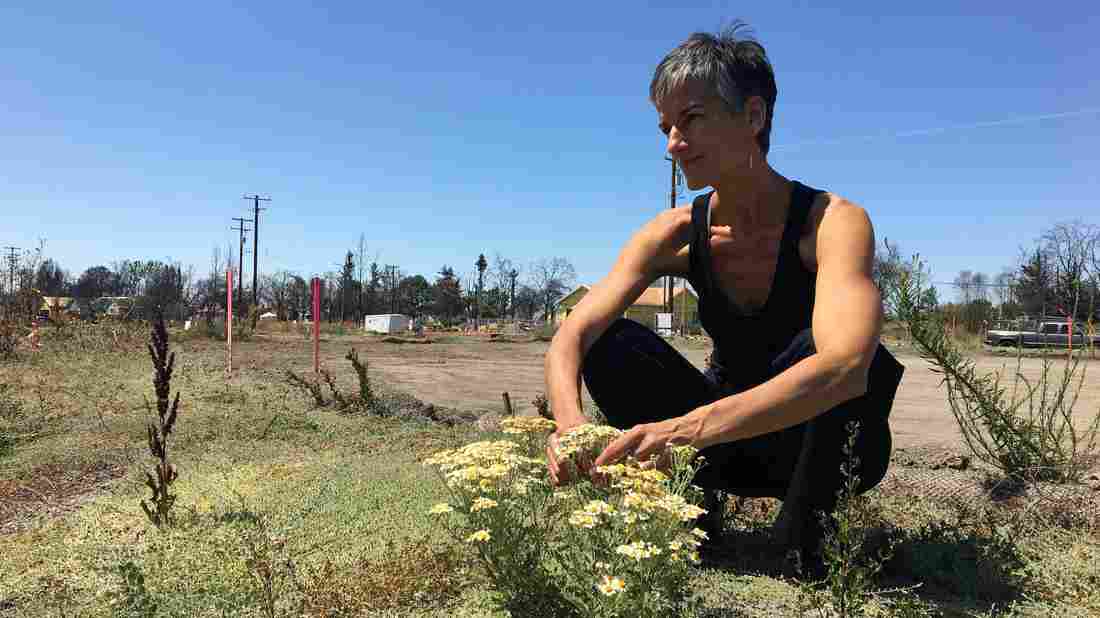
Triggered memories can still feel overwhelming, but her neighborhood is also coming back to life. Next door, a crane drops a pile of plywood beams, and construction crews are framing new homes. All over the ground, green sprouts are pushing through the blackened decay.
“This green is hopeful to me,” says Bryant. “This is just a sign that nature comes back — and is forgiving. And that we can, we can. We can come back.”
To help process her grief Bryant is taking a writing class. She’s finding it therapeutic to put her painful memories into words and phrases.
“Grief breathing into my bones of lead,” reads Bryant. “It stuck there in the deep. Was it all a dream? After we were refugees.”
Even as wildfires rage within an hour of Santa Rosa, Bryant is excited at the prospect of rebuilding her house in the old neighborhood, and moving back –within about year, she hopes.
“It is going back to the place of trauma,” Bryant admits. “But it’s also going back to our home.”
KQED’s Marisol Medina-Cadena also contributed to this story.
Share this Post
