 Enlarge this image
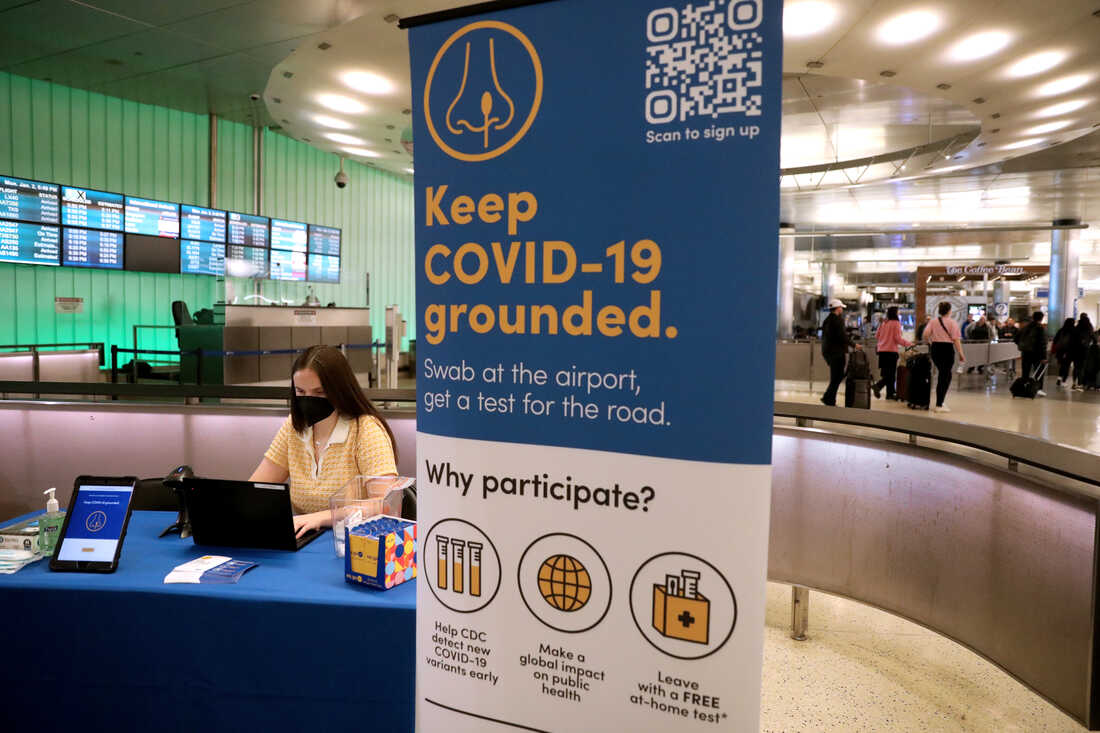
In hopes of getting a better sense of which SARS-CoV-2 variants might be coming into the U.S., the Centers for Disease Control and Prevention recently expanded its voluntary testing of some passengers exiting from international flights at certain airports. Rick Bowmer/AP hide caption
toggle caption
Rick Bowmer/AP
In hopes of getting a better sense of which SARS-CoV-2 variants might be coming into the U.S., the Centers for Disease Control and Prevention recently expanded its voluntary testing of some passengers exiting from international flights at certain airports.
Rick Bowmer/AP
It’s early morning at Dulles International Airport outside Washington, D.C., and Ana Valdez is already hard at work at one of the international gates.
“Hello everybody. Welcome,” she shouts with a big smile as arriving travelers flood through two large swinging doors. “Do you like to help the CDC to find new variants for COVID?”
Valdez works for a year-old program that the Centers for Disease Control and Prevention recently expanded to try to spot new variants of SARS-CoV-2, the virus that causes COVID-19, coming into the country.
The most recent expansion was prompted by China’s abrupt decision to abandon its zero-COVID policy. The resulting massive surge of infections there is raising fears the move could spawn a new, even more dangerous strain.
“It will take 35 seconds of your time. It’s free. It’s voluntary. It’s anonymous,” Valdez announces. “Thirty-five seconds of your time.” The samples are pooled and sent off-site for PCR analysis with no identifying information on the volunteers. The point of the research is solely to identify any viral variants in the samples — not to see if a particular passenger has COVID.
Most of the travelers trudge past, lugging their luggage, without even making eye contact.
“They have to stop by immigration and customs and that takes another hour or two. By the time they come here they’re already exhausted, angry,” Valdez says. “So I really appreciate that some people would stop.”
Over and over again, Valdez promises to make the test, which involves the usual nasal swabbing, quick and easy; she also offers the travelers a free rapid COVID test to take home as an incentive. One pandemic-jaded traveler jokes he’d volunteer if they offered him a free Starbucks instead.
Travelers on flights from China aren’t the only ones tested
Valdez keeps trying. Valdez and her colleagues are collecting samples from travelers coming in from China as well as other countries where the virus is spreading fast.
Finally, a man stops to talk to her.
Peter Yuka, 38, is on his way from Nigeria to Texas to study.
“Nigeria is one of the countries of interest for the CDC. So your help will be very helpful,” Valdez tells him.
“What do I have to do?” Yuka asks.
He’d have to fill out a form detailing whether he’s been vaccinated or ever tested positive for COVID, and then swab the inside of his own nose.
Even though he says he finds the swabbing unpleasant, Yuka agrees to the test. After filling out the form, he sanitizes his hands and collects the sample and hands it to Valdez. She thanks Yuka and hands him a free COVID test to take home.
“I think it’s cool,” Yuka tells NPR in an interview before he continues on his journey. “I think we should do whatever we can to fight the COVID. I saw the damage it did to the whole world, and countries like mine were really badly affected. So whatever I can do to help I’m willing to do it.”
After Valdez and other employees of Xprescheck, the company contracted by the CDC, collect the samples, the swabs are sent to Concentric by Ginkgo, a private lab that conducts a genetic analysis of any SARS-CoV-2 strain that pops up. That allows scientists to spot any new mutations that might make that strain more dangerous.
Enlarge this image
This volunteer testing site inside the international terminal at Los Angeles International Airport is one of two additional sites recently set up on the West Coast to test for new viral variants of SARS-CoV-2. Gary Coronado/Los Angeles Times via Getty Images hide caption
toggle caption
Gary Coronado/Los Angeles Times via Getty Images
This volunteer testing site inside the international terminal at Los Angeles International Airport is one of two additional sites recently set up on the West Coast to test for new viral variants of SARS-CoV-2.
Gary Coronado/Los Angeles Times via Getty Images
“Whenever you have viral transmission, you know, these viruses are smart — they can mutate,” says Dr. Cindy Friedman, who runs the program at the CDC. “And we want to be ahead of the game and early in our detection of new variants.”
The current focus on China, Friedman says, “is because there’s so much spread and so little data or information. So we want to make sure that we have eyes on what variants are coming out of China. But we’re also keeping a watch on all the other regions and the travelers coming back from those areas.”
The CDC recently expanded the program from five U.S. airports to seven — adding Seattle and Los Angeles because those West Coast hubs receive large numbers of travelers from Asia. The CDC also increased the number of flights being screened at Dulles and the other airports in the program from 300 to 500 each week, enabling the program to now collect samples from more than 4,000 passengers a week, she says.
Homegrown U.S. omicron variants are a more immediate threat, some scientists say
But many scientists doubt that China poses a particular risk right now for generating threatening new COVID variants — the newest hyper-transmissible variant taking over in the U.S. at the moment is an omicron subvariant known as XBB.1.5, which originated in New York.
“So far we have no evidence that there are variants of concern that we haven’t seen already,” says Michael Osterholm, director of the Center for Infectious Disease Research and Policy at the University of Minnesota. “And I’m not sure that China poses the great risk for new variants, necessarily.”
Although China’s population of 1.4 billion gives the virus many chances to mutate, “there’s not a lot of population-based immunity — which would be what would drive new mutations,” Osterholm says.
And some researchers say it would make more sense to sequence virus from the wastewater of planes — to get a better picture of what sort of variants might be aboard, rather than relying on a sampling from individual travelers who might not be representative of everyone on the plane.
“I can imagine if I were walking through an airport and I wasn’t feeling well and I was asked if I wanted to participate in a COVID surveillance program — even if it were guaranteed that it would be anonymous — I don’t think I would be likely to want to participate,” says Jennifer Nuzzo, who runs the Pandemic Center at Brown University.
“You can imagine other travelers may want to test themselves privately and know the results before the government does,” she says.
Other researchers wonder if the U.S. is prepared to act aggressively at this point in the pandemic, even if the CDC does spot a worrisome new variant.
“We need to be having a conversation about what it is that we do if a novel variant is detected,” says Sam Scarpino, who’s been monitoring the pandemic at Northeastern University.
“Right now there doesn’t seem to be much that anyone is prepared to do,” Scarpino says. “We need to have clear guidance around how we will actually go about slowing the spread, how we will protect people who are in high-risk groups, how we’ll work on getting vaccination numbers up, etc.”
Friedman says the agency is taking steps to possibly monitor wastewater from planes, after conducting a successful pilot project in New York. In the meantime, she says, every bit of information is useful to determine how best to respond if a new variant does emerge.
“The first step in any plan is to have good information,” Friedman says.
The day an NPR reporter visited Dulles, Valdez and her colleagues managed to convince more than 50 passengers in those few hours to volunteer for the study.
“Welcome. Welcome to America. Would you like to help the CDC find new variants?” Valdez says, as the next planeload of passengers arrives from South Korea.
Share this Post
