 Enlarge this image
This hole was made in a Bronze Age man’s skull shortly before he died, archaeologists say, based on several clues. It’s the result of a surgical procedure called a trephination. Kalisher et al., 2023/PLOS ONE hide caption
toggle caption
Kalisher et al., 2023/PLOS ONE
This hole was made in a Bronze Age man’s skull shortly before he died, archaeologists say, based on several clues. It’s the result of a surgical procedure called a trephination.
Kalisher et al., 2023/PLOS ONE
During the Bronze Age some 3,500 years ago, the town of Megiddo, currently in northern Israel, was a thriving center of trade. “It was already quite influential and powerful in the region, and had a very cosmopolitan population,” says Rachel Kalisher, a bioarchaeologist and graduate student at Brown University. “It’s one of the most important sites in the ancient Near East because it is sitting at the crossroads of these major trade routes that connected the East and West.”
Today, it’s the site of a major excavation, one that Kalisher has visited often. In a new paper published Wednesday in the journal PLOS ONE, she and colleagues describe something surprising they discovered there about ancient medical practices in the region.
Kalisher had been examining the remains of a burial site there, cleaning out the skull of an adult male. As she manually removed the dirt “with dental tools or wooden tools and maybe a paintbrush,” she explains, “I see this giant trephination in it.”
Enlarge this image
Bioarchaeologist and Brown University graduate student Rachel Kalisher working at the Megiddo excavation site in northern Israel. Rachel Kalisher hide caption
toggle caption
Rachel Kalisher
Bioarchaeologist and Brown University graduate student Rachel Kalisher working at the Megiddo excavation site in northern Israel.
Rachel Kalisher
A skull trephination is a hole made by a surgical procedure during which a piece of the skull is removed to relieve pressure on the brain. In addition to treating penetrating head trauma at the time, Kalisher says, it was used to try to manage seizures and other medical problems.
How scientists knew the hole had been made before death
So, when she spotted this square hole in the skull about the size of a large postage stamp, she knew it was special. “It looked so fresh and so sharp and it was unlike anything I’d ever seen,” she recalls.
Kalisher and the research team could tell the hole had been made in the man’s skull while he was still alive and not too long before his death, from the color and slope of the cut, the fact that there had been no growth of the bone in the skull after that excision was made, and that care had been taken not to puncture a tissue layer protecting the brain.
And the way the hole was created, Kalisher says (with intersecting incisions cut into that patch of skull before removing the resulting bone shards), was rare. “We actually even found two of the pieces of bone that had been wedged out,” she says. They were in the grave, alongside the body.
Earliest example of the surgical technique in this area
Worldwide, the practice of trephination of the skull dates back thousands of years to the Neolithic period. But this is the earliest example of this “angular notched” technique in the geographic region by at least several centuries.
Today, a similar procedure called a craniotomy is used to treat brain tumors, aneurysms and other problems.
Enlarge this image
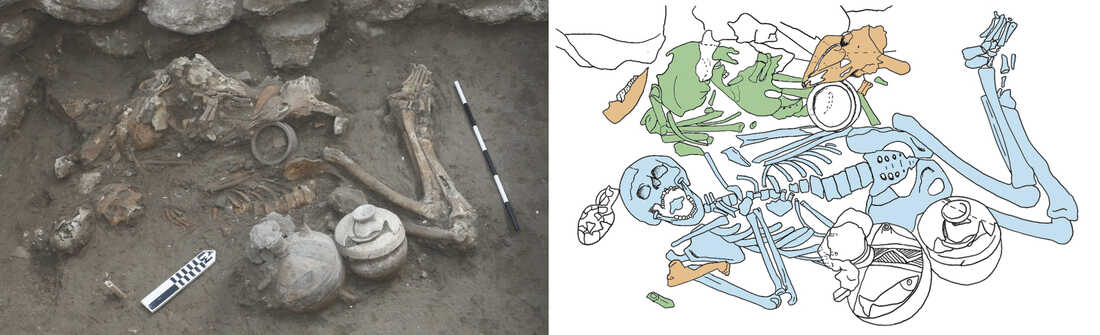
Some 3500 years ago, two brothers were buried alongside one another. Once excavated, their skeletons revealed numerous anomalies. The remains of the older brother are colored blue and those of the younger brother are colored green. Kalisher et al., 2023/PLOS ONE hide caption
toggle caption
Kalisher et al., 2023/PLOS ONE
Some 3500 years ago, two brothers were buried alongside one another. Once excavated, their skeletons revealed numerous anomalies. The remains of the older brother are colored blue and those of the younger brother are colored green.
Kalisher et al., 2023/PLOS ONE
The man’s skull had several other anomalies — including an extra molar, “which is really odd and rare,” Kalisher says. His two forehead bones never fused properly. His nose had been broken, and had healed in a lopsided way.
Below the skull, the bones of the man’s skeleton were marked by lesions consistent with an infectious disease like tuberculosis or leprosy. Even his foot bones were reshaped — “kind of squished,” says Kalisher. “So that individual, from head to toe, had a lot going on.”
Kalisher and her colleagues speculate in their research paper that the trephination was likely an intervention for the man’s declining condition. Sadly, however, he didn’t survive long after the procedure. He was buried beside someone else whose bones also had lesions. Earlier DNA analysis revealed it was his younger brother.
Shots – Health News
Stone Age brain surgery? It might have been more survivable than you think
“Maybe they were predisposed to have the same illnesses,” suggests Kalisher. Or “maybe they were living together and one caught the infectious disease from the other.”
However it came about, the fact that the brothers lived with some kind of severe illness into early adulthood suggests they’d lived lives of at least some privilege. “As messy as their bones looked, they lived long enough to have whatever was going on reflected in [those] bones,” notes Aja Lans, a bioarchaeologist at Harvard University who wasn’t involved in the research. Without access to a special diet or caregivers of some sort, Lans says, the brothers would likely have died before their disease progressed to the point of leaving lesions on their bones.
“This is just a really good example of collaborative work that’s using as many lines of inquiry as possible,” says Lans. “And they’re doing a very good job of putting it together with the actual historical context of the site in the Bronze Age.”
Kalisher offers one final observation. There were no signs that the men had been ostracized because of the chronic illness or disability they’d experienced. “We tend to think about disability or any kind of illness as something that would have gotten you shunned,” says Kalisher. “And this doesn’t seem to be the case in this context.” Rather, she says, they were honored in death with a shared grave, alongside food offerings and fine ceramics. “I think that it really illustrates the humanity of whoever buried them.”
For Kalisher, these fragments of bone have at last assembled themselves into the outlines of a story of a people who lived — and died — long ago.
Books
Civil Surgery: ‘Bleeding Blue and Gray’
Share this Post
