 Enlarge this image
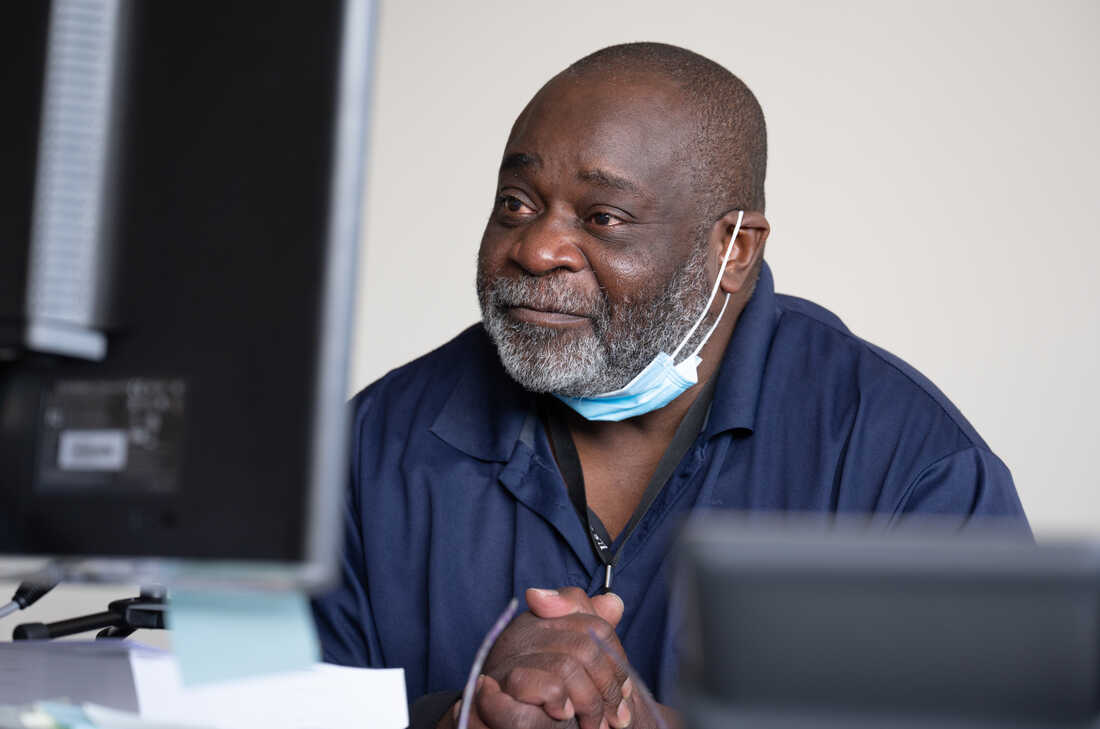
When he was in prison, Lee Reed was in agonizing back pain. His doctors there told him he needed back surgery, but because he was so close to his release date, they said he’d have to get it done on the outside. Reed saw that surgery as his ticket to being able to get a job and effectively reenter society. Amy Osborne for Tradeoffs hide caption
toggle caption
Amy Osborne for Tradeoffs
When he was in prison, Lee Reed was in agonizing back pain. His doctors there told him he needed back surgery, but because he was so close to his release date, they said he’d have to get it done on the outside. Reed saw that surgery as his ticket to being able to get a job and effectively reenter society.
Amy Osborne for Tradeoffs
Lee Reed spent his first night after getting out of a state prison sleeping in the stairwell of a parking garage in downtown San Francisco.
Just a few days shy of his 62nd birthday, Reed had nowhere else to go. During his two decades in prison, his mom and wife had died, and he’d lost touch with most of his family.
“I had nothing. I had nobody,” Reed said.
But he wasn’t alone on that first night. He had the same companion he’d had for years: agonizing back pain.
“Imagine somebody standing on your foot, and you can’t stop that pain,” Reed said. “It’s going to be there when you wake up. It’s going to be there when you go to sleep. Half the time I never even got out of bed while I was in prison because I couldn’t stand up, it was so painful.”
Shots – Health News
Frail people are left to die in prison as judges fail to act on a law to free them
Reed’s doctors in prison told him he needed back surgery, but because he was so close to his release date, they said he’d have to get it done on the outside. Reed saw that surgery as his ticket to being able to get a job and effectively reenter society.
But without health insurance or a support network, being able to do any kind of work seemed impossible as he laid down in the concrete stairwell, his prison-issued walker his only blanket.
“I was tired, and I was literally ready to give up,” Reed said.
Medicaid can be a bridge to a healthy life outside
Around 600,000 people leave prison in the U.S. every year, and another 10 million are released from county jails. Like Reed, many of them suffer from chronic physical, mental and substance use conditions. Research shows they are also at an extremely high risk of hospitalization and death; one study from Washington state found that recently incarcerated people were 12 times more likely to die in their first two weeks after release from prison than the general population.
That’s why in January, federal health officials for the first time signed off on having Medicaid pay for services for some people in state or local jails, prisons or juvenile facilities. The goal is to use the time before someone leaves a corrections facility to connect them with medical providers in the community and limit any disruption in their care as they transition out of incarceration.
Shots – Health News
Why millions on Medicaid are at risk of losing coverage in the months ahead
Consider This from NPR
Inside Story: Life in Prison, As Told by Formerly Incarcerated People
Most people who are incarcerated are eligible for Medicaid based on their low income, but a provision known as the “inmate exclusion policy” prohibits federal Medicaid dollars from being spent on a person’s care while incarcerated. (The only exception is for an overnight hospital stay.) Many counties and states try to connect people to Medicaid as soon as they’re released, but it can be a bureaucratic nightmare, and even if it works, people often have other priorities like finding a job, food and a place to live.
Some states like Arizona require private Medicaid plans to connect with incarcerated people before they are released, which state officials say helps individuals get care more quickly when they get out. And small pilot programs in California and New Mexico showed offering care coordination before release led to more primary care visits, less recidivism and fewer ER trips. But the inmate exclusion policy remains a significant barrier.
In 2018, Congress directed federal health officials to help states figure out a better transition plan for people leaving incarceration. Since then, 15 states from across the political spectrum have asked the Centers for Medicare and Medicaid Services to let them test what would happen if they turned Medicaid on before people leave jail, prison and juvenile facilities. In January, California became the first state to get the green light.
“We hope that what we are approving today is an exciting model for what we are able to partner [on] with states across the country,” said Dan Tsai, deputy administrator and director of the Center for Medicaid and CHIP Services at CMS.
States are taking differing approaches
All of the proposals pending before CMS share a common goal: bridging care between incarceration and the community for the more than 10 million people who leave incarceration each year. Many policymakers also see this as a way to improve health equity — people of color are disproportionately incarcerated in the U.S.
In theory, getting people connected to care sooner and keeping them on their medications should improve health outcomes and, over time, help state Medicaid programs save money, because fewer people will end up needing expensive hospital and ER visits. But with limited previous experience to guide them, states are having to guess at the best way to use finite Medicaid dollars when it comes to who should receive these new benefits, what benefits they should receive and when those benefits should start.
Shots – Health News
Signed Out Of Prison But Not Signed Up For Health Insurance
“If you are providing and paying for the Medicaid services, you want to ensure that you are focused on those that truly need it,” said California Medicaid Director Jacey Cooper.
Most states, including California, would limit eligibility to incarcerated people with documented health needs, such as chronic physical and mental health conditions or substance use disorder. Cooper estimates around 70% of people incarcerated in California meet this criteria.
In West Virginia and Kentucky, only people with a substance use disorder would be eligible, as part of those states’ broader efforts to address addiction. Research shows drug overdose is one of the most common ways people die after leaving prison, with studies suggesting returning prisoners are 40 to 129 times more likely to fatally overdose in their first two weeks after release.
Rhode Island, Vermont, Washington and Oregon would offer pre-release services to everyone in jail and prison who is eligible for Medicaid.
Shots – Health News
Helping Ex-Inmates Stay Out Of The ER Brings Multiple Benefits
“The odds are so high that people in that situation are going to need the support that it didn’t seem to make sense to us to be trying to distinguish who did and who did not meet some threshold or have a particular condition,” said Amy Katzen, the director of policy and strategy for Rhode Island’s Medicaid program.
Rhode Island is one of four states — along with Massachusetts, Utah and Vermont — that would offer people soon to leave jails and state prisons the same Medicaid benefits as anyone else in the community.
“This is going to be so complicated to implement,” said Mike Levine, director of MassHealth, Massachusetts’ Medicaid program. “When we finally do, there’s something to be said for just if you are a MassHealth member, you’re getting the MassHealth benefit.”
The other 11 states would offer a more limited set of services for people in the weeks or months before they leave incarceration, focused on transitioning someone back into the community. Services would include connecting them to new doctors, making sure they can get their prescriptions filled and helping them find housing.
In most of these states’ proposals, services like addiction treatment and daily medications would continue to be provided and paid for by the jail or prison. However, Rahul Gupta, the director of the White House Office of National Drug Control Policy, said on Tuesday that states would be required at a minimum to provide mental health and drug treatment services in this pre-release period. CMS would not confirm Gupta’s statement and said the agency plans to release further guidance for states soon.
Hard Time
Some advocates believe Medicaid should take a larger role in health care during incarceration, pointing to numerous reports of inadequate and negligent health care behind bars.
“I’ve seen people wither away — literally, people who were 280 pounds solid, healthy-looking individuals, wither all the way down to skin and bones. And that was because something that they had was diagnosed late or was misdiagnosed in the beginning,” said Khalil Cumberbatch, who served 6½ years in a New York prison before becoming the director of strategic partnerships at the Council on Criminal Justice.
For now, states are unwilling to go that far. Most are asking for Medicaid to start paying for services 30 days before someone is released, but a few have asked for more, including California, which has been approved to start coverage 90 days pre-release. Medicaid Director Cooper said that’s a more realistic window to build a trusting clinical relationship with someone, get all their appointments set up and make sure they have everything they need before they’re released.
Medicaid experts suggested the quickest way for the other 14 states to win CMS approval may be to follow California’s lead on these questions, but they believe federal health officials might want to let states make different choices so they can gather more evidence about what works best.
Implementation challenges await
In California, the first incarcerated people won’t receive Medicaid services until April 2024, Cooper said, with full implementation expected to take until 2026. That’s in part due to the daunting task of integrating the health care and criminal justice systems. The state asked for and received $561 million from the federal government to help providers and correctional facilities build up the infrastructure to do things like share data and bill appropriately.
Massachusetts’ Mike Levine said his team has been working closely with law enforcement and corrections officials for years. “You can’t wait to engage correctional partners when it’s time to implement,” Levine said. “They have to be involved in the policy design because this is going to require so much change within their workflows and their daily business that they have to be at the table.”
Advocates insist that people who are incarcerated or formerly incarcerated need to be included in these conversations too. “If we want people to use that Medicaid card to engage in services in the community, we need to ask them, what is it you need? How can we support you best in coming home?” said Shira Shavit, a professor of family and community medicine at the University of California San Francisco and executive director of the Transitions Clinic Network, which specializes in caring for people post-incarceration.
Including those perspectives, Shavit said, could prevent unintended consequences, like people becoming less likely to engage with Medicaid because they see it as a part of a criminal justice system they don’t trust.
Help came late, but Reed has hope for the future
This entire conversation is coming too late for Lee Reed. No one reached out to him before he got out of prison. He spent two days sleeping in that parking garage stairwell before a security guard pointed him toward a nearby homeless shelter.
A few weeks later, a doctor at the shelter restarted Reed’s medications for diabetes and high blood pressure, and referred him to a specialist who scheduled his back surgery for early 2023 — more than six months after Reed had been released from prison.
Enlarge this image
Six months after he was released, Reed finally got his back surgery. He’s in less pain now, but he’s still homeless, jobless and struggling to find purpose in his life. Amy Osborne for Tradeoffs hide caption
toggle caption
Amy Osborne for Tradeoffs
Six months after he was released, Reed finally got his back surgery. He’s in less pain now, but he’s still homeless, jobless and struggling to find purpose in his life.
Amy Osborne for Tradeoffs
But his pain continued to get worse. The constant agony and Reed’s inability to support himself took a toll on his mental health, occasionally making him wonder if his life was worth living.
“Who would want to live this? This is horrible, man,” he said. “I can’t do anything to protect myself. I can’t do anything to feed myself. How the hell am I a man?”
The doctor at the shelter referred Reed to Shira Shavit’s Transitions program at the Southeast Family Health Center, a community clinic run by the San Francisco Department of Public Health. Shavit prescribed a medication patch for Reed’s back and scheduled follow-up appointments for his diabetes. The program also gave him a bag of groceries, a bus card and ordered him a winter coat.
“When people come out of prison, they have so many needs,” Shavit said. “[We’re] just trying to bring people to the starting line to kind of get them to where they need to be to then even start to be able to become successful in the community.”
Reed finally got his surgery at the end of January, the day after CMS approved California’s request to bring Medicaid behind bars. He’s in less pain now and dreams of moving back to Arkansas to spend time with his grandchildren.
But his challenges are far from over. He’s still living at the homeless shelter without a job and struggling to find purpose. He said if someone had reached out to him before he left prison and helped him get his surgery sooner, there’s a better chance he’d be supporting himself by now.
“I’m trying to keep a positive attitude on everything because my whole world feels like it’s falling apart,” he said a week after his surgery. “I have no control over my own life right now. I’m just like a child. I’m just helpless.”
This story comes from the health policy podcast Tradeoffs. Dan Gorenstein is Tradeoffs’ executive editor, and Ryan Levi is a reporter/producer for the show, where a version of this story first appeared.
Share this Post
