 Enlarge this image
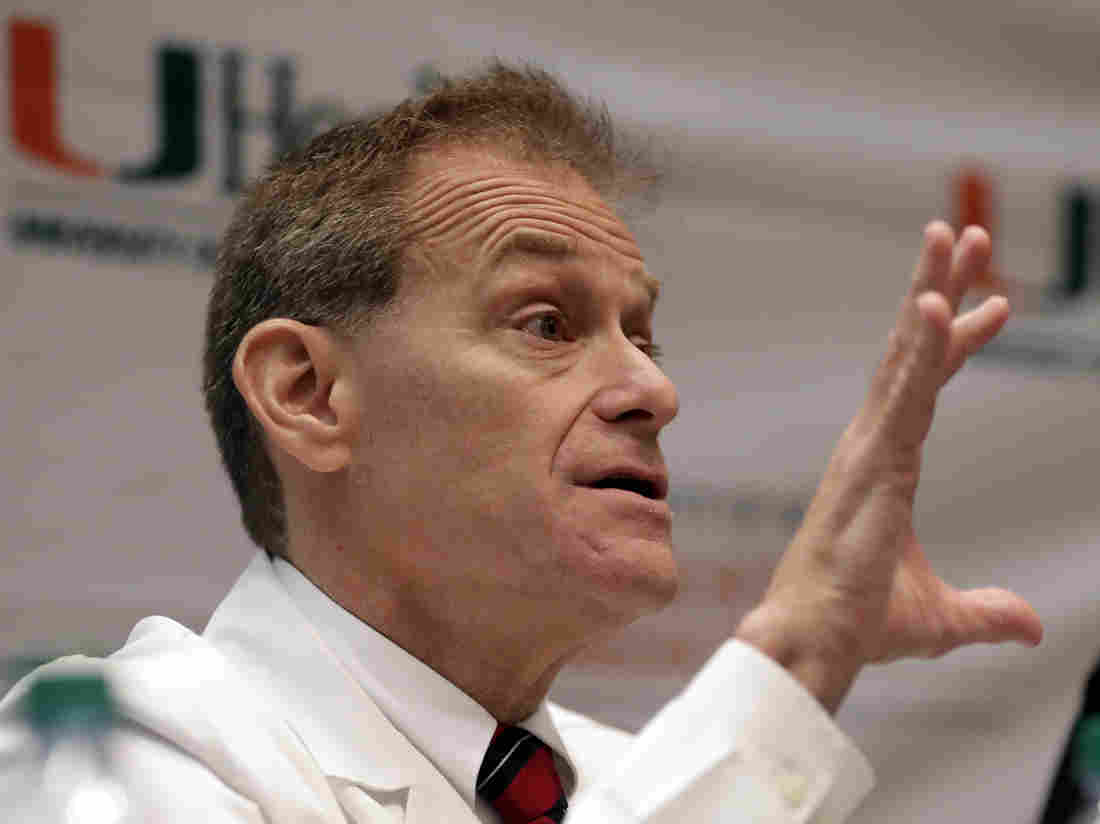
Scientists are questioning the evidence about an alleged attack on diplomats at the U.S. Embassy in Havana. Ramon Espinosa/AP hide caption
toggle caption
Ramon Espinosa/AP
Scientists are questioning the evidence about an alleged attack on diplomats at the U.S. Embassy in Havana.
Ramon Espinosa/AP
The claim was extraordinary.
More than 20 U.S. diplomats in Cuba had “suffered significant injuries” in a series of attacks that seemed to target the brain. Or at least that’s what State Department officials told reporters during a briefing in September 2017.
A couple of weeks later, President Trump went even further. “I do believe Cuba is responsible,” he said during a Rose Garden news conference.
Nearly two years later, the State Department maintains that attacks did occur and that people associated with the embassy in Havana were injured. But a number of prominent scientists are now challenging that assertion.
There is “no evidence” of an attack, says Dr. Sergio Della Sala, a professor of human cognitive neuroscience at the University of Edinburgh in the U.K. “There is no data whatsoever that these people are suffering from any brain injury.”
Other scientists say the case for what they now often call “Havana syndrome” involves a troubling mix of secrecy, conjecture and shoddy science. Many now doubt it ever happened.
A sound, then symptoms
Havana syndrome started with a sound — an intense, high-pitched piercing sound.
Then came symptoms: hearing loss, dizziness, tinnitus, balance problems, fatigue and trouble concentrating, among others.
When diplomats began suggesting a link between the sound and their symptoms, the State Department called in Dr. Michael Hoffer.
Hoffer is an ear, nose and throat specialist at the University of Miami. And he has been a prominent voice in saying that something bad happened to people associated with the U.S. Embassy in Cuba.
Hoffer recalls that in February 2017, he was at his desk when the phone rang. “And the individual, who I cannot name, unfortunately, said, ‘This is the State Department, and we have a problem.’ “
The individual wanted Hoffer to assess some ailing diplomats who had been flown to Miami. Later, the State Department asked him to check out embassy workers still in Havana. “So a colleague of mine and I went down to Cuba and basically set up a little screening clinic in the embassy there,” Hoffer says.
Hoffer and his colleagues evaluated a total of 140 people, all told. Of these, 25 reported symptoms that appeared after they heard a strange sound or felt a pressure wave.
The Two-Way
At Least 16 U.S. Embassy Staff In Cuba Treated After ‘Health Attacks’
Their symptoms were a lot like those from concussions. But Hoffer’s experience as a military doctor told him the problem involved the vestibular system, a part of the inner ear that plays a critical role in balance. And tests supported that idea, he says.
“I’m confident that their vestibular systems were damaged by something,” he says. “What it was, who was doing it — I don’t know.”
Even so, Hoffer and his colleagues were quick to speculate.
In interviews and during a televised news conference, they suggested the cause might be a weapon that used sound waves or microwaves or some other form of electromagnetic energy.
The idea of a “sonic attack” was appealing because it appeared to explain the odd sound reported by embassy workers who later had symptoms.
The weapon that wasn’t
But then in October 2017, The Associated Press released a recording of the sound. And that’s when the scientific support for an attack began to crumble.
A pair of experts on insect sounds decided to analyze the audio. And they soon realized that the sound was no weapon. “The recording released by the AP is, in fact, a cricket,” says Alexander Stubbs, a doctoral student at the University of California, Berkeley. To be precise, he says, it’s the mating call of a male Indies short-tailed cricket.
And it’s no wonder that diplomats found the calls from these crickets disturbingly loud, Stubbs says. “If you’re driving a diesel truck on the freeway, you can hear these crickets with all the windows closed as you pass one.”
Of course that didn’t explain all the symptoms that diplomats were reporting. So scientists waited for two medical studies that they hoped would make sense of the dizziness, the hearing loss and the foggy thinking.
The first study to be published appeared in JAMA, the journal of the American Medical Association, in early 2018. It came from a team at the University of Pennsylvania who examined 21 diplomats.
“We are collectively convinced that these individuals as a group sustained a neurological injury,” the lead author, Dr. Randel Swanson, said in an audio report released with the study. The injury was like a concussion, but with no blow to the head, the team said.
The reaction from other scientists was swift and harsh.
“It’s surprising that a fantastic, great journal like JAMA publishes such a poor report,” says Della Sala, the University of Edinburgh professor. “It’s just astounding. It’s unbelievable.”
And four other scientists who published letters in JAMA offered their own pointed adjectives to describe the study. Among them: “improper,” “inappropriate,” “problematic” and “misleading.”
Much of the outrage came because the authors had used a definition of impairment that would apply to nearly half the general population, Della Sala says.
“What they did was to find a way so that everybody’s pathological,” he says.
The second medical study came from the University of Miami’s Hoffer and his colleagues. They described 25 embassy workers who had reported both exposure to a noise and symptoms.
This study was rejected by JAMA but was eventually published in Laryngoscope Investigative Otolaryngology. It’s a lesser-known journal for which Hoffer serves as an editor.
Enlarge this image
“I’m confident that their vestibular systems were damaged by something,” says Dr. Michael Hoffer, of the University of Miami. “What it was, who was doing it — I don’t know.” Lynne Sladky/AP hide caption
toggle caption
Lynne Sladky/AP
“I’m confident that their vestibular systems were damaged by something,” says Dr. Michael Hoffer, of the University of Miami. “What it was, who was doing it — I don’t know.”
Lynne Sladky/AP
One of the paper’s key findings involved special goggles that track eye movements, Hoffer says. “So the eye movements, which we could read right away from the goggles, were looking like patterns that we see in people that have a particular balance disorder,” he says.
The balance disorder — an ” otolithic abnormality” — is caused by invisible damage to the inner ear. But critics have noted that lots of factors can cause a healthy person to fail this test.
“This task is failed by anybody with anxiety, anyone with concern, anyone who’s very tired,” Della Sala says.
And neither study shows that U.S. diplomats were attacked or even harmed, he says.
“At the moment, there is no data whatsoever that these people are suffering from any brain injury,” Della Sala says. “There is no evidence.”
In other words, no support for Havana syndrome.
More criticism came in February during a scientific panel held in conjunction with the American Association for the Advancement of Science’s annual meeting. The event took place at the Cuban Embassy in Washington, D.C.
Several scientists on the panel said they are frustrated that the medical studies have so far omitted critical information. “Our concern is that none of the data was shared. We don’t have access to the raw data,” says Dr. Janina Galler, a professor of psychiatry at Harvard Medical School. “We don’t have access even to the full sample size and how individuals were selected and why so many were not included in the study at the end of the day.”
Another complaint was that the U.S. has had nearly two years to back up its claims of an attack but has yet to do so.
“There’s a whole story that there’s a group of diplomats, they were attacked with a weapon and they have brain injury,” says Dr. Mitchell Valdés-Sosa, who directs the Cuban Neurosciences Center in Havana. “There’s no evidence for brain injury. There is no evidence of an attack. You see vague symptoms that are very prevalent, that are common to any cross section of the population.”
Even some scientists who once believed in the attack narrative now reject it.
“When I first heard about it, I think, like everybody, I was very concerned. It’s terrible. Americans injured. I was very concerned that there was a weapon,” says Douglas Fields, a brain scientist who spent months investigating the events in Cuba.
Fields read the medical studies. He interviewed experts on brain injury and inner ear problems. He even went to Cuba. But he didn’t find any evidence to support the claim of an attack.
“And then the story keeps changing,” he says. “Not a sonic weapon. Then it’s microwaves, and then it’s hysteria and then it’s an infection and on and on and on.”
Now Fields thinks Havana syndrome is really a collection of symptoms and health problems you might see in any group of people — and especially people doing a highly stressful job in a sometimes hostile environment.
And Fields believes the truth will emerge, eventually.
“Science has gone astray, gone off the rails many times,” he says. “But eventually it self-corrects and we get to the right answer.”
That happened after a similar incident during the Cold War. The story then was that Soviet microwaves were causing cancer and a rare blood condition among staff at the U.S. Embassy in Moscow.
A large study disproved that claim.
The State Department says the number of embassy workers affected in Havana now stands at 26. Some have recovered. Others still have symptoms.
Share this Post
