Explaining Medicine
  • News
  • Health & Lifestyle
    • Diet & Weight Management
    • Exercise & Fitness
    • Nutrition, Food & Recipes
    • Prevention & Wellness
  • Conditions
    • Custom1
      • Conditions A-Z
      • Procedures A-Z
      • Allergies
      • Alzheimer’s
      • Arthritis
      • Asthma
      • Blood Pressure
      • Cholesterol
      • Cancer
    • Custom2
      • Chronic Pain
      • Cold Flu
      • Depression
      • Diabetes
      • Digestion
      • Eyesight
      • Health Living
      • Healthy Kids
      • Hearing Ear
    • Custom3
      • Heart
      • HIV/AIDS
      • Infectious Disease
      • Lung Conditions
      • Menopause
      • Men’s Health
      • Mental Health
      • Migraine
      • Neurology
    • Custom4
      • Oral Health
      • Pregnancy
      • Senior Health
      • Sexual Health
      • Skin Problems
      • Sleep
      • Thyroid
      • Travel Health
      • Women’s Health
  • Medications
    • Medications
    • Supplements and Vitamins
  • Medical Dictionary
  • Health Alerts
Flu shot recommendation for kids dropped just as...
The CDC just sidelined these childhood vaccines. Here’s...
Your next primary care doctor could be online...
In Lodge Grass, Montana, a Crow community works...
RFK Jr.’s new dietary guidelines go all in...
More seniors are becoming homeless. Shelters are trying...
Health officials slash the number of vaccines recommended...
Wegovy obesity pill now available at pharmacies
In the U.S., hunger is often hidden. But...
One doctor’s experience shows the battle for the...
Top Posts

Explaining Medicine

  • News
  • Health & Lifestyle
    • Diet & Weight Management
    • Exercise & Fitness
    • Nutrition, Food & Recipes
    • Prevention & Wellness
  • Conditions
    • Custom1
      • Conditions A-Z
      • Procedures A-Z
      • Allergies
      • Alzheimer’s
      • Arthritis
      • Asthma
      • Blood Pressure
      • Cholesterol
      • Cancer
    • Custom2
      • Chronic Pain
      • Cold Flu
      • Depression
      • Diabetes
      • Digestion
      • Eyesight
      • Health Living
      • Healthy Kids
      • Hearing Ear
    • Custom3
      • Heart
      • HIV/AIDS
      • Infectious Disease
      • Lung Conditions
      • Menopause
      • Men’s Health
      • Mental Health
      • Migraine
      • Neurology
    • Custom4
      • Oral Health
      • Pregnancy
      • Senior Health
      • Sexual Health
      • Skin Problems
      • Sleep
      • Thyroid
      • Travel Health
      • Women’s Health
  • Medications
    • Medications
    • Supplements and Vitamins
  • Medical Dictionary
  • Health Alerts
  • News

    Failure To Save A Child In Wartime Inspires Wound-Healing Tech

    by Jon Hamilton April 2, 2018

    Enlarge this image

    As a soldier, Kit Parker saw horrific injuries. As a scientist, he and his team have developed wound dressings that use incredibly thin fibers to speed healing and reduce scarring. Courtesy of Karaghen Hudson/Harvard University hide caption

    toggle caption

    Courtesy of Karaghen Hudson/Harvard University

    As a soldier, Kit Parker saw horrific injuries. As a scientist, he and his team have developed wound dressings that use incredibly thin fibers to speed healing and reduce scarring.

    Courtesy of Karaghen Hudson/Harvard University

    The Afghan boy arrived at the U.S. military hospital in Kandahar with severe burns from the chest down. He was about 5.

    “I knew as soon as I saw him it was just too much surface area,” says Kit Parker, who, at the time, was an Army Civil Affairs officer working with Afghan villagers. “I knew he was going to die.”

    Even so, Parker and his team sergeant, Aaron Chapman, stayed at the hospital throughout that night in 2003, while military doctors worked to keep the boy alive.

    “There’s no greater sense of helplessness than to stare into this child’s eyes knowing that you can’t save them, you can’t help them,” Chapman says.

    Slug Slime Inspires Scientists To Invent Sticky Surgical Glue

    Shots – Health News

    Slug Slime Inspires Scientists To Invent Sticky Surgical Glue

    Parker recalls feeling “horror, rage [and] despair” that night. “It was the most scarring event of the war for me,” he says.

    The experience influenced the careers of both men. Chapman went on to become a government agent investigating crimes against children.

    Parker returned from the war to his civilian job as a biophysicist at Harvard. But the memory of the injured child continued to haunt him.

    “I couldn’t save that kid,” he says. “But that doesn’t mean there’s not something I could do.”

    So Parker assembled a team of young scientists. Their job: Find a better way to heal burns and other wounds.

    Kit Parker (second from left) and Aaron Chapman (third from left) meet with village elders in the village of Loy Kariz, Afghanistan in 2003. Ed Kashi/VII/Redux hide caption

    toggle caption

    Ed Kashi/VII/Redux

    The team focused on a discovery made in the late 1970s and early 1980s, when surgeons began correcting birth defects in babies still in the womb. After these babies were born, doctors took a close look at the sites where incisions had been made.

    “And they realized that they typically healed with a lot less [scarring] or, in some cases, without any scars at all,” says Christophe Chantre, a graduate student and researcher in Parker’s lab.

    One reason is that fetal skin, unlike adult skin, contains large amounts of a substance called fibronectin. So Chantre and his team set out to create a bandage made of the stuff.

    Enlarge this image

    This experimental cellulose and soy nanofiber wound dressing releases a form of estrogen known to promote skin regeneration. Courtesy of Grant Gonzalez hide caption

    toggle caption

    Courtesy of Grant Gonzalez

    This experimental cellulose and soy nanofiber wound dressing releases a form of estrogen known to promote skin regeneration.

    Courtesy of Grant Gonzalez

    “Our idea was to actually try to replicate this fibronectin-rich environment to get a better healing process,” Chantre says.

    To do that, they needed to spin fibronectin into incredibly thin strands known as nanofibers. Eventually, they found a way to do this using a kind of souped-up cotton candy machine.

    Then the team applied dressings made from these nanofibers to wounds in mice. The wounds healed with very little scarring. And they also healed faster.

    “The wounds treated with fibronectin closed at around Day 11 and the control was several days later — at, on average, Day 14,” Chantre says.

    Perhaps most impressive, the structure of the new skin was similar to healthy skin. It even contained hair follicles, which are not found in scar tissue, the team reported in March in the journal Biomaterials.

    Enlarge this image

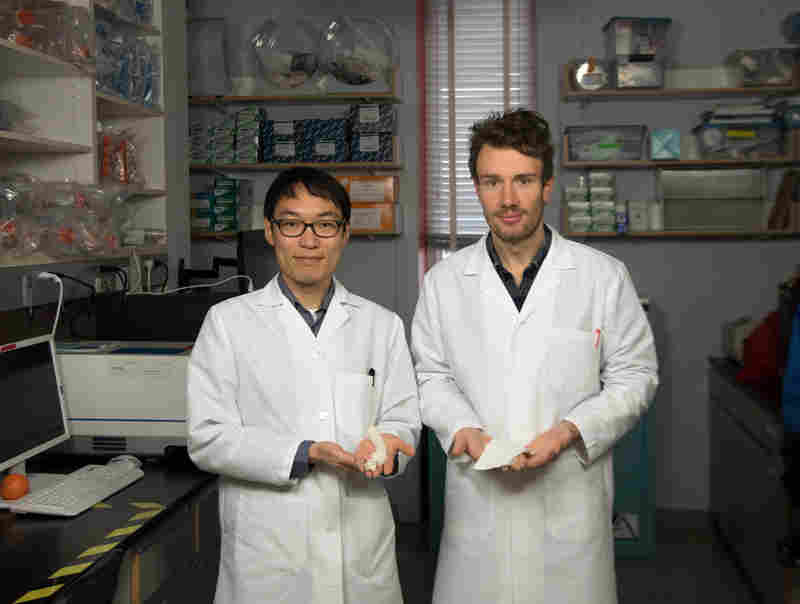
    Graduate research scientists Seungkuk Ahn (left) and Christophe Chantre (right) hold nanofiber scaffolds in their lab at Harvard. Their goal is to develop an inexpensive material that can close big wounds with little scarring. Courtesy of Michael Rosnach hide caption

    toggle caption

    Courtesy of Michael Rosnach

    Graduate research scientists Seungkuk Ahn (left) and Christophe Chantre (right) hold nanofiber scaffolds in their lab at Harvard. Their goal is to develop an inexpensive material that can close big wounds with little scarring.

    Courtesy of Michael Rosnach

    In a second study, published in the journal Advanced Healthcare Materials, researchers from Parker’s lab showed that another sort of nanofiber could also help wounds heal faster.

    “This nanofiber is made of cellulose and soy protein,” says Seungkuk Ahn, who led the effort. The soy protein releases a form of estrogen that is known to promote skin regeneration, Ahn says, “so the bandage generates new tissue formation.”

    The soy wound dressing does not decrease scarring as effectively as fibronectin does, Ahn says. But it is far easier and less expensive to make, so it could be more suitable for very large wounds.

    The new wound dressings are an advance, Parker says. But they represent only a small step toward helping people like the child with severe burns he saw in Afghanistan 15 years ago.

    “I don’t know if my technology would have helped that night,” Parker says. “I doubt it.”

    The little boy’s burns were just too extensive. But Parker hopes the dressings will someday help another injured child.

    “Once we’ve saved a kid,” he says, “then we’re evening the score a little bit.”

    Genetically Altered Skin Saves A Boy Dying Of A Rare Disease

    Shots – Health News

    Genetically Altered Skin Saves A Boy Dying Of A Rare Disease

    Read the article here

    Share this Post

    Share Explaining Medicine Share Explaining Medicine

    Failure To Save A Child In Wartime Inspires Wound-Healing Tech was last modified: April 12th, 2018 by Jon Hamilton

    Related

    bioengineerburnsnanotechnologywound repair
    0 comment
    0
    Facebook Twitter Google + Pinterest
    Jon Hamilton

    previous post
    The cirrhosis chalk talk
    next post
    Baby’s Heart Defects Tied to Mom’s Heart Trouble

    Related Articles

    Meat-Heavy Diet May Raise Older Women’s Heart Risk

    November 14, 2016

    Bed rest is bad for IVF patients.

    March 23, 2019

    As a cardiologist, I’m concerned that California isn’t very heart healthy

    April 13, 2019

    New Drug of Last Resort Tackles Resistant HIV

    August 16, 2018

    Are Kids’ Ball Pits Jumping With Germs?

    March 26, 2019

    What Are Rosacea Triggers?

    December 12, 2018

    Study: Dentists Prescribe Antibiotics Far Too Often

    June 5, 2019

    Your muscles keep time too. How circadian rhythms affect your workout and your health

    March 29, 2024

    Common Chemicals Harm Sperm in Both Men and Dogs

    March 12, 2019

    CHART: CBO Weighs Who Wins, Who Loses With Senate Health Care Bill

    June 27, 2017

    Recent Posts

    • Flu shot recommendation for kids dropped just as the illness rages

      January 12, 2026
    • The CDC just sidelined these childhood vaccines. Here’s what they prevent

      January 9, 2026
    • Your next primary care doctor could be online only, accessed through an AI tool

      January 9, 2026
    • In Lodge Grass, Montana, a Crow community works to rebuild from meth’s destruction

      January 8, 2026
    • RFK Jr.’s new dietary guidelines go all in on meat and dairy

      January 7, 2026

    Keep in touch

    Facebook Twitter Google + RSS

    Recent Posts

    • Flu shot recommendation for kids dropped just as the illness rages

      January 12, 2026
    • The CDC just sidelined these childhood vaccines. Here’s what they prevent

      January 9, 2026
    • Your next primary care doctor could be online only, accessed through an AI tool

      January 9, 2026
    • In Lodge Grass, Montana, a Crow community works to rebuild from meth’s destruction

      January 8, 2026
    • RFK Jr.’s new dietary guidelines go all in on meat and dairy

      January 7, 2026
    • Terms of Service
    • Privacy Policy

    @2026 - Explaining Medicine. All Right Reserved.


    Back To Top
    Explaining Medicine
    Proudly powered by WordPress Theme: soledad child.