 Enlarge this image
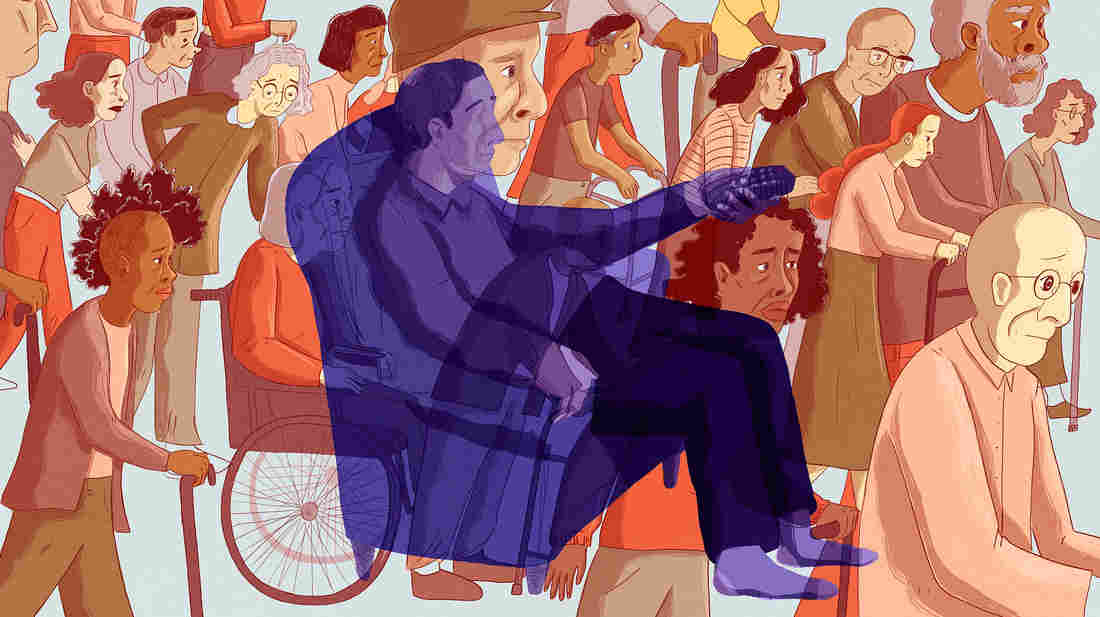
Young bodies may more easily rebound from long bouts of sitting, with just an hour at the gym. But research suggests physical recovery from binge TV-watching gets harder in our 50s and as we get older. Lily Padula for NPR hide caption
toggle caption
Lily Padula for NPR
Young bodies may more easily rebound from long bouts of sitting, with just an hour at the gym. But research suggests physical recovery from binge TV-watching gets harder in our 50s and as we get older.
Lily Padula for NPR
Editor’s Note: This encore story, originally published in September, seems especially relevant this week, as we all relax (aka sit! binge-watch! eat!) for the holidays.
Count the number of hours you sit each day. Be honest.
“If you commute an hour in the morning and hour after work — that’s two hours, and if you sit at an eight-hour-a-day desk job that’s 10,” says epidemiologist Loretta DiPietro of the Milken Institute School of Public Health at George Washington University.
“Then you come home at, say, 6 p.m., eat dinner and crash into your recliner for another three to four hours,” says DiPietro. “That’s 13 to 14 hours of sitting.”
The Salt
Netflix And Chew: How Binge Watching Affects Our Eating Habits
Being immobile like that for many hours each day does more than raise the risk of a host of diseases. DiPietro and her colleagues have good evidence that, as the years wear on, it actually reduces the ability of older people to get around on foot at all.
In a study of sitting and walking ability that surveyed people ages 50 to 71 across eight to 10 years, those who tended to sit the most and move the least had more than three times the risk of difficulty walking by the end of the study, when compared to their more active counterparts.
Some ended up unable to walk at all. The study appears in the current issue of The Journals of Gerontology: Medical Sciences.
Prolonged sitting and TV watching were particularly harmful, DiPietro found, especially when combined with low levels of total physical activity. Young bodies may rebound from prolonged sitting with an hour at the gym, she says. But that seems less true in late middle age.
“Sitting and watching TV for long periods, especially in the evening,” she says, “has got to be one of the most dangerous things that older people can do.” And the period studied — the mid-1990s to 2005, or so — was even before the advent of rampant online streaming of shows, she notes. The problem today is likely even worse.
“Before binge watching, at least when a show ended you got up and walked around,” DiPietro says. “It’s now possible to watch several hours without moving.”
Though being sedentary at work is also a risk, office employees tend to at least get up now and then, walk down the hall to the printer or restroom, and go to lunch, she says. Or at least workers used to do that. Increasingly, she says, many of us of all ages are engineering much of that light activity out of our lives.
“We now use the Internet to go shopping, order groceries, send messages and even gossip,” DiPietro says. “We used to walk down the hall and gossip; now we send it via email or text.”
To measure the effect of prolonged sitting on mobility, DiPietro and colleagues took data from the large NIH-AARP Diet and Health Study of men and women ages 50 to 71. The participants were all healthy when the study started in 1995 and 1996.
The researchers recorded how much those in the study watched TV, exercised, or did gardening, housework or other physical activity at the beginning of the investigation. They included “light” physical activity like “puttering around, walking to get the mail, or walking to the car” says DiPietro.
The results: Those who watched five or more hours of TV per day had a 65 percent greater risk of reporting a mobility disability at the study’s end, compared with those who watched less than two hours per day. DiPietro says this association was independent of their level of total physical activity and other factors known to affect the ability to easily move around.
She offers an antidote: Get up at least every 30 minutes when staring at a screen.
“And if you insist on staying seated during that 15 second interval between episodes,” DiPietro says, “at least stand up, march in place, jump around, kick legs — do anything to move about for at least one to two minutes.”
The result of that would be “phenomenal” to mobility, she says, and be at least a start toward heart health, too.
Shots – Health News
Walking Fends Off Loss Of Mobility, And It’s Not Too Late To Start
Dr. Andrew Freeman, who directs cardiovascular prevention and wellness at National Jewish Health in Denver and represents the American College of Cardiology, says people should do even more higher intensity exercise regularly — at least to the point of being “breathless.”
But that doesn’t necessarily mean jogging around the neighborhood, he says. It can be as simple as walking at a slow pace.
In an older population, Freeman says if you’re going to be sedentary, you should try to be “as active” as you can when not sedentary. That may sound like common sense, he says, but the findings of the DiPietro study underscore the importance. Just five minutes a day of brisk movement, he says, is beneficial.
For Denver businesswoman Liz King, that translates to a 20-minute daily walk during the week, and longer on the weekends. King says she’s joined walking groups — including the national program Walk With A Doc — as a way to build more activity into her day.
King is 61 years old and very busy starting a vegan food company in Denver — but does it, pretty much, sitting down, she says.
“When you have your own business, you have a little more flexibility,” she says. “But I’ll tell you one thing that’s constant — that’s eight hours, at least, of looking at the screen and sitting in the chair.”
And, for her, being glued to the computer — and the chair — doesn’t necessarily stop when the work day ends.
Shots – Health News
Does Binge-Watching Make Us Depressed? Good Question
“The inbox that may be overflowing,” she says. Or she’s doing homework for an online course. She’ll check in with a chat session or with other family and friends online.
Then there’s about an hour or more of watching television, King says. It all adds up.
So she makes sure to get out and walk at least a little bit, every day. She varies the pace, she admits, and laughs.
“If I’m walking solo I’m probably walking at a more leisurely pace,” she says, “because I tend to take a picture of the occasional wildflower, or the clouds that are in a wonderful formation.”
But on a speedier walk with a group, she keeps up.
It’s all a big win for King’s health, Freeman says, because she’s away from the screen and moving. Exercise, he says, is nature’s best medicine.
Share this Post
